Best SellerAmp alternative for Amazon sellers in 2026 | Nova
SellerAmp is a sourcing scout for single-ASIN buy-or-skip calls. Nova is the per-SKU P&L for the catalog you already own. Where each tool fits, and how to run them together in 2026.
SellerAmp SAS is the default scouting app for online arbitrage and wholesale buyers, used to scan a product and decide buy or skip in a couple of seconds. It is excellent at that job. It is not built for what happens after the units land in FBA: tracking net profit per SKU, fees, returns, reimbursements, and PPC across a live catalog. That is where most sellers start shopping for a SellerAmp alternative.
This guide is honest about the split. SellerAmp answers should I buy this?. Nova answers is the catalog I already own still profitable today?. They are different jobs, and the right answer for most growing sellers is to use both rather than swap one for the other.
Below is a side-by-side of what each tool is for, where sellers outgrow a sourcing-only stack, and how to wire Nova in next to SellerAmp without changing your sourcing workflow.
TL;DR - Key Takeaways
•SellerAmp is a single-ASIN sourcing and scouting tool. Nova is a full-catalog profit and operations analytics platform.
•Sourcing tools cannot see your real return rate, storage fees, refunds, reimbursements, or PPC product-level spend once SKUs are live.
•Nova starts at $49/month with a 14-day free trial, no card required, and supports 23 Amazon marketplaces.
•The common pattern: keep SellerAmp for buy or skip, add Nova for the per-SKU P&L that decides reorder and discontinuation calls.
SellerAmp vs Nova: quick comparison
The two products sit on opposite ends of the seller workflow. SellerAmp lives at the sourcing decision; Nova lives at the profitability decision.
Per-SKU net profit with COGS, fees, refunds, reimbursements, PPC product-level spend
Fee tracking
Live FBA and FBM fee breakdown per ASIN at scan time
Actual Amazon fees from hourly finance transactions, including storage, LIL fee, returns processing
Marketplaces
US and major European marketplaces
23 Amazon marketplaces in one dashboard
Refresh cadence
On-demand at scan
Hourly SP-API and Ads API refresh
Pricing floor
Monthly subscription per user
$49/month, 14-day free trial, no card
Best for
Picking the next product to buy
Deciding which products to reorder, scale, fix, or cut
What SellerAmp does well
SellerAmp is built around one workflow: scan, evaluate, decide. Paste an ASIN or scan a barcode via the mobile app (UPC/EAN), and the app returns BSR, estimated monthly sales, current Buy Box price, a profit calculator with an FBA/FBM toggle and payout comparison, referral and fulfilment fees, eligibility, IP alerts, hazmat flags, and ROI (SellerAmp feature list). Keepa-driven charts (BSR, Buy Box, FBA/FBM prices over time) sit alongside the calculator, drawing on Keepa's historical Amazon dataset. For someone walking a clearance aisle or working through a wholesale price list, that is the right shape of tool. Independent reviewers consistently rate it as a strong all-round sourcing app (Clear The Shelf review).
Where it stops, and where this guide picks up, is everything that happens after the units are bought. Scouting math is pre-launch by design. It does not, and cannot, see your real return rate, your eventual storage tier, your LIL fee exposure, or your PPC product-level spend once the units are live. Amazon's posted Selling on Amazon fee schedule breaks fees into referral, fulfilment, storage, returns processing, and low-inventory-level surcharges, only some of which a sourcing tool can estimate at scan time.
Where sellers outgrow a sourcing-only stack
The pattern shows up around the time a seller crosses roughly 20 to 30 active SKUs, or adds a second marketplace, or starts running meaningful Sponsored Products spend. Three things break at once:
Estimated ROI stops matching reality
Returns, storage tiers, LIL fees, and refund-related fees all land after the fact. Scouting estimates cannot see them, so the SKUs that looked best at sourcing are not always the ones earning at the end of the quarter.
Spreadsheets stop scaling
Reconciling Seller Central reports, Ads spend, COGS, and reimbursements by hand burns half a day a week at 20 SKUs and becomes impossible at 200. The math is right; the throughput is the problem.
Multi-marketplace breaks the view
Each marketplace has its own fees, FX, and ad spend. Without a unified P&L, comparing EU and US performance turns into a monthly spreadsheet exercise instead of a daily check.
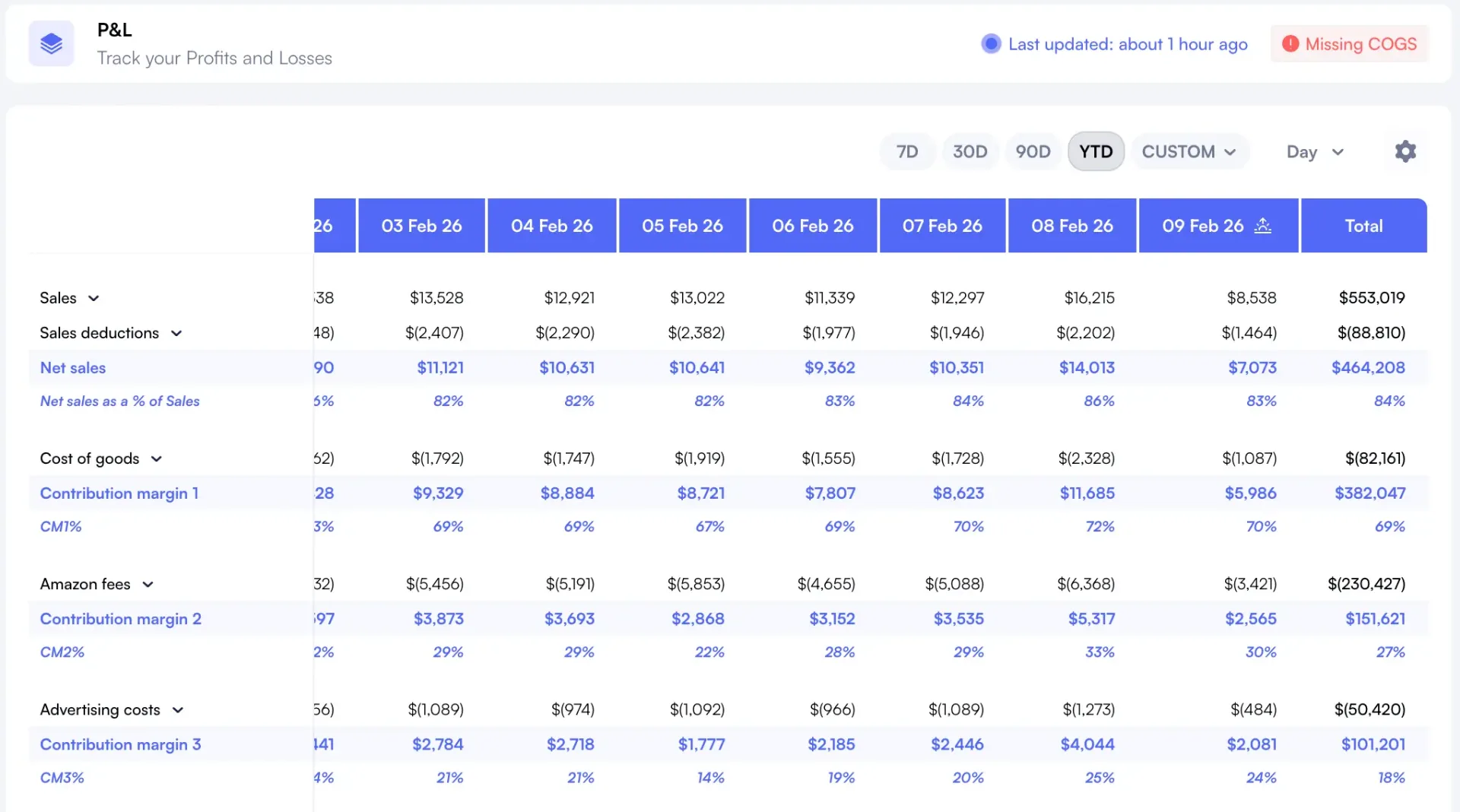
Nova picks up at exactly that point. It connects to Amazon via OAuth, ingests SP-API and Ads API hourly, joins in COGS, and renders a per-SKU, per-marketplace, per-account P&L that is honest about every fee Amazon charged you. See P&L analytics for the full feature scope.
Nova's per-SKU P&L joins SP-API fees, returns, reimbursements, and PPC product-level spend into a single hourly view.
How to run SellerAmp and Nova together
The workflow most growing sellers settle on looks like this:
1
Keep SellerAmp for buy or skip
Sourcing decisions stay where they are. SellerAmp is fast, cheap, and battle-tested for arbitrage and wholesale buyers.
2
Connect Nova to Seller Central
Five minutes for OAuth. Historical backfill runs in the background. No spreadsheets to maintain after that.
3
Upload COGS once, then forget it
Bulk import or per-SKU entry, with effective dating so price changes do not corrupt historical margin. Accurate COGS is what turns SP-API revenue into real net profit.
4
Use Nova for reorder and discontinuation calls
Once a product is live, the decision shifts from should I buy to should I reorder, scale, fix, or cut. Nova's per-SKU P&L, Custom Breakdowns, and Winners and Losers views are built for that decision.
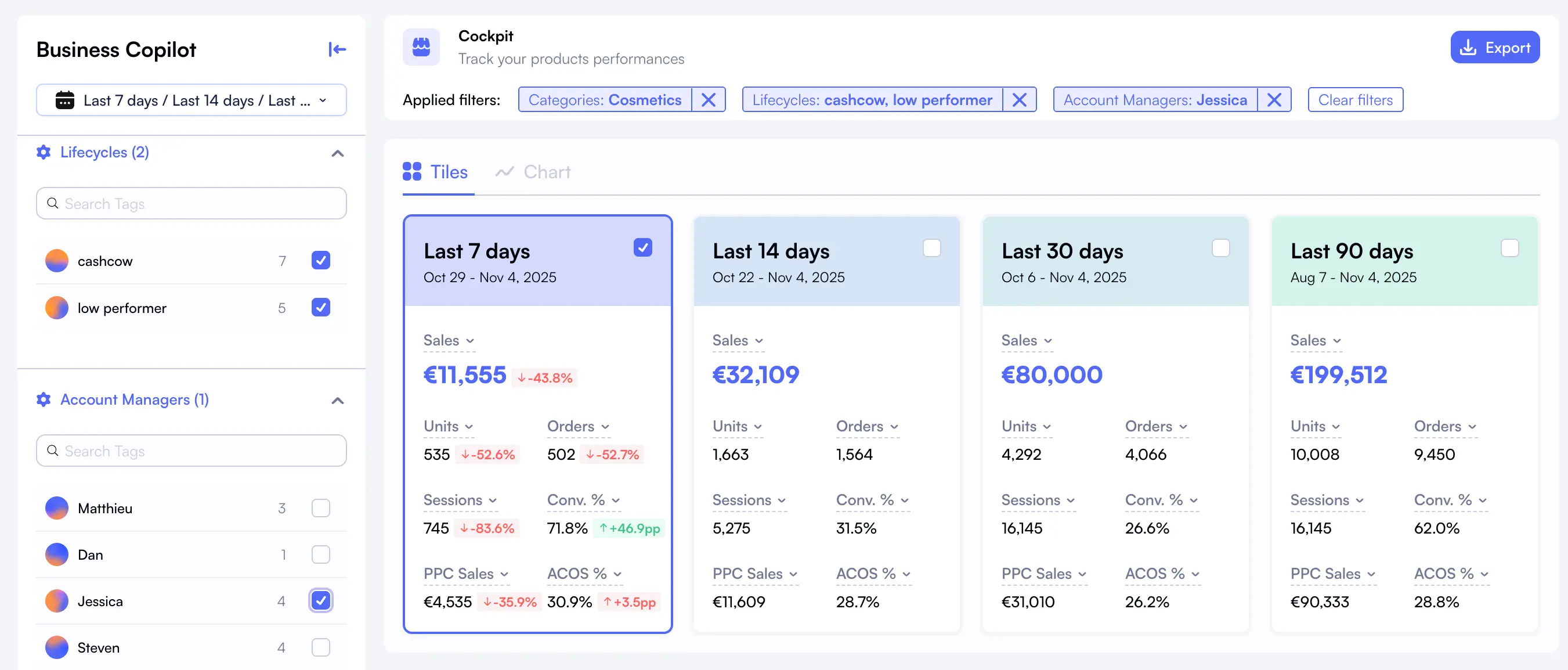
Custom Breakdowns let buyers group the catalog by supplier, lifecycle, or any dimension they actually think in.
The full stack overview, including sourcing, PPC, and analytics.
Your History Comes With You
Switching from SellerAmp? Give us access to your current tool or share your data exports. Our team handles the rest. You start Nova with your full history on Day 1. No data loss, no hassle.
Works with exports from any analytics tool. Free for all new users. Talk to our team →
Frequently asked questions
No. SellerAmp SAS is built for single-ASIN sourcing decisions: scan or paste a product, see ROI, BSR, fees, eligibility, and buy-or-skip signals. Nova is built for full-catalog profit and operations analytics once those products are live. If your job is finding the next deal, keep SellerAmp. If your job is running a profitable catalog, add Nova.
Yes, once you have a real catalog. Nova tracks net profit per ASIN, fees, returns, reimbursements, refunds, and PPC product-level spend across every Amazon marketplace you sell on. Sourcing tools tell you whether to buy; Nova tells you whether the SKUs you already bought are still earning after Amazon's fee changes and your return rate.
Nova starts at $49/month with a 14-day free trial and no credit card required. Extra Seller Central accounts are also $49/month each. Agency and enterprise plans are custom and start with a demo.
Nova supports 23 Amazon marketplaces, so multi-region sellers can consolidate net profit, fees, and PPC into a single view instead of switching Seller Central regions.
Plan on about 5 minutes for Amazon OAuth, 2 to 24 hours for historical SP-API backfill depending on account size, and 1 to 2 hours to upload COGS and tag the catalog. The full migration playbook is in the switching-to-Nova guide.
Want to see your own numbers, not a SellerAmp feature list?
Book 30 minutes with our team. We connect your Seller Central data and walk through your real profit, fees, and inventory picture, so you can judge the switch on your own catalog. Prefer to explore alone? Start the free trial instead.