
Amazon Bookkeeping Services vs Software
Compare DIY, software, and professional bookkeeping services for Amazon sellers. Decision framework by revenue size with cost analysis and ROI comparison.
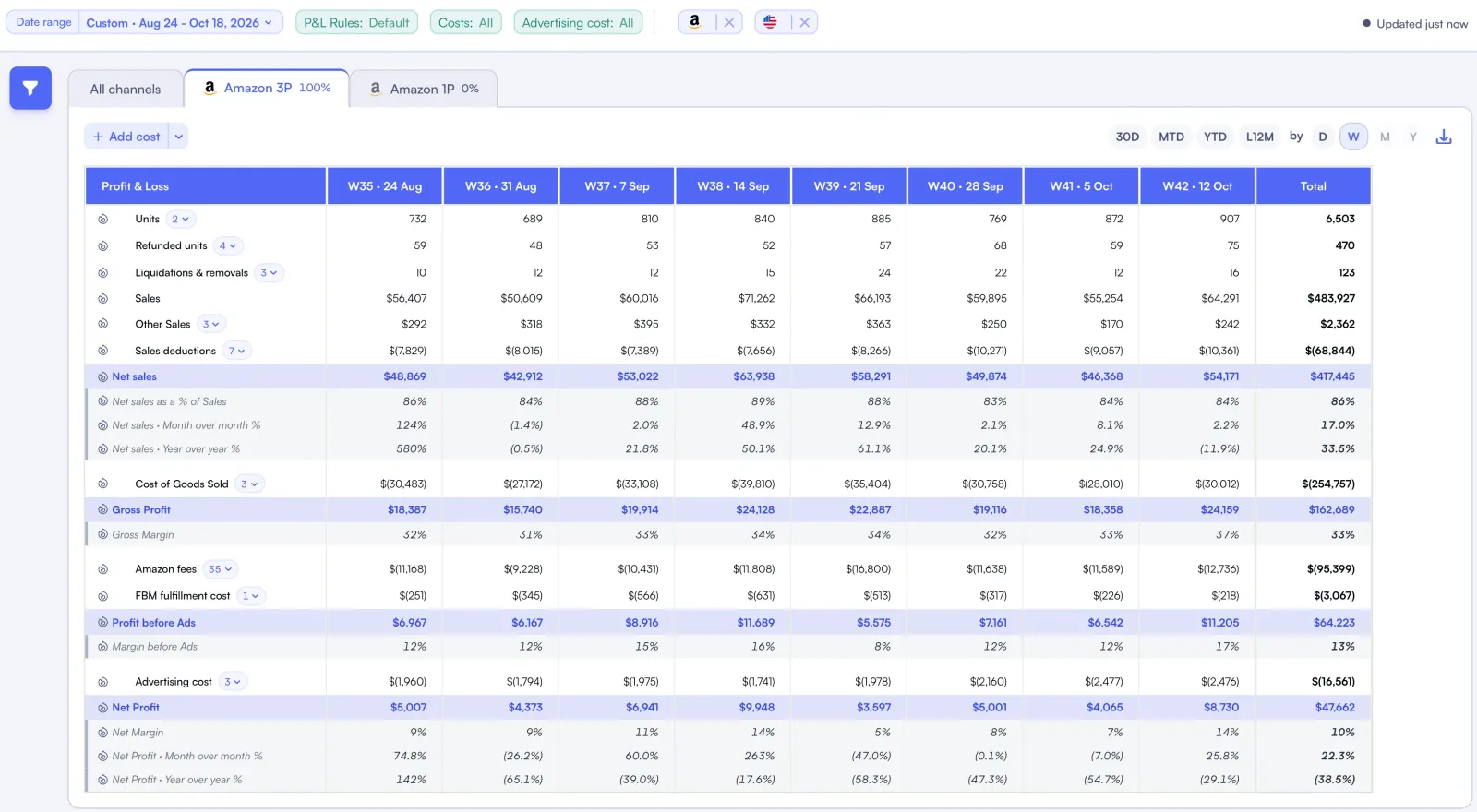
Every Amazon seller faces a critical decision: handle bookkeeping yourself, invest in specialized software, or hire professional bookkeeping services. The choice affects your time, accuracy, costs, and scalability, and there's no one-size-fits-all answer. The brands that scale past the plateau, in our cohort, are the ones that measure the items below weekly.
This guide compares all three options with honest pros/cons, cost analysis, and a revenue-based decision framework so you can choose the right bookkeeping approach for your business stage and goals.
The Three Bookkeeping Approaches
Option 1: DIY Bookkeeping
The approach: track everything manually in spreadsheets or basic tools like QuickBooks/Xero without specialized Amazon integration.
✓ Pros
- Lowest upfront cost ($0 or basic software)
- Full control over your data
- Learn your business financials intimately
- Good for understanding fundamentals
- Flexible and customizable
✗ Cons
- 10-15 hours weekly time investment
- High error rate (5-10% typical)
- No near real-time visibility
- Doesn't scale beyond $50K revenue
- Delayed decision-making
- High stress during tax time
Best for:
- • Revenue: $0-$50K annually
- • ASINs: 1-5 products
- • Profile: Side hustler testing the waters
- • Timeline: First 6-12 months only
Option 2: Bookkeeping Software
The approach: Specialized Amazon accounting software that automates data sync, categorization, and reporting (like Nova).
✓ Pros
- Saves 10+ hours weekly (85-90% automation)
- Near real-time financial visibility (hourly - 24 hrs)
- 99.5-99.8% accuracy (vs 90-95% manual)
- Product-level P&L automatically
- Scales to $50M+ revenue
- Multi-marketplace consolidation
- Custom dashboards and alerts
- Much cheaper than human bookkeeper
✗ Cons
- Monthly software cost ($69-300)
- Still need to review and understand reports
- May need accountant for taxes
- Initial setup time (1-3 days)
- Learning curve for new users
Best for:
- • Revenue: $50K-$5M annually (sweet spot: $200K-$2M)
- • ASINs: 10-500 products
- • Profile: Full-time seller wanting operational intelligence
- • Goal: Scale efficiently with data-driven decisions
Option 3: Professional Bookkeeping Services
The approach: Hire a dedicated bookkeeper, accounting firm, or CFO service that manages all financial operations for you.
✓ Pros
- Completely hands-off (save 15+ hrs/week)
- Expert financial guidance and strategy
- Tax planning and preparation included
- Audit-ready books maintained
- Human judgment for complex situations
- Financial reporting for investors/lenders
- Peace of mind and reduced liability
✗ Cons
- High monthly cost ($500-$3,000+)
- Less timely data (weekly/monthly reports)
- Less control over your data
- Communication delays for questions
- May not understand Amazon specifics
- Often still need software underneath
Best for:
- • Revenue: $2M-$50M+ annually
- • Complexity: Multi-channel, international, multiple entities
- • Profile: Established brand with team, raising capital
- • Need: Strategic CFO guidance, not just bookkeeping
Cost Comparison Analysis
| Cost Factor | DIY | Software | Services |
|---|---|---|---|
| Monthly Software/Service | $0-50 | $69-300 | $500-3,000 |
| Your Time (hrs/week) | 10-15 | 2-3 | 1-2 |
| Time Value ($50/hr) | $2,000-3,000/mo | $400-600/mo | $200-400/mo |
| Annual Tax Prep | $500-1,500 | $500-1,000 | Included |
| Total Monthly Cost | $2,000-3,100 | $470-900 | $700-3,400 |
Key Insight:
When factoring in time value, software is the most cost-effective option for 80% of Amazon sellers. DIY appears cheap but costs $2,000-3,000/month in opportunity cost. Services make sense at scale or when you need strategic CFO guidance beyond just bookkeeping.
Decision Framework: Revenue-Based Recommendations
$0-$50K Annual Revenue
Recommended: DIY with spreadsheets or basic integration tool
Reasoning: at this stage, cash is king. Your time investment (10-15 hrs/week) teaches you the business fundamentals. Use free templates and basic QuickBooks.
Action: Download P&L template, track COGS in spreadsheet, categorize Amazon settlements manually.
$50K-$200K Annual Revenue
Recommended: Amazon accounting software like Nova
Reasoning: you're hitting the scale where manual bookkeeping breaks down. At 10-15 hours weekly, you're losing $2,000-3,000/month in opportunity cost. Software pays for itself 10x over.
Action: Invest in Nova for real-time P&L and product-level profitability. Hire accountant quarterly for tax planning.
$200K-$1M Annual Revenue
Recommended: Software + quarterly accountant review
Reasoning: you need daily operational intelligence (software) AND strategic tax/financial guidance (professional). Hybrid approach maximizes value.
Action: Nova for day-to-day ($169-299/mo) + ecommerce CPA for quarterly reviews and tax strategy ($500-1,000/quarter).
$1M-$5M Annual Revenue
Recommended: Software + monthly bookkeeping service
Reasoning: Complexity increases with scale (multiple ASINs, team, possibly multi-channel). You need automation + human oversight for accuracy and strategic decisions.
Action: Nova ($299/mo) + monthly bookkeeper specializing in ecommerce ($800-1,500/mo). Consider fractional CFO for growth planning.
$5M+ Annual Revenue
Recommended: Full-service CFO + software
Reasoning: at this scale, financial strategy determines your next $5M-10M in value creation. You need sophisticated forecasting, scenario planning, and capital allocation, plus clean books for potential exit.
Action: Nova Enterprise + dedicated ecommerce CFO firm ($2,000-5,000/mo). Focus on EBITDA optimization and exit readiness.
ROI Calculator: Is Software Worth It?
Scenario: $500K Annual Revenue Seller
DIY Bookkeeping Cost
Software Cost
Start With the Right Solution
For most Amazon sellers doing $50K-$5M annually, specialized software is the optimal choice. Try Nova free for 14 days and see the time savings and accuracy improvement firsthand.
Related read
Amazon Seller Calculator: forecast fees and margin per SKU
Continue Learning
Explore more expert insights to grow your Amazon business
Amazon Pricing Strategy
Pricing is the highest-leverage profit lever most sellers never revisit. Learn the 4 pricing models, how to A/B test prices, and how to track the actual profit impact of every price change.
Amazon FBA Profit Margins by Category (2026 Benchmarks)
What's a good FBA profit margin? See 2026 benchmarks by category, the real formula (not the simplified version), and 8 strategies that added 5-12% margin for real sellers.
Amazon Listing Optimization 2026: A10 Algorithm Playbook
How Amazon's A10 algorithm ranks listings in 2026. Title formulas, bullet point templates, image specs, and A/B test data from 200+ listings. Step-by-step with examples.
Gemini
ChatGPT