Amazon chargebacks and deductions: what vendors actually pay
Amazon deductions are two families: invoice and payment deductions (shortage claims, price claims, quick-pay) and operational chargebacks for how goods were shipped. Different causes, owners and fixes.
What you invoice Amazon is not what Amazon pays you. Between the invoice and the remittance, Amazon takes deductions, and most vendors see them only as one shrinking total.
That total has two different causes, and each needs a different response. Some deductions are disputes about what Amazon received and what it agreed to pay. Others are penalties for how the goods were shipped. Treating them as one number sends the wrong team after the wrong problem. If you are working out what a product really earns, this guide is one step of measuring 1P profit on Vendor Central.
The two families of Amazon deductions
Amazon deductions fall into two families: invoice and payment deductions, which are disputes about quantity and price, and operational chargebacks, which are penalties for how goods were sent. They have different causes, different owners inside your company and different fixes.
Invoice and payment deductions are shortage claims, price claims and the quick-pay discount. They question the invoice itself: did Amazon receive what you billed, at the cost you billed it. Amazon's own vendor documentation names the matching credit notes: a PQV credit is "credit for items billed but not received", and a PPV credit is "credit for items billed at a higher/lower cost" (Amazon Selling Partner API, submit credit notes). These belong to finance and account management.
Operational chargebacks are penalties for breaking Amazon's shipping and receiving requirements: a late or missing ASN, carton and labelling errors, routing and carrier compliance, purchase order on-time and fill performance. SPS Commerce sums it up: at Amazon, a chargeback signifies "an AR deduction for a compliance defect" (SPS Commerce, What are Amazon's compliance chargebacks). These belong to supply chain and logistics, and no amount of claim disputing fixes them.
The split matters because each family answers a different question. For invoice and payment deductions, the question is "was this deduction right?", and the answer comes from proof of delivery, cost agreements and payment terms. For chargebacks, the question is "what went wrong in how we shipped?", and the answer comes from the warehouse floor. A finance team can recover a wrongly withheld shortage. It cannot stop a carton label from being printed on a seam. When both families are reported as one line, neither team can tell whether the number belongs to them, and the total keeps growing while each side assumes the other is handling it.
Shortage claims, withheld and settled
A shortage claim is Amazon paying less on an invoice because it recorded receiving fewer units than you billed. SPS Commerce, quoting Amazon's shortages training, describes a shortage as an invoice sent "for a quantity of items that is higher than the quantity received" (SPS Commerce, Shortage claims at Amazon).
A shortage passes through two states. Withheld means Amazon has held back the amount while the discrepancy is open: the money is missing from the remittance, but the claim can still be disputed with proof of delivery and reversed. Settled means the claim is closed against you and the amount is gone.
Only settled claims are a cost. Withheld amounts are still in play, so counting them as lost overstates the damage, and ignoring them understates the cash you are owed. Track the two separately, and watch how much moves from withheld to settled because nobody disputed it in time.
Shortages often have an operational root as well. If units were shipped but not recorded at receiving, the cause may sit in your ASN or carton labels rather than in the count itself. That is one reason the two families need to be read side by side: a rise in withheld shortages on the same products that carry ASN or carton chargebacks points to one shipping problem showing up in two places.
Price claims
A price claim is a deduction raised when the cost price on your invoice does not match the cost price on Amazon's file for that item. Amazon pays the price it holds and deducts the difference.
Cost changes are the usual cause. A new cost is agreed, but the invoice goes out at the new price before Amazon's file is updated, or the old price stays in your billing system after Amazon has moved. The fix is process, not argument: confirm the effective date of every cost change on both sides before invoicing at the new price.
The quick-pay discount
The quick-pay discount is a payment term, not an error: you accept a deduction in exchange for being paid sooner. There is nothing to dispute.
It applies to every invoice under that term, not to some. That makes it predictable, and it belongs in your margin model as a known cost of selling to Amazon on those terms. Whether it is worth it is a cash decision: compare the discount with what earlier payment is worth to your business.
Operational chargebacks: paying for how you shipped
Operational chargebacks charge you for how goods reached Amazon, whatever was in the boxes. They group by cause:
ASN accuracy and timing: the advance shipment notice arrived late, was never sent, or did not match what was received.
Carton and labelling compliance: missing or unscannable carton labels, carton contents that differ from the ASN, non-compliant barcodes, overweight or oversized cartons.
Routing and carrier selection: the pickup or delivery did not follow the agreed routing, carrier or appointment.
Purchase order on-time and fill performance: goods arrived outside the purchase order window, or fewer units were sent than were confirmed.
Each of these is fixed upstream, in the warehouse, the labelling station or transport planning. Disputing them can recover an individual charge that was raised in error, but it does not stop the next one. The useful question for a chargeback is which step in your shipping process produced it.
That makes ownership simple to assign. ASN and labelling issues belong to whoever builds shipments and prints labels. Routing issues belong to whoever books freight. On-time and fill issues belong to whoever confirms purchase orders and plans production, because confirming units you cannot ship on time turns a forecasting gap into a charge. Review chargebacks with those people, by cause and by product, rather than with the team that handles invoice disputes.
Why deductions are easy to miss
Deductions are easy to miss because none of them changes the invoiced figure most reports start from. Revenue looks complete while the cash received is lower.
They also arrive late and in pieces: on remittances, one line at a time, often months after the shipment they relate to. By then the purchase order is closed and the margin for that period has already been reported. Unless someone matches each remittance line back to an invoice and a product, deductions stay an unexplained gap between sales and cash. The 1P profit ladder puts them in their place, straight after invoiced revenue and before cost of goods.
Seeing them by type, and by product
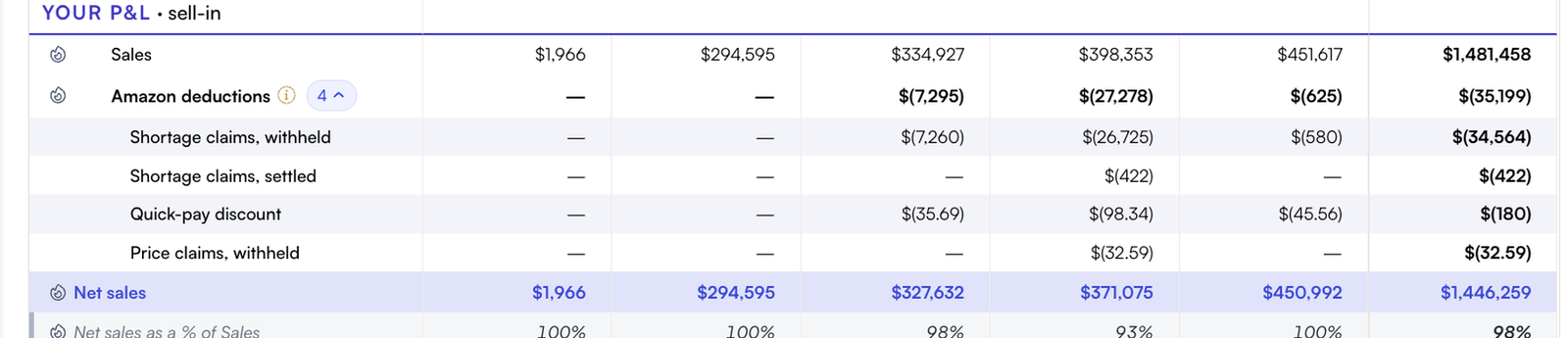
Nova breaks Amazon deductions out by type on the vendor P&L, including chargebacks, so you can see which products carry them instead of one total. Withheld and settled shortage claims sit on separate lines, next to price claims and the quick-pay discount, between sales and net sales.
From there you can tell a finance problem from a logistics one and send it to the right team. The Vendor Central page shows the full trail from purchase order to what Amazon actually paid.
Find answers to common questions about our platform
On Vendor Central, a chargeback is a deduction Amazon takes for a compliance defect in how goods were sent: a late or inaccurate ASN, a missing carton label, a missed purchase order window or a routing error. It is a penalty for how you shipped, not a dispute about what Amazon received or what it paid.
A shortage claim is an invoice deduction: Amazon pays less because it recorded receiving fewer units than you billed. A chargeback is an operational penalty for breaking a shipping or receiving requirement. Shortages are handled by finance and account management through disputes. Chargebacks are fixed in the warehouse and in transport planning.
No. The quick-pay discount is a payment term: you accept a deduction on each invoice in exchange for being paid sooner. It is applied to every invoice under that term, so it belongs in your margin model as a known cost, not in your dispute queue.
Most reports start from invoiced or shipped revenue, and deductions do not change that figure. They arrive later on remittances, one line at a time, often well after the shipment they relate to. Unless you match remittances back to invoices and products, the revenue line looks complete while the cash received is lower.

 Claude
 Gemini
 ChatGPT