Amazon advertising for vendors: your break-even ACOS is not a seller's
ACOS is measured at the shopper's price, but a vendor earns its invoice price, net of deductions and co-op. Why a seller's target ACOS overspends on 1P, and how vendors should judge advertising.
Vendors run the same ad formats as sellers, in the same console, and are often handed the same ACOS targets. The targets do not transfer.
The reason is not the ads. It is what the ACOS figure is measured in, and what your margin is made of. Both differ on 1P, and both push in the same direction: a target that is safe for a seller lets a vendor overspend. This guide explains why, as one part of measuring 1P profit on Vendor Central.
Your ads are measured in Amazon's revenue, not yours
ACOS measures your advertising against Amazon's revenue, not yours. Amazon Ads defines it as ad spend divided by ad revenue: "Amazon ACOS is calculated by dividing ad spend by ad revenue, then converting it to a percentage" (Amazon Ads, What is advertising cost of sales). That ad revenue is the attributed sales, recorded at the price the shopper paid Amazon.
A vendor never earns that price. As Reddog Consulting Group puts it, "Amazon buys your inventory at wholesale prices", and from then on Amazon sets "the final retail price" (Reddog Consulting Group, What is Amazon Vendor Central). Your revenue is the cost price you invoiced. Because the retail price sits above it, the same spend is a smaller share of attributed sales than of what you actually receive. ACOS understates what advertising costs you, every time, on every campaign.
For a seller there is no such gap: the shopper's price is the seller's revenue, so ACOS and the seller's own cost of advertising describe the same thing.
The gap also moves. Amazon sets and changes the retail price, so when it raises a price your attributed sales rise and your ACOS improves without any change in what you earn per unit. When it cuts a price, ACOS worsens while your invoice price stays where it was. Read on its own, ACOS on a vendor account partly tracks Amazon's pricing decisions rather than your campaigns.
What break-even actually means for a vendor
For a vendor, advertising breaks even when spend equals the margin the advertised units leave you, and that margin is net of Amazon deductions and co-op. Amazon Ads makes the same link in general terms, advising advertisers to start by "achieving break-even ACOS and comparing it to your profit margin".
The margin is the hard part. On 1P it starts from your invoice price, then loses shortage and price claims, the quick-pay discount, the co-op and allowances in your trading terms, and your cost of goods. None of those deductions or co-op exist on 3P. The full sequence is laid out in the 1P profit ladder; the break-even point is the rung just before advertising.
To compare it with an ACOS figure, the margin has to be expressed against the retail price, because that is the unit ACOS is counted in. Skip that conversion and you compare a share of one price with a share of another.
Do it per ASIN. Cost price, co-op terms and deductions differ from product to product, and so does the gap between your cost price and Amazon's retail price. One break-even figure for the whole account averages away exactly the products where advertising loses money.
Why copying a 3P target overspends
A 3P target overspends on a vendor account because it is wrong twice, in the same direction. It is set against the shopper's price, which overstates the revenue a vendor's ad spend is weighed against. And it is set against a seller's margin, which carries none of the deductions or co-op that shrink a vendor's.
The result is campaigns that report on target while the advertised units lose money for the vendor. Nothing in the ad console flags it, because the console has no view of your invoice price, your deductions or your trading terms. The target has to be rebuilt from your own margin, product by product.
This does not mean vendors should advertise less. Some products deserve spend above break-even, for a launch or to defend a category, and Amazon's reorders can make that spend pay later. It means the decision should be made knowingly, against your own margin, rather than inherited from a target built for a different business model.
Sell-out is the right denominator for ad efficiency, sell-in for profit
Judge campaign efficiency against sell-out and whether advertising paid against sell-in. Advertising drives sell-out: shoppers buy from Amazon's stock. Sell-out then drives Amazon's reordering, which becomes your sell-in later.
That delay matters. A campaign can lift sell-out this month while your sell-in moves only when Amazon's next purchase orders arrive, as covered in knowing what Amazon will reorder. Measure the campaign on the sales it drove, and measure the payback on the revenue you invoiced over a period long enough for reorders to land.
It also explains why advertising can look better or worse than it is in any single week. Amazon may already hold enough stock to cover the lift, in which case no new order follows soon. Or it may reorder on the strength of the lift, in which case your sell-in jumps after the campaign has ended. Neither is visible in the ad console.
Reading ad spend next to what you actually earn
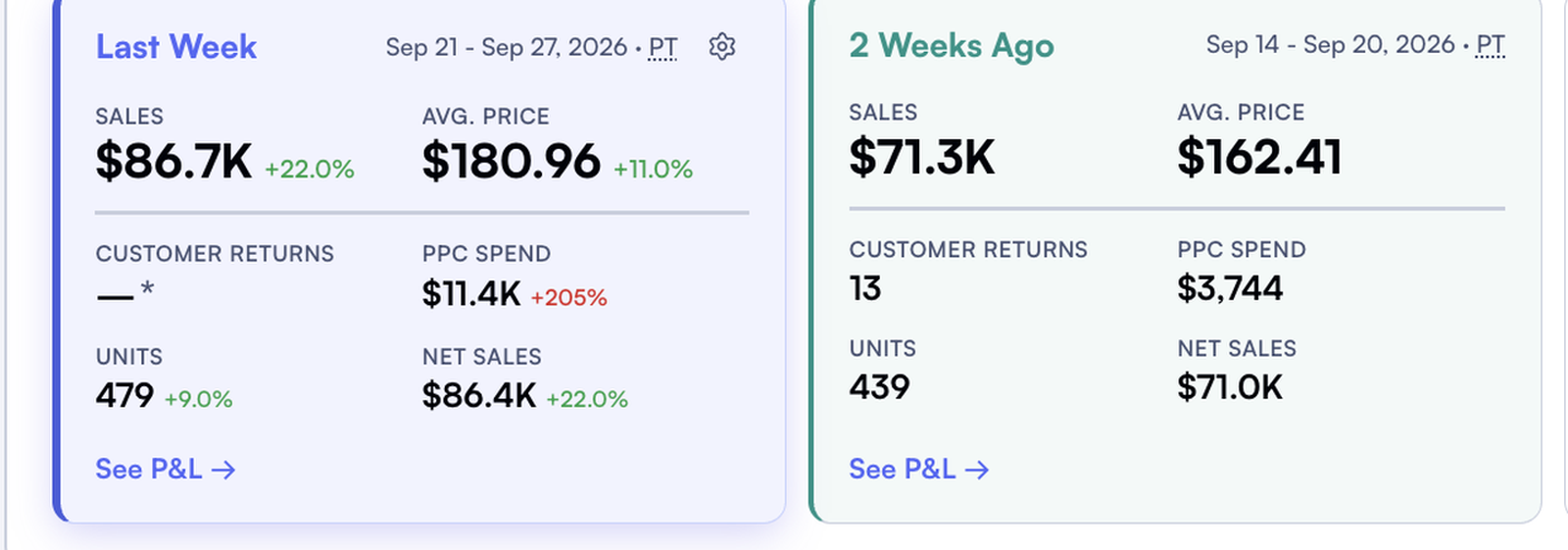
Nova shows advertising spend alongside net sales for a 1P account, period by period, so spend is read against your own revenue rather than only against attributed sales.
The vendor P&L also carries profit before advertising, so you can see the margin your advertising is being judged against. The Vendor Central page shows the rest of the 1P view.
Find answers to common questions about our platform
No, the formula is the same: advertising spend divided by attributed sales. What differs is what the denominator means to you. Attributed sales are recorded at the price the shopper paid Amazon, while a vendor earns the cost price it invoiced Amazon. The same ACOS therefore takes a larger share of a vendor's own revenue.
Start from the margin an advertised unit leaves you: your invoice price, minus Amazon deductions, co-op and cost of goods. Advertising breaks even when spend equals that margin. To compare it with ACOS, express that margin against the retail price Amazon sells at, because that is the price ACOS is measured in.
Not safely. A seller's target is set against the shopper's price and a seller's own margin, with no co-op or Amazon deductions. Applied to a vendor account, the same target lets advertising spend more than the units it sells leave the vendor, so campaigns that look on target can lose money.
Both, for different questions. Advertising drives sell-out, so campaign efficiency is judged against sell-out. Whether advertising paid is judged against sell-in, because that is your revenue, and it arrives later, through the purchase orders Amazon places as stock sells through.

 Claude
 Gemini
 ChatGPT