Amazon Vendor Central inventory: knowing what Amazon will reorder
On 1P, Amazon controls replenishment. How vendors read Amazon's signals early: net PPM per ASIN, CRaP, confirmation and fill, and Amazon's P70, P80 and P90 demand forecasts.
The stock of your products in Amazon's warehouses is Amazon's stock. It bought it from you, and you do not get to restock it.
What you get instead is a set of signals about what Amazon intends to buy next: the margin it makes on each item, whether it still considers the item worth selling, how reliably you have confirmed and shipped past orders, and its own demand forecast. Reading those signals early is the whole discipline. It is also one part of measuring 1P profit on Vendor Central, because an item Amazon stops ordering earns nothing however good its margin looked.
Your stock is Amazon's stock, and that changes the question
On 1P, Amazon controls replenishment, so the question is not when to send more stock but what Amazon will order next. A seller on 3P decides when to ship and how much. A vendor waits for a purchase order.
That turns one question into three. What will Amazon order, and when? Can you confirm it and ship it on time? And does the item still earn its place in Amazon's catalogue? A reorder point answers none of them. The answers sit in the signals Amazon sends, most of them visible weeks before the purchase orders change.
It also changes what good stock management looks like on your side. Your own warehouse still needs a plan, but the demand it serves is Amazon's purchase orders, not shoppers. Production you schedule against shopper demand that Amazon never orders becomes stock you hold. Production you skip because orders were quiet can leave you unable to confirm when Amazon comes back.
Net PPM per ASIN is a reorder signal, not just a margin
Net PPM is a reorder signal because Amazon keeps ordering what makes it money. It is Amazon's margin on selling your item, not yours, as set out in the guide to measuring 1P margin.
Read per ASIN, a falling net PPM is an early warning. It tends to come before smaller purchase orders, a request for a lower cost price or more funding, or the item being flagged as not worth selling. Track the direction on each ASIN, not the account average, because a healthy average can hide the items that are drifting towards the bottom of Amazon's list.
The response depends on why it is falling. If Amazon's retail price has dropped while your cost price stayed put, the pressure is on price, and a cost conversation is coming. If the price held but the item is expensive for Amazon to store and ship, packaging or case pack changes may do more than a discount. Either way, you hear about it earlier in the margin than in the purchase orders.
CRaP: when Amazon decides an item is not worth selling
CRaP, short for Can't Realize a Profit, is Amazon's label for an item it cannot sell at a profit. Pattern describes these as usually "low-cost, high-weight products that don't ship well", with prices "in constant flux" because of price matching across retailers (Pattern, What happens to CRaPped out products).
The usual triggers are price erosion, heavy or bulky items whose shipping cost eats the margin, and deep discounting. What follows is a change in Amazon's behaviour rather than a fee: purchase orders slow or stop, the item may be harder to promote, and Amazon may ask for better terms or a different way of selling it. Since net PPM is the measure behind the decision, the same falling margin that warns of smaller orders is the one to watch here.
Confirmation rate and fill rate decide the next purchase order
Your confirmation and fill record decides how much Amazon orders next, because Amazon orders against what it expects you to supply. You confirm the units you can deliver, then you ship them.
Both sides of that carry a cost. Under-confirming shrinks what Amazon expects from you and, over time, what it orders, so a supply problem today becomes a demand problem next quarter. Missing units you did confirm is worse: it brings shortage claims and purchase order on-time and fill chargebacks, covered in Amazon chargebacks and deductions. The rule is simple to state and hard to keep: confirm what you can ship on time, and ship what you confirmed.
Past due units are the bridge between the two. A purchase order line that is confirmed but not yet received is a promise in flight. Watching past due units per ASIN shows which promises are at risk while there is still time to ship them, before they turn into a fill problem and a deduction.
Amazon gives you its own forecast
Amazon publishes its customer demand forecast to vendors, per ASIN and per week, at several confidence levels. Its developer documentation describes the vendor forecasting report as containing "forward looking mean, Prior 70, Prior 80, and Prior 90 weekly customer demand forecasts" (Amazon Selling Partner API, analytics reports).
The P-level is a confidence level. Amazon explains it with P80: "there is an 80% probability customer demand will not exceed the weekly forecasted units". P70 reads the same way at a lower confidence level, and P90 at a higher one. The mean is the central estimate, so demand lands above it often.
For a product you cannot afford to be out of, plan production against a higher P-level, because it is the number demand is less likely to exceed. For a slow item where unsold stock is the bigger risk, a lower level is enough. Either way, it is Amazon's view of demand, and Amazon's purchase orders will tend to follow it.
Reading stock and margin in the same table
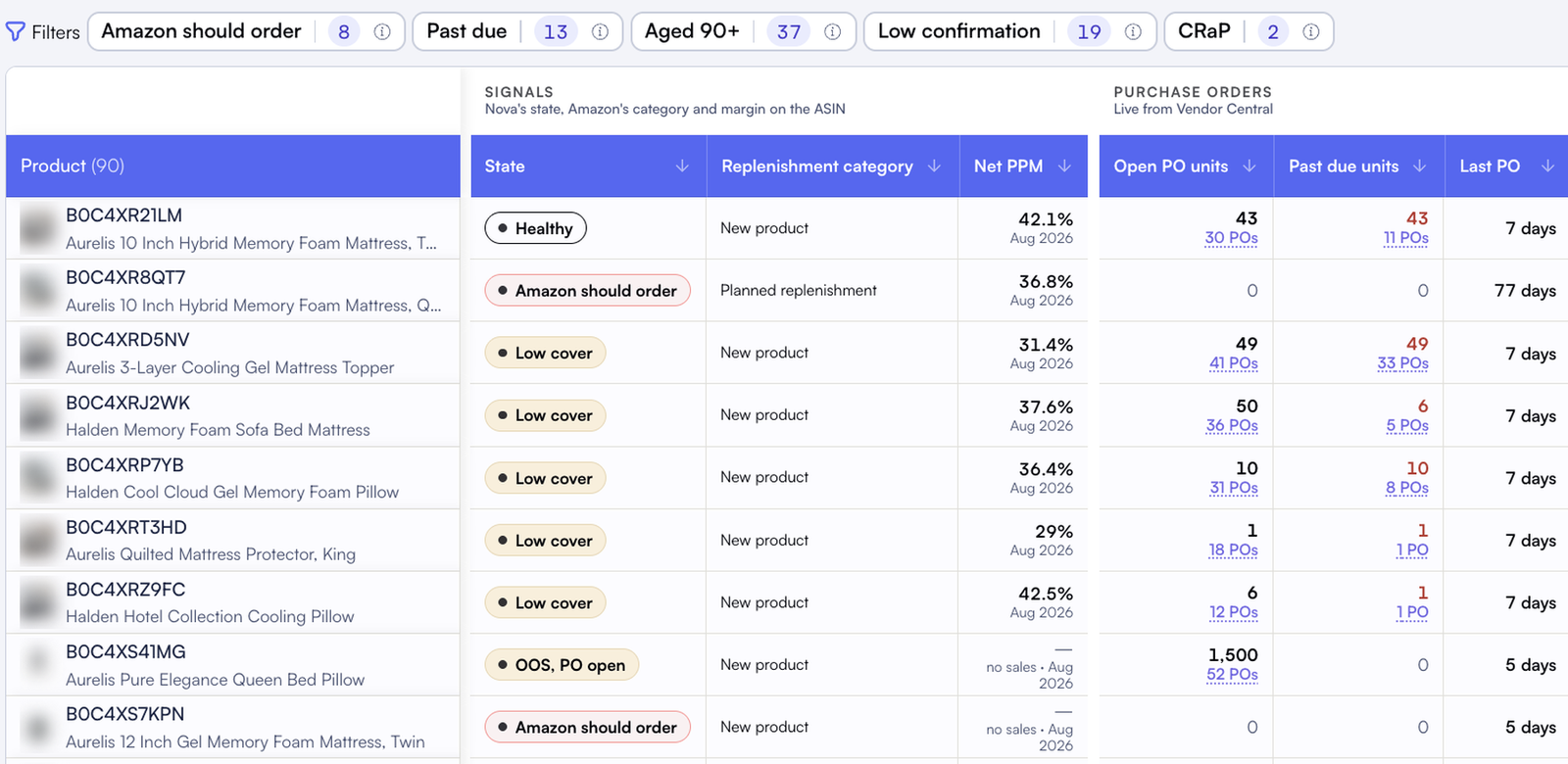
The useful view puts the replenishment signal, the margin and the open purchase orders on the same row, because a stockout on a high margin item and one on a low margin item are not the same event. One costs you an item Amazon wants to keep buying. The other may be Amazon quietly letting the item go.
Nova's vendor Inventory table lines up Amazon's replenishment category, net PPM, open and past due purchase order units and Amazon's forecast for each ASIN, so you can see which items need supply attention and which need a margin conversation. The Vendor Central page shows the rest of the 1P view.
Find answers to common questions about our platform
Amazon does. On 1P, Amazon buys your stock through purchase orders and decides when and how much to reorder. A vendor cannot send stock unasked. What a vendor controls is whether it confirms and ships what Amazon orders, and whether the item stays attractive enough for Amazon to keep buying.
It is one of the weekly customer demand forecasts Amazon gives vendors per ASIN, alongside a mean, P80 and P90. The P-level is a confidence level: Amazon's documentation explains that it is the probability that customer demand will not exceed the forecasted units. A higher P-level is a more cautious planning number.
CRaP stands for Can't Realize a Profit. Amazon applies it to items it cannot sell at a profit, typically low priced, heavy or bulky products, or items caught in repeated price matching. A CRaP item tends to see fewer or no purchase orders, and Amazon may ask the vendor for better terms or a change in how the item is sold.
Your confirmations tell Amazon what it can rely on you to supply. Confirming less than Amazon orders reduces what it expects from you, and over time what it orders. Confirming units you then fail to ship leads to shortage claims and operational chargebacks, so confirm only what you can deliver on time.

 Claude
 Gemini
 ChatGPT