Amazon PPC AI Agent - Build a Weekly Routine That Works
Most PPC work is scanning, not strategy. An AI agent connected to live ad and profit data does the scanning: wasted search terms, promotion candidates, and spend running above break-even ACoS.
•A PPC agent is only as good as the data it can reach: ad metrics alone produce ACoS advice, not profit advice.
•The three queries that carry most of the value are wasted search terms, promotion candidates and spend above break-even ACoS.
•Diagnose with a read connection, execute deliberately with Amazon's own ads tooling.
•Set thresholds in the prompt so filtering happens server side, which keeps answers fast and cheap.
•Weekly cadence beats daily fiddling on most accounts.
Most Amazon PPC work is not strategy, it is scanning. Scanning search-term reports for waste, scanning campaigns for drift, scanning products for the ones where ad spend quietly exceeded margin. That scanning is exactly what an AI agent connected to live data does well.
A Claude query through Nova MCP turns PPC spend data into an analysis to review.
What "agent" means here, precisely
An assistant that can call tools on your data through the Model Context Protocol, the open standard introduced by Anthropic and now supported across the major AI clients. Connected to an advertising and profit dataset, it can pull a filtered slice, reason on it, and hand you a ranked list of actions.
What it is not: an always-on bidder making changes while you sleep. Amazon's own Ads MCP server does provide write capability if you want execution from chat, but the useful default is analysis first, human approval second.
The three queries that do the work
1. Waste, with a threshold
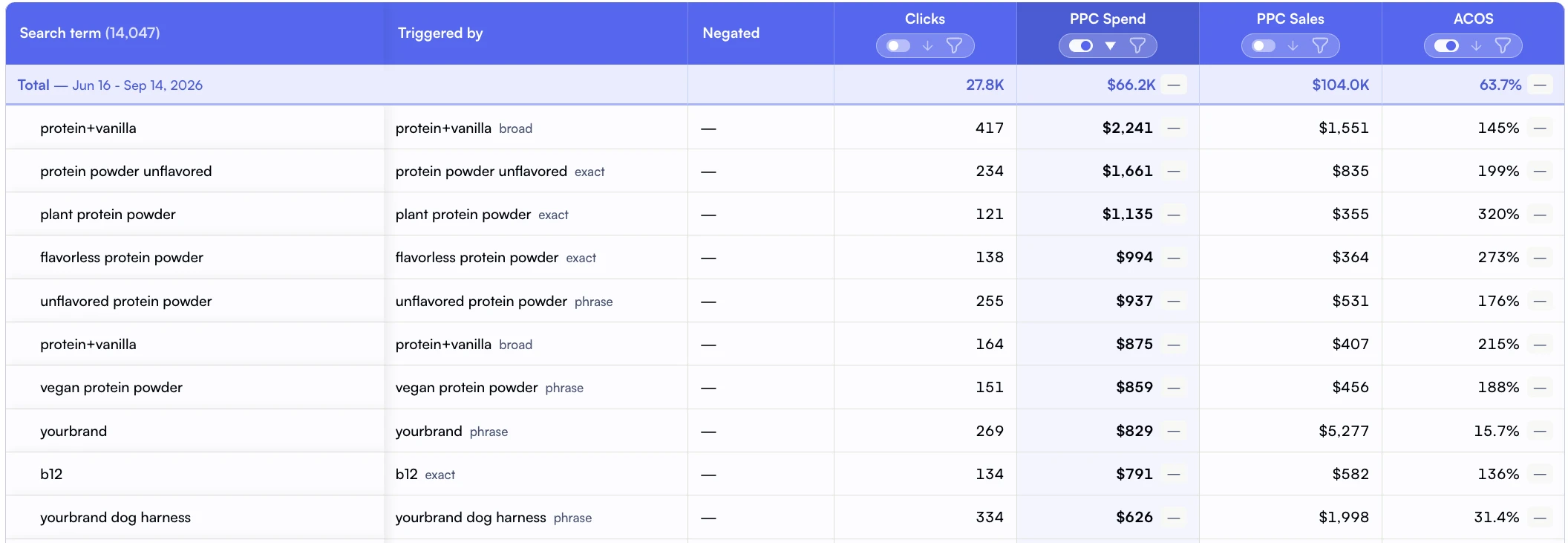
"Search terms from the last 30 days with more than $75 spend and zero orders, ranked by spend." This is a negative-keyword worklist. The threshold matters: without it you get thousands of rows of noise, most of them a single click.
Search term costs and conversions give keyword decisions a measurable starting point.
2. Promotion candidates
"Auto-campaign search terms with at least 3 orders and ACoS below 20% in the last 60 days." The mirror image of the first query, and the one most sellers skip. Every discovered term that converts cheaply belongs in an exact-match structure where you can control the bid.
3. Spend above break-even
"Which campaigns ran above the break-even ACoS of the products they advertise last month?" This is the one that requires profit data. Break-even ACoS is contribution margin expressed as a percentage of price, and it differs for every SKU. A campaign at 32% ACoS is healthy on a 45% margin product and destroying money on a 25% margin one.
The number to put in the prompt
Ask for contribution margin alongside ACoS in the same table. Once the two sit side by side, the decision makes itself and no one has to remember which SKU has the thin margin.
Give your PPC agent the profit layer
Nova MCP exposes Sponsored Products down to the customer search term, joined to fees, COGS and margin.
Monday, waste pass. Run the threshold query, approve the negatives, apply them.
Monday, promotion pass. Pull the converting discoveries, move the best into exact match.
Wednesday, drift check. "Which campaigns changed CPC by more than 20% versus the previous week, with conversion rate for both periods?" Rising CPC with flat conversion is competitive pressure; falling conversion is usually a listing or price issue, not an ads issue.
Month end, structure review. Spend by targeting type, ACoS against break-even by product family, and the SKUs where ads carry more than half of total sales.
The last one deserves attention. Heavy ad dependency is a risk metric, not a performance metric, and it is invisible in an ads-only view. Our PPC analytics page shows the same breakdown in the cockpit.
Where agents get it wrong
Optimising ACoS in isolation. Cutting spend on a profitable high-ACoS SKU reduces profit. The margin column prevents this.
Acting on thin data. A term with 4 clicks and no orders is not evidence. Set a click or spend floor in the prompt.
Ignoring the attribution window. Recent days under-report sales. Exclude the current incomplete period when comparing.
Confusing organic and ad-driven change. Ask for total sales alongside ad sales, otherwise a healthy organic lift reads as a paid collapse.
Our take
Is a PPC agent worth setting up?
Yes if you manage more than a handful of SKUs and currently do search-term reviews in spreadsheets. The waste query alone usually pays for the setup in the first pass.
Best fit if
•Sellers spending meaningful budget across several campaigns
•Agencies reviewing many accounts on a weekly cadence
•Teams that need margin context, not just ad ratios
Skip if
•Very small accounts where a manual monthly review is enough
•Anyone expecting fully autonomous bidding, which this deliberately is not
What they do well, and the data they need to be useful
An AI assistant connected to your live advertising and profit data through an MCP server, able to answer questions and recommend changes on real numbers. It is not an autopilot bidder: the analysis is automated, the decision stays with you unless you separately enable a write tool.
No. It replaces the report-building half of the job, which is often the majority of the hours. Strategy, creative, launch plans and negotiation with the wider business stay human.
Because ACoS is measured against revenue, not margin. Break-even ACoS varies per SKU with referral fees, fulfilment fees, returns and COGS. An agent without those inputs will confidently recommend scaling a campaign that loses money on every order.
Pattern work at scale: wasted search terms, terms worth promoting, campaigns above break-even, spend drifting against a stable conversion rate. These are tedious for a human and trivial for a query with a threshold.
A weekly waste-and-promotion pass plus a monthly structural review covers most accounts. Daily checks make sense during peak events or a launch.
Ready to Transform Your Amazon Business?
Join thousands of successful sellers who use Nova Analytics to make data-driven decisions and maximize their profits.