Amazon MAP Violation - Enforcement That Works 2026
A single MAP violation can reset an ASIN's price floor in 72 hours. Amazon does not enforce MAP; the brand does. Here is the enforcement stack that actually removes violating offers.
A single MAP violation on a hero ASIN can reset the market floor for the product inside 72 hours. Amazon does not enforce MAP; the brand does. This guide covers how MAP violations actually propagate on Amazon in 2026, why direct MAP complaints do not work, and the enforcement path that removes violating offers without an antitrust hangover.
TL;DR - Key Takeaways
•MAP is a unilateral brand pricing policy. Amazon does not enforce it; the brand does through reseller agreements and, when needed, IP or brand-integrity tools.
•A single MAP-violating offer usually takes the Buy Box, which pulls other resellers into matching and resets the ASIN price floor inside 72 hours.
•Direct 'MAP violation' complaints to Amazon do not remove offers. Removal routes through Report a Violation on IP, counterfeit, or listing-accuracy grounds.
•Enforcement stack: written warning, supply cutoff for authorized resellers, IP-based takedown via Brand Registry for unauthorized offers.
•Detection matters as much as enforcement; the earlier the violation is caught, the fewer resellers have matched by the time removal lands.
Our take
If a MAP-violating offer appears today
Identify the seller. If they are an authorized reseller, send the written warning and start the supply-cutoff clock. If they are unauthorized or the offer misrepresents the product, test-buy for evidence and file Report a Violation through Brand Registry on IP or listing-accuracy grounds. Do not file a bare 'MAP violation' complaint; it will not be actioned.
Best fit if
•Brand owners with a published MAP policy and an authorized-reseller program
•Brand-protection or agency operators enforcing across a portfolio
•Finance leads sizing the Buy Box-loss risk from pricing events on hero ASINs
Skip if
•Sellers without registered trademarks (Brand Registry gating is a prerequisite for the fast path)
•Brands who have no MAP policy in writing (enforcement starts with a written, dated policy)
MAP (Minimum Advertised Price) is a unilateral pricing policy the brand publishes. Under the Colgate doctrine in the US, a manufacturer can independently set the price at which resellers may advertise its product and can cut off resellers who violate, provided the policy is unilateral (no bilateral agreements). The Eightx MAP-pricing explainer is a good starting point on the mechanics.
Amazon does not enforce MAP. Amazon's position is that pricing is a seller decision, and enforcement would risk antitrust exposure. That means every MAP-enforcement action on Amazon has to route through a policy Amazon does enforce: intellectual property (trademark, copyright), counterfeits, unauthorized reseller status, or listing accuracy (product misrepresentation). The Gray Falkon 2026 MAP enforcement overview covers the current-year enforcement landscape in operator language.
How a single violation resets the ASIN price floor
The propagation is mechanical:
Day 0. Violating seller lists 5 to 15 percent below MAP. They take the Buy Box because Amazon's algorithm favors the lowest landed price on comparable offers.
Day 1-2. Other resellers on the ASIN see they are no longer winning the Buy Box. They match or beat the new price to recover share.
Day 3-5. The ASIN price floor on Amazon resets at the new (lower) level. Even after removing the original violator, the market takes weeks to drift back toward MAP.
This is why detection speed matters more than enforcement mechanism. A violation caught in 6 hours costs one seller's inventory position. A violation caught in 6 days costs the ASIN's whole reseller pricing structure.
MAP without a Brand Registry is a policy, not a lever
If the brand does not have Brand Registry, the enforcement toolset is limited to the reseller agreement (which only reaches authorized resellers) and slow legal channels. The practical enforcement lever on Amazon in 2026 is Brand Registry's Report a Violation flow on IP or listing-accuracy grounds. Everything else is a policy statement.
Written MAP policy. Published, dated, distributed to every authorized reseller with a signed acknowledgment. Without this, the rest of the stack is legally shaky.
Written violation notice. To the violating seller if identifiable, citing the specific MAP price and the violated offer. Timestamped.
Supply cutoff for authorized resellers. If the violator is an authorized reseller, cutting supply is the fastest durable fix. It is a business decision, not an Amazon-flow decision.
Report a Violation via Brand Registry. For unauthorized resellers, file on IP grounds (trademark, counterfeit) or listing-accuracy grounds (product misrepresentation, incorrect condition). Amazon actions these; it does not action pure MAP complaints.
Test buys for evidence. Amazon rejects filings without evidence. Photos of packaging, invoices, product markings, and shipping labels are what turn a filing into a takedown.
Legal-grade detail on the filing mechanics is documented in the Sigil MAP-enforcement attorney guide, which is a useful complement for legal teams.
Catch MAP violations same day
Nova's Listing Health Scanner flags Buy Box undercuts against your reference price per ASIN with P&L exposure. 14-day free trial, no card.
How Nova detects the violation before the floor resets
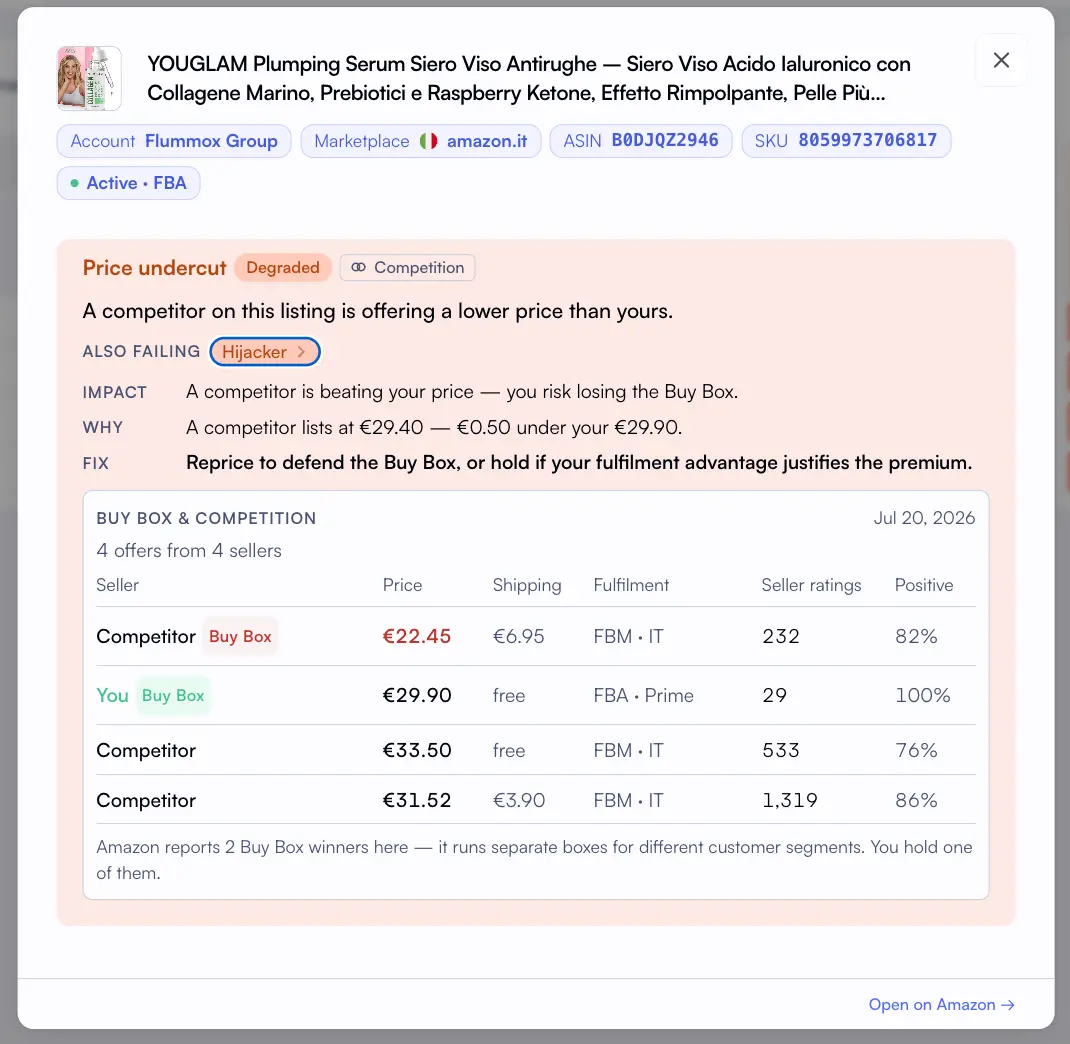
Listing Health Scanner surfaces the price undercut against your reference price per ASIN, so the enforcement clock starts on day zero, not day five.
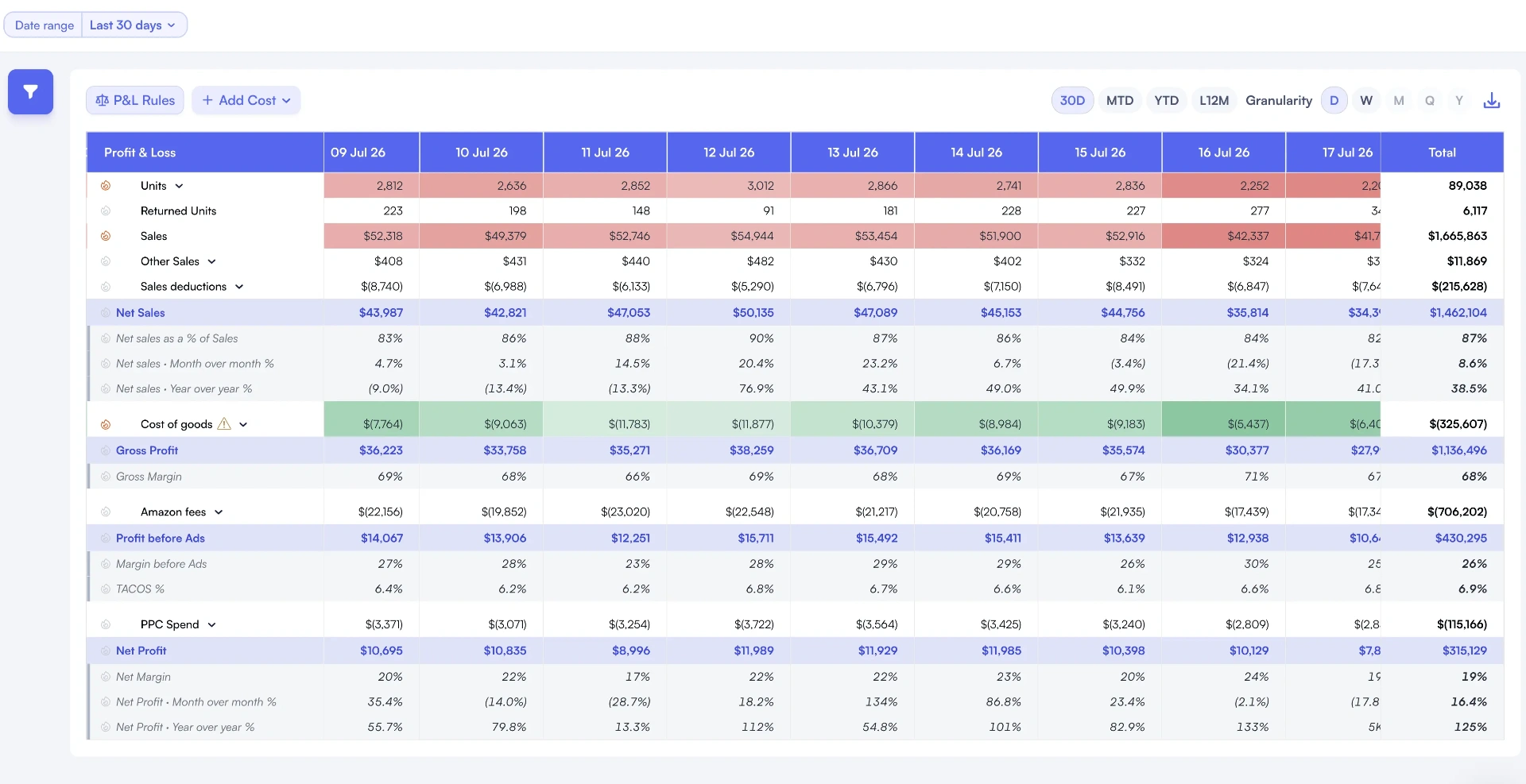
Listing Health Scanner monitors Buy Box price versus your reference price per ASIN per marketplace and flags an undercut the same day. The alert lands next to the trailing-30-day P&L exposure so the enforcement queue sorts by revenue at risk rather than by SKU. On hero ASINs, that is the difference between a 24-hour reseller warning and a 5-day floor reset.
Daily P&L heatmap: the pricing event shows up as reallocated Buy Box share and a slight total-revenue dip as the market floor resets around the violator.
Q4 and Prime Big Deal Days considerations
MAP violations spike around Q4 promotions because inventory turnover encourages faster undercutting. Two guardrails that hold up in practice:
Pre-brief authorized resellers on MAP flexibility during promotional windows. A published, dated promotional exception is not a MAP weakening; it is a clarification.
Watch the reference-price delta more closely during peak. The window when a single 3-day violation can reset the ASIN floor for months is October through December.
For portfolio brands running MAP across a large catalog, contribution margin per SKU determines which ASINs are worth aggressive enforcement. The math sits inside the P&L view; without it, enforcement priorities drift toward the loudest ASINs, not the most profitable ones.
Frequently asked questions
MAP (Minimum Advertised Price) is a unilateral pricing policy the brand publishes. A violation is a reseller advertising below the brand's floor. Amazon does not enforce MAP; the brand does.
Amazon considers pricing a seller decision and treats MAP enforcement as an antitrust risk. Amazon polices IP, counterfeits, and detail-page accuracy, which is why MAP takedowns usually route through those grounds.
A reseller pricing below MAP usually takes the Buy Box, which pulls traffic to the undercut offer and triggers other resellers to match, resetting the price floor on the ASIN in days.
Warn in writing citing your MAP policy, cut supply to authorized resellers who violate, and file a Report a Violation through Brand Registry on IP or listing-accuracy grounds where the offer is unauthorized or misrepresents the product.
The bottom line
MAP enforcement on Amazon runs through IP and listing-accuracy grounds, not through MAP complaints. Publish the policy, warn the violator in writing, cut supply where the violator is authorized, and file Report a Violation through Brand Registry where they are not. Detection speed matters as much as the takedown path; caught in hours, the ASIN floor holds. Caught in days, the floor resets.
Ready to Transform Your Amazon Business?
Join thousands of successful sellers who use Nova Analytics to make data-driven decisions and maximize their profits.