A hijacker takes 60 to 90 percent of your Buy Box share the day they appear. Here is how to detect them same day, file the takedown that actually works, and build the monitoring loop that catches the next one.
A hijacker on your Amazon listing typically takes 60 to 90 percent of your Buy Box share inside 24 hours and holds it until you remove them. The offer page still shows your product photos and your reviews, which is what makes hijacking so hard to spot from a distance. This guide covers how to detect a hijacker the day they appear, how to file a takedown that actually works, and how to build a monitoring loop that catches the next one before your on-call review.
TL;DR - Key Takeaways
•A hijacker is an unauthorized seller on your ASIN, competing on the Buy Box with counterfeit, arbitrage, or gray-market units.
•Detection signals: Buy Box loss on a normally-won ASIN, new offer in More Buying Choices, price undercut, and fulfillment center mismatch on orders.
•Brand Registry's Report a Violation tool is the fastest removal path. Without Brand Registry, expect slower A-to-Z or IP claims and lower success on gray market.
•The correct KPI is Buy Box recovery time in hours, not average removal time. A paused hijacker who returns in a week is not a resolved case.
•Same-day detection matters more than the takedown mechanism; Buy Box lost for a week costs more than any single hijacker's inventory is worth.
Our take
If a hijacker appears today
Test buy the offer to document the infringement (photos of packaging, invoice, product), then file Report a Violation through Brand Registry citing counterfeit or trademark infringement. Do not spend more than 15 minutes on the seller's contact form. The IP path is what removes them; the direct-contact path is what wastes your afternoon.
Best fit if
•Registered brand owners with an active Brand Registry account
•Operators managing 20+ ASINs where the Buy Box is a P&L line
•Agencies running brand-protection SLAs across a portfolio
Skip if
•Resellers on shared catalog ASINs (there is no hijacker if the ASIN is inherently shared)
•Brands without trademark registration (Brand Registry gating is a prerequisite for the fast path)
Amazon organizes the catalog at the ASIN level: one product page per ASIN, with a shared photo, title, description, and set of reviews. Multiple sellers can offer against the same ASIN if they claim to be selling the same product. The Buy Box (now called the Featured Offer) rotates between eligible sellers based on price, fulfillment method, seller performance, and inventory position, per Amazon's Featured Offer documentation.
A hijacker is a seller who adds themselves to your ASIN without authorization, typically because they source counterfeit units, buy retail-arbitrage inventory, or import gray-market stock. The customer sees your product page. The order ships from the hijacker's inventory. Your reviews absorb the quality difference. That is the mechanism, and it is why hijackers can convert like a normal offer for weeks before a review-quality drop tips it off.
How to detect a hijacker the day they appear
The five signals, ordered by how early they surface:
Buy Box lost on an ASIN you always won. If your Buy Box share on a specific ASIN drops from 95 percent to under 30 percent inside a day, the cause is almost always a new offer, and the new offer is often a hijacker.
New offer in More Buying Choices. The offer page shows every seller. A seller name you do not recognize appearing on your ASIN is the first place to look.
Price undercut. The hijacker prices below your reference to win the Buy Box. The visible drop on the offer page is usually 3 to 15 percent under your price.
Fulfillment mismatch on orders. Your ASIN keeps selling, but the shipping speed and fulfillment center on the order confirmations do not match your inventory placement. If you are FBA in the EU and shipments start going FBM from a US address, the seller is not you.
Review-quality shift. One-star reviews mentioning packaging, product condition, or authenticity concerns rising within a week. This is a lagging signal; do not wait for it.
The Buy Box share test
The cleanest one-line test: on any ASIN where you are the brand and Brand Registered, if your Buy Box share on any given day drops below 80 percent, treat it as a hijacker until proven otherwise. On unbranded shared-catalog ASINs, the same test does not apply. This is why the Listing Health Scanner signal has to run per ASIN with a per-ASIN baseline, not a portfolio average.
Test buy the hijacker's offer. Order at your address. Document packaging, invoice, product markings, and any missing certifications with photos.
File Report a Violation through Brand Registry, citing the specific infringement (trademark, counterfeit, listing misrepresentation). Attach the test-buy documentation.
Send a cease-and-desist to the seller in parallel if the seller entity is identifiable. Some resellers back off on a legitimate C&D; most do not, but the timestamp helps if the case escalates.
Escalate to the Brand Registry team if the takedown does not clear in 72 hours. Reference the case ID and add fresh evidence (new test buys, new reviews).
Monitor for repeat listings for the next 30 days. Hijackers frequently rotate seller entities.
The IP-based path is durable because Amazon acts on documented infringement. A pure MAP or authorized-reseller complaint is not; Amazon does not enforce MAP (covered in the MAP violation response guide).
Catch hijackers same day, not weekly
Nova's Listing Health Scanner flags new offers and Buy Box losses per ASIN with SKU-level P&L exposure. 14-day free trial, no card.
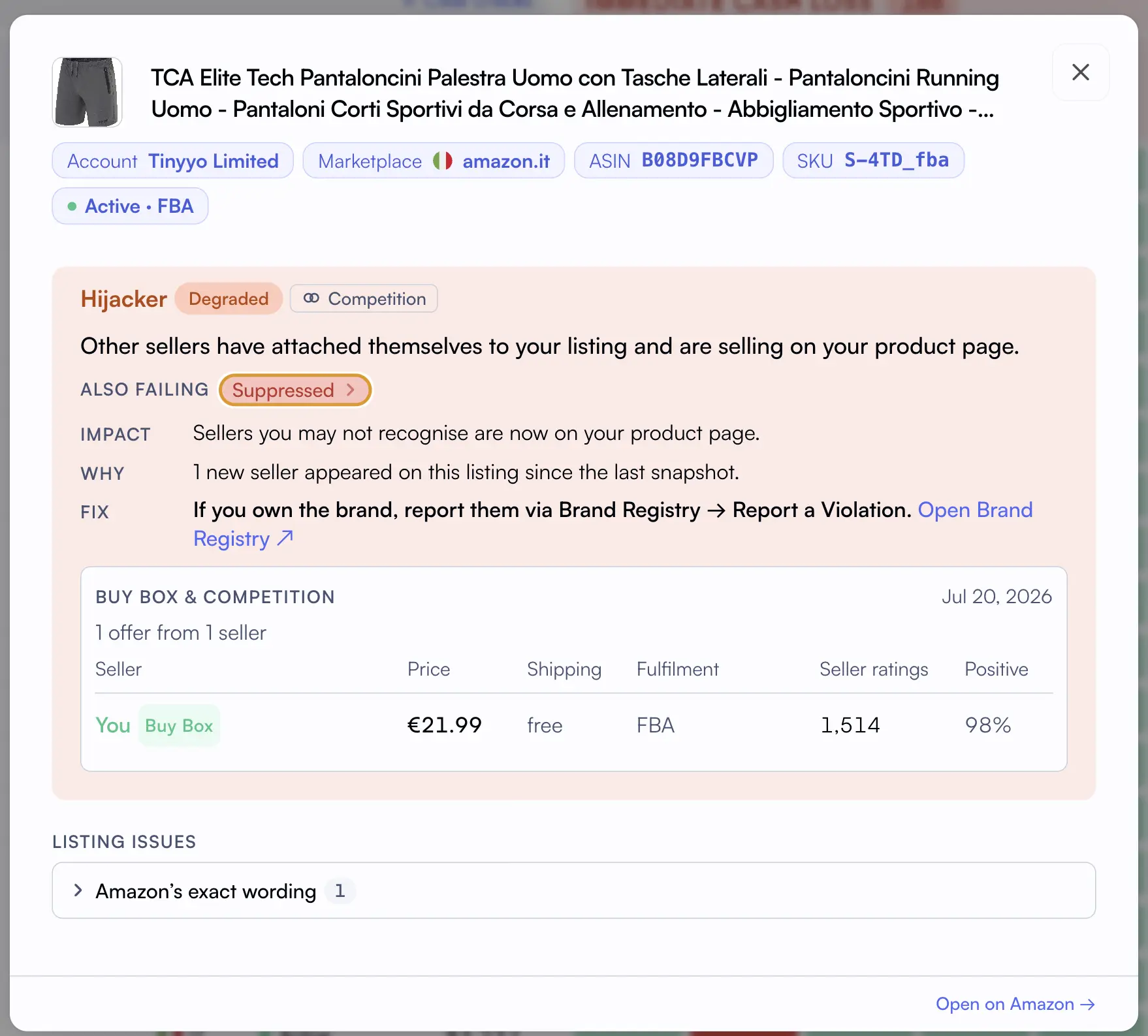
Listing Health Scanner surfaces the hijacker the same day the offer appears, with Buy Box share drop and price delta in one view.
The design intent is same-day, not weekly. Nova monitors offers, Buy Box share, and price per ASIN per marketplace, and raises a Listing Health Scanner alert when a new seller joins or takes the Buy Box. The alert is joined against the trailing SKU-level P&L so the on-call operator can see revenue at risk, not just a status change. Full context on the Listing Health Scanner feature page.
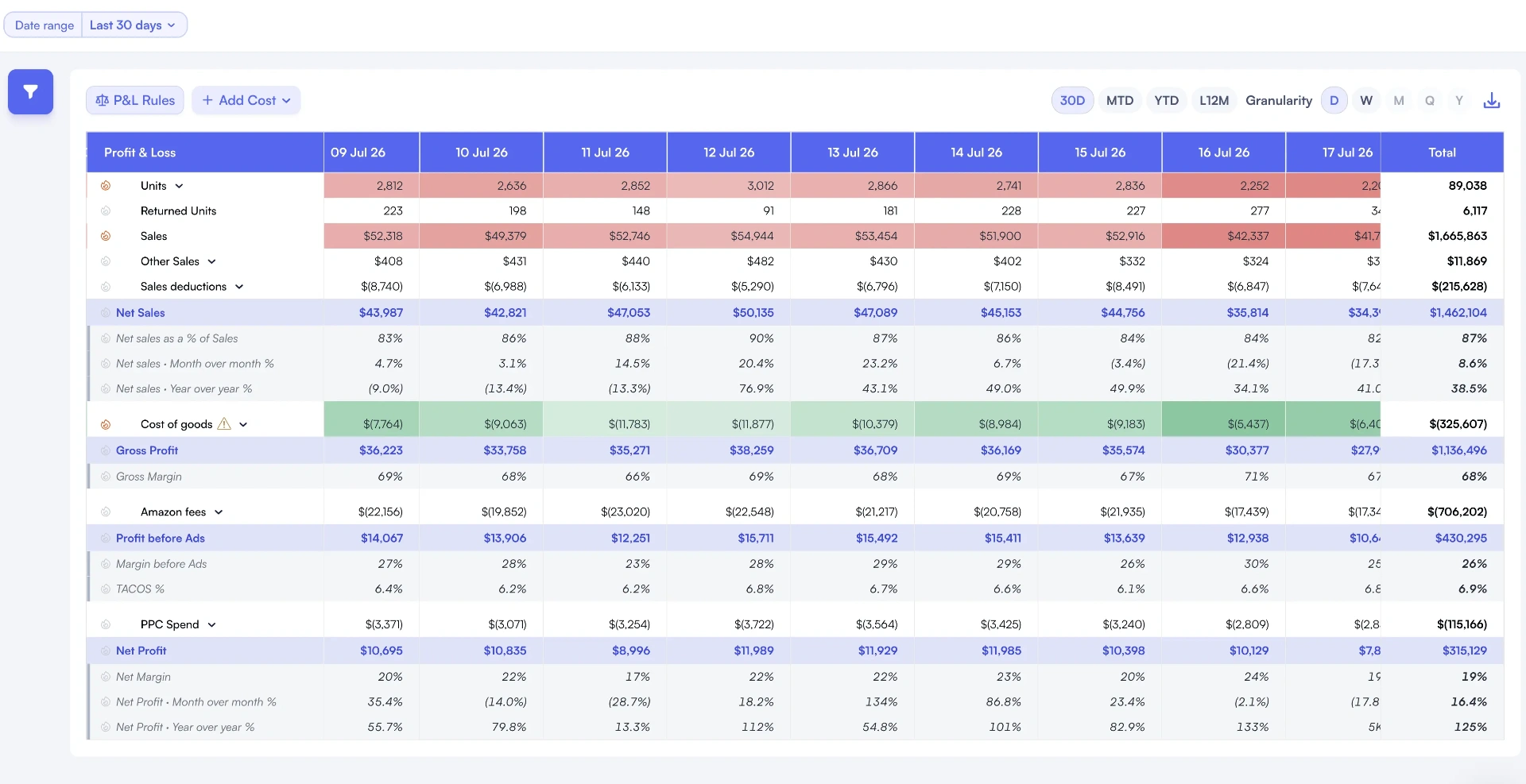
The revenue drop shows up in the daily P&L heatmap next to unchanged PPC spend, which is the fingerprint of a Buy Box event.
Prevention: what actually reduces hijacker frequency
Register the trademark and enroll Brand Registry. The single largest factor in takedown speed.
Enroll Transparency on high-value SKUs. Each unit gets a scannable code; Amazon rejects unscannable inventory at the FC, which kills gray-market and counterfeit paths.
Cut off supply channels that leak inventory. Most hijacker inventory comes from a small number of leaks. The audit is boring; the P&L impact is not.
Set a same-day monitoring alert. The most expensive hijacker is the one nobody noticed for a week.
A third-party seller who adds themselves to your ASIN without authorization, usually to steal the Buy Box with counterfeit, arbitrage, or gray-market units.
Sudden Buy Box loss on an ASIN you always won, price undercutting in More Buying Choices, and units shipping from a fulfillment center you didn't send to.
For anything durable, yes. Brand Registry unlocks the Report a Violation tool, which is the fastest path to remove infringing offers.
With Brand Registry and documented infringement, 24 to 72 hours. Complex cases (authorized reseller disputes, gray market) can run one to three weeks.
The bottom line
Hijacking is a Buy Box event dressed as a legal problem. Detect it same day, file the takedown through Brand Registry, and put same-day monitoring on the ASIN so the next one does not surface at the Monday review. Nova's Listing Health Scanner closes the detection gap; the takedown workflow is the piece you still run manually.
Ready to Transform Your Amazon Business?
Join thousands of successful sellers who use Nova Analytics to make data-driven decisions and maximize their profits.