Stranded FBA inventory keeps costing storage fees while it cannot be sold. Here is what causes it in 2026, the fix workflow sorted by exposure, and how to catch strands before the next storage cycle.
By MatthieuPublished Jul 20, 20268 minListing Health
Stranded inventory is FBA stock that cannot be sold because the listing is broken, deleted, blocked, or suppressed. The units keep accruing storage fees the whole time. On a mid-sized catalog, the aggregate cost typically shows up as a slow bleed inside the P&L that nobody attributes to a specific event. This guide covers what causes strands in 2026, how to fix them in priority order, and how to catch new ones before the next storage cycle.
In short
•Stranded inventory sits in an FBA warehouse without a live listing. Storage fees accrue; sales cannot happen.
•The 2026 triggers are: unresolved suppressions, deleted or merged parent variations, compliance blocks (GPSR, HAZMAT), and accidental SKU closures during catalog cleanups.
•US standard-size storage: $0.87/cubic foot Jan-Sep, $2.40/cubic foot Oct-Dec, plus long-term storage after 271 days at the FC.
•Fix workflow: sort by exposure (units × unit cost), resolve listing status on the top decile first, then file removals for units that will never sell.
•Detection is the real fix. Seller Central flags the state but not the P&L exposure; Nova's Listing Health Scanner surfaces both in one view.
Our take
If your stranded report is climbing
Pull the Stranded Inventory report, sort by units × unit cost, and work the top decile. Resolve the listing status where the SKU is worth relisting; file a removal order where it is not. Do not treat the report as a housekeeping task; the cost is compounding daily and long-term storage triggers at 271 days.
Best fit if
•FBA brands with 100+ ASINs across one or more marketplaces
•Operators or 3PLs closing month-end P&L who see storage creep without an obvious cause
•Finance teams sizing the working-capital hit before Q4 storage-fee peak
Skip if
•Sellers with under 20 ASINs who can eyeball the stranded tab weekly
•Brands who are 100 percent FBM (no FBA storage exposure)
Amazon marks inventory as "stranded" when units are physically in an FBA fulfillment center but no active listing points at them. The units keep accruing monthly storage fees, they are exposed to long-term storage surcharges once they cross 271 days, and they cannot generate revenue. Amazon documents the state and its causes in the Fix stranded inventory help article.
Fee math for US standard-size units: $0.87 per cubic foot per month January through September, $2.40 per cubic foot per month October through December. On a small-standard SKU (roughly 0.15 cubic feet packed) with 500 stranded units, that is $65/month in peak season plus long-term storage exposure after nine months. On a large-catalog brand, unaddressed strands run into thousands of dollars per month.
The four triggers that cause almost every strand in 2026
Unresolved suppression. A listing was suppressed for content or image compliance, the seller never republished, and the FBA units are now behind a dead listing. This is the single most common cause, covered in the suppression playbook.
Deleted or merged parent variation. A catalog cleanup deleted the child SKU or merged variations; the units at FBA still reference the old SKU that no longer resolves.
Compliance block. GPSR data missing for EU marketplaces, HAZMAT information missing, or a category-specific compliance flag that took the listing offline.
Accidental SKU closure. A bulk operations file with an unintended "Delete" or "Close" instruction. Common enough that Amazon's own Avoid stranded inventory article opens with it.
The fix workflow, in priority order
Export the Stranded Inventory report from Manage FBA Inventory.
Join it against unit cost to compute exposure per line: units × unit cost = capital tied up. Add a second column for units × monthly storage per unit = fee bleed per month.
Sort descending by exposure. Work the top 10 percent of lines first; the Pareto is extreme on stranded reports.
For each top-exposure line, choose one action: relist (fix the listing status and republish), file a removal order (dispose or return-to-vendor), or match the units to an existing live ASIN if the strand was caused by SKU deletion.
Set a 30-day re-check. Strands recur when the underlying trigger is not fixed at the source (catalog QA, GPSR data pipeline, ops process).
The removal order lag
Removal orders take 14 to 30 days to process, and Amazon keeps charging storage until the units physically leave the FC. That means the fee bleed continues on units you have already given up on. Factor the lag into your decision: on a slow-moving SKU with three months of long-term storage exposure ahead, the removal cost plus lag can still beat continuing to pay storage.
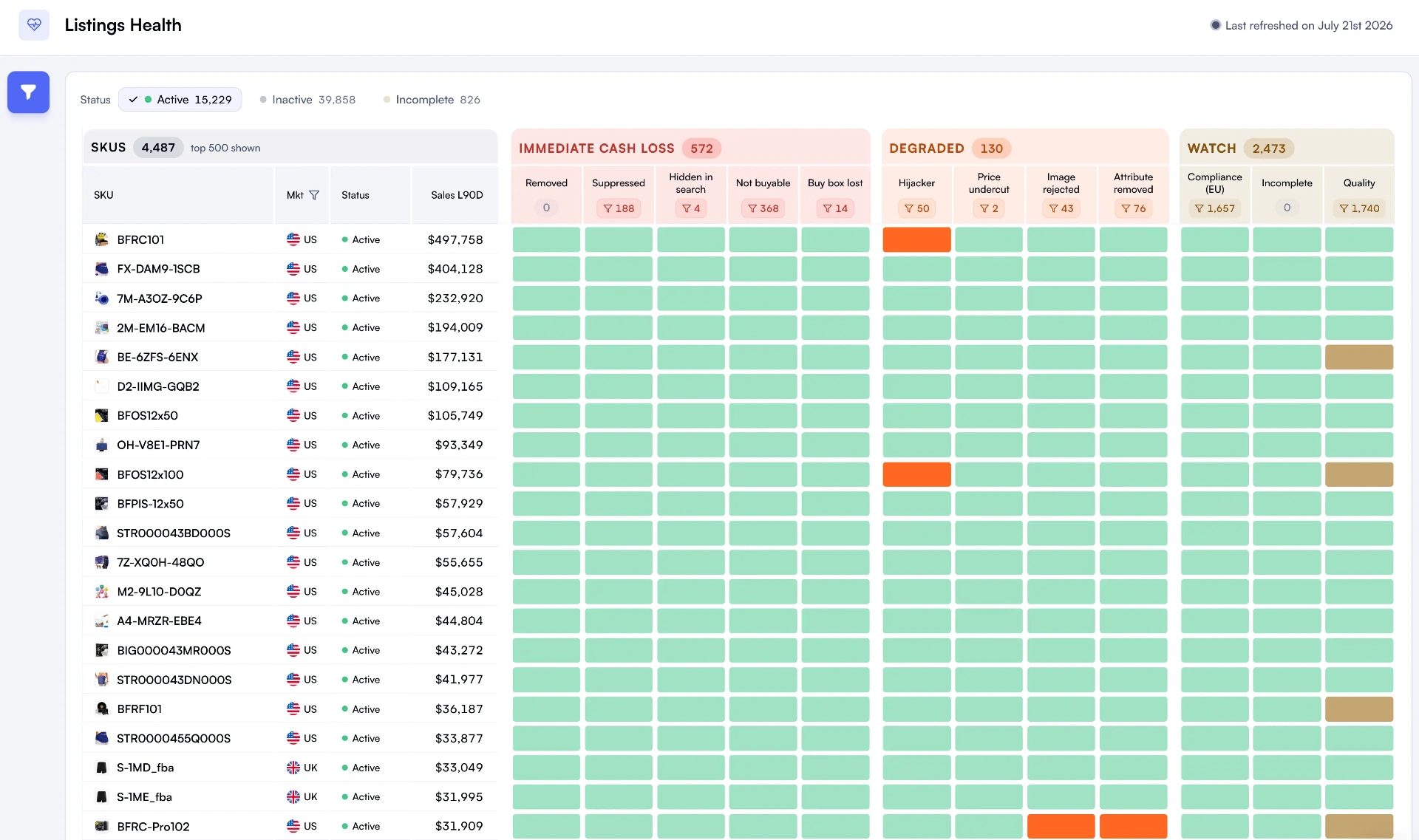
Listing Health Scanner flags stranded units per ASIN per marketplace with the storage-fee exposure computed alongside.
The design intent of Listing Health Scanner is to surface the state change on the day it happens, joined against the trailing P&L exposure so the operator sorts the queue by dollars, not by SKU. On a fresh catalog upload that accidentally strands 40 SKUs, the alert lands the same day and the decision (relist vs. remove) happens before the next monthly storage invoice.
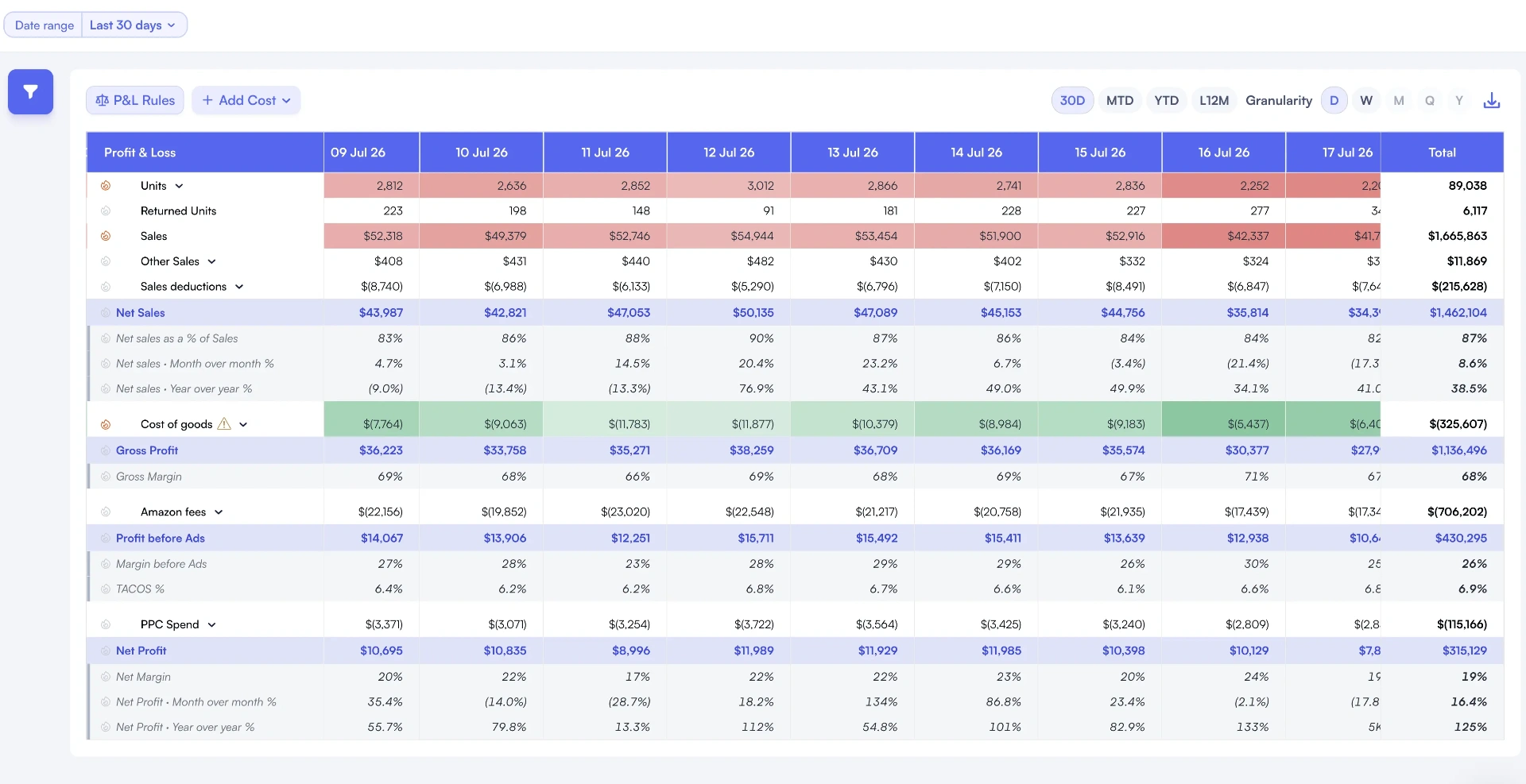
Daily P&L heatmap: storage fees on stranded SKUs isolate from the rest of the fee line, which is how the bleed becomes a decision instead of a footnote.
Prevention: what actually reduces strand rate
Catalog QA before every bulk upload. Reject files that close or delete SKUs with active FBA inventory unless flagged intentionally.
Same-day suppression alerting. Unresolved suppressions are the number-one strand cause; catching them fast prevents the downstream strand.
GPSR data pipeline that maintains manufacturer contact info per EU marketplace, so a compliance sweep does not strand units in DE, FR, IT, ES.
Quarterly SKU-lifecycle review. SKUs at end-of-life should be planned into removal, not orphaned.
Frequently asked questions
Units sitting in an FBA fulfillment center that no longer have an active listing to sell through. Storage fees keep accruing while the units cannot be purchased.
Most common: the ASIN was suppressed and never reactivated, a parent variation was deleted or merged, the listing was blocked for compliance, or the SKU was closed during a catalog cleanup.
Standard-size US storage runs $0.87 per cubic foot Jan-Sep and $2.40 Oct-Dec. On 500 units of a small standard SKU, roughly $30 to $80 monthly plus long-term storage after 271 days.
Sort by units times unit cost, resolve the listing status on the top-exposure SKUs first, and file removal orders for units that will never move. Removals take 14 to 30 days to process.
The bottom line
Stranded inventory is not a housekeeping task; it is a compounding storage-fee expense that peaks in Q4 and triggers long-term surcharges at nine months. Sort by exposure, fix the top decile, remove what will not sell, and put a same-day alert on the trigger. Nova's Listing Health Scanner closes the detection gap; the fix workflow is the piece you still run per SKU.