Amazon MCP servers compared: every server a seller can connect
Thirteen Amazon MCP servers, ranked by criterion instead of overall. Nova wins profit modelling, SQP, marketplace coverage and multi-account. Amazon Ads MCP wins write actions. The open source repos win on free. Sources and dates on every claim.
•Amazon now has two official AI routes: the Ads MCP server, and since 23 September 2026 the Selling Partner plugin for Amazon Quick (live, US) and Claude (beta, US). Neither holds your cost side.
•Ranked by criterion rather than overall. Nova wins profit modelling, Search Query Performance, marketplace coverage and multi-account. Amazon Ads MCP wins write actions today. The open source repositories win on free.
•Nova reconciles net profit per SKU after 40+ Amazon fee types, with your own COGS, FBM cost and VAT. No other server on this list models that.
•Free and self-hosted exists: community SP-API wrappers on GitHub. The most visible one had 43 stars and was last pushed in April 2025.
•Every claim below carries a source and a verified date, last checked 30 August 2026.
Thirteen servers an Amazon seller can connect this week. What each one reads, what it can change, and which one wins on the criterion you actually care about. Ecommerce platforms are covered further down; the money question here is Amazon.
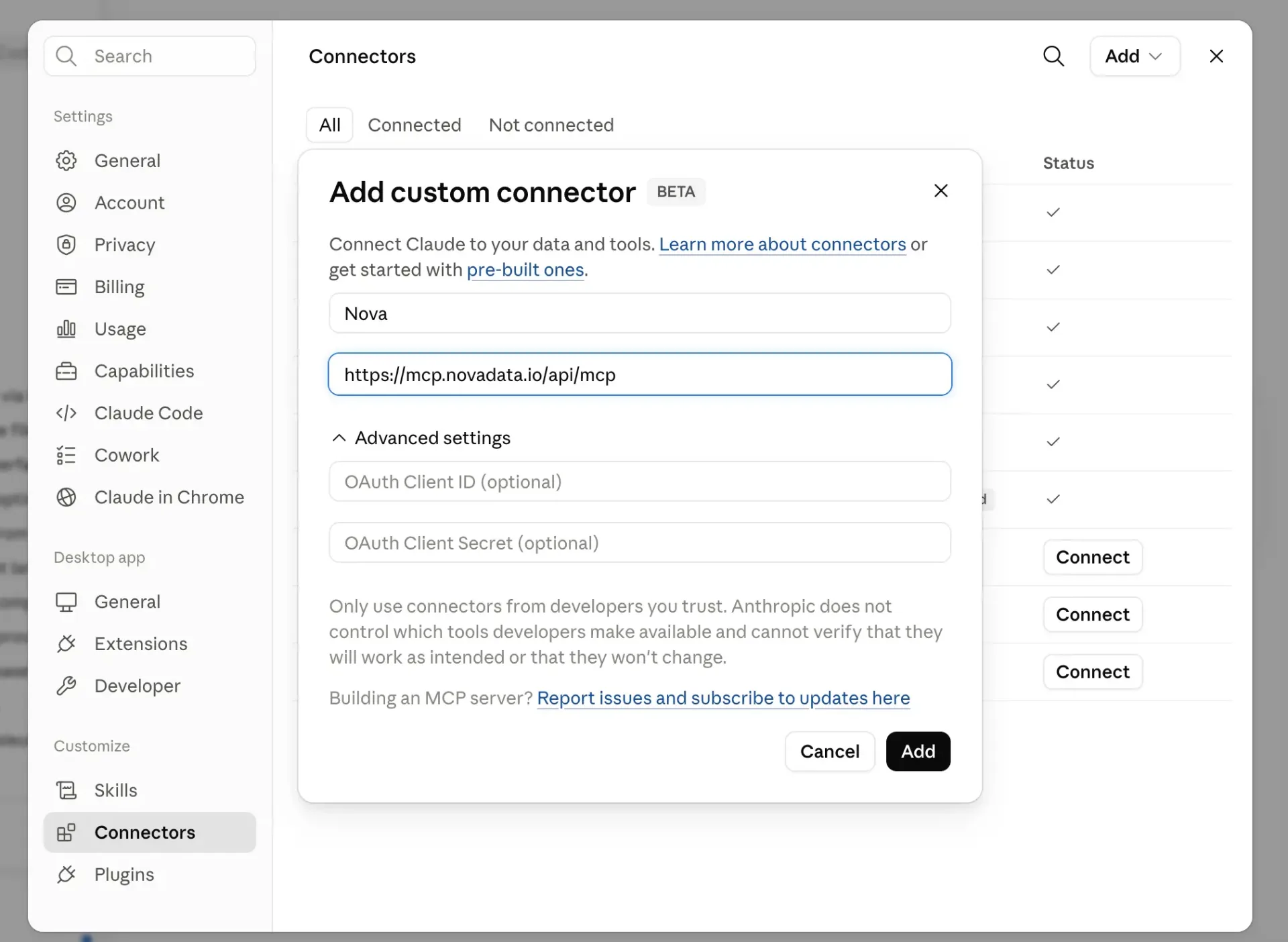
The custom connector links Claude to Nova for questions about your Amazon data.
The short answer
Your money, per SKU: Nova. Net profit after 40+ Amazon fee types, your COGS, your FBM costs, across 23 marketplaces. Search Query Performance too, which almost nobody else exposes. Write mode is in beta.
Changing campaigns today: Amazon's own Ads MCP server. Official, free, and it writes. Use it for execution.
Free and self-hosted: the community SP-API repositories on GitHub. No profit model, no maintenance either.
Market research, outside your account: SmartScout.
Test it in 5 minutes
1. Start a Nova trial. 14 days, no card.
2. Connect Seller Central with Amazon OAuth.
3. Paste one connector URL into Claude, ChatGPT, Gemini or Cursor.
4. Ask this, word for word:Which SKUs lost the most net profit versus last month, and why?
You get rows: SKU, profit change, and the fee, price or ad-spend line that moved it.
One overall ranking on a vendor's own page is worth nothing, so here is the ranking split by the thing you are buying for. Nova wins four rows. It loses two, and it loses them cleanly.
Deepest profit modelling
Nova
Net profit reconciled to the cent at SKU level across 40+ Amazon fee types, with your own COGS, FBM cost and VAT categories included.
Closest alternative: DataDoe models SKU profit but on daily tables and without your landed cost.
Search Query Performance
Nova
SQP exposed through the assistant, de-duplicated, with like-for-like period comparisons. Almost no other Amazon MCP exposes SQP at all.
Closest alternative: Helium 10 covers keyword and reverse-ASIN research, which is a different question.
Marketplace coverage and history
Nova
23 marketplaces in a single call, currency-normalised, with 24 months of backfilled history.
Closest alternative: Fluvi publishes broader marketplace coverage but not the history depth.
Agencies and multi-account
Nova
Several Seller Central accounts under one connection, one currency, one model, so a client question is one call rather than one call per account.
Closest alternative: Two Minute Reports puts Amazon beside other channels, but without the account economics.
Campaign write actions available today
Amazon Ads MCP
Amazon's own server, free, generally reachable with Ads API credentials, and it creates campaigns and moves bids today. Nova write mode is still in beta.
Closest alternative: PPC Assist and DataDoe also write, both third-party, both paid.
Free and self-hosted
Open source SP-API servers
No licence, no vendor, full control. You get raw endpoints and you maintain them.
Closest alternative: Amazon Ads MCP is also free, but scoped to advertising only.
Every server, entry by entry
Nova's entry is verified first-hand by introspecting the live server. Everything else comes from vendor documentation, the official MCP Registry or public repository metadata, and each entry says which. Nothing here was tested on a live competitor account.
40+ fee typesSKU-level profitBeta: Write modeVendor Central
Profit you cannot get elsewhere. Net profit per SKU after every Amazon deduction, reconciled to the cent across 40+fee types, with your own COGS and FBM costs inside the number. Every other server on this list either stops at account level or stops at what Amazon publishes.
Search Query Performance in the chat. De-duplicated, with like-for-like period comparisons. Ask which keyword lost share and get the answer, not a report to download.
Write actions with profit context, in beta. Amazon's server can move a bid but does not know your landed cost, so it cannot tell a profitable ACoS from an unprofitable one. A profit tool that cannot act leaves you doing the work by hand. Nova is building the combination, and write mode is in beta today, not shipped.
Your cost data, maintained by talking. COGS per SKU, FBM rates and VAT categories can be set and corrected through the MCP itself, in conversation. That is live now, and no competitor on this list offers it.
One call, not eight. Pre-aggregated, structured tables rather than raw payloads, so a question costs one low-token call instead of paging through orders, settlements and fees and joining them in the model.
The widest modeled Amazon layer on the market: SKU-level profit after every fee, PPC, search query performance, inventory, inbound and 3PL, listing health and BSR, joined in one model, plus live Vendor Central (1P) connections. Write mode is in beta.
•Net profit per SKU after every Amazon fee, plus your COGS and FBM costs
•PPC spend, ACoS, TACoS and search terms at product level
•Search Query Performance, de-duplicated, with like-for-like comparisons
•Inventory, days of cover, inbound shipments and 3PL
•Listing health, Buy Box state and BSR on your own ASINs
•23 marketplaces, 24 months of history, refreshed up to in real time on money metrics
Best for: Brands and agencies that want an assistant to answer any Amazon question, from which SKU is losing money after fees to which keyword is worth the bid.
Weakness: Write mode is in beta rather than generally available.
Source: Live tool and metric introspection, plus novadata.io documentation. Verified 30 August 2026.
F
Fluvi
Data server
A read layer across nine data domains, including sales, profit, ads, inventory, orders, returns, shipments and keywords.
DetailsHide details
Best for: Sellers who want a single flat price with operations coverage included on every plan.
Weakness: Fee modeling depth and aggregation guards are not published, so you cannot tell in advance how a margin figure is built.
Source: fluvi.com/mcp. Verified 30 August 2026.
H
Helium 10
Research server
A large tool surface across keyword research, reverse ASIN, product research, rank tracking and listing analysis, plus an account-level profit breakdown.
DetailsHide details
Best for: Keyword and product research inside an assistant.
Weakness: The profit breakdown is account level, not SKU level, so it cannot answer which product is actually losing money after fees.
Source: Vendor documentation and public repository, July 2026. Verified 30 August 2026.
D
DataDoe
Action server
Read and write across Seller Central, Vendor Central and Ads, with previews and approvals gating every write.
DetailsHide details
Best for: Teams that want the assistant to execute, and 1P sellers who need Vendor Central coverage.
Weakness: Tables refresh daily, so intraday questions read yesterday's account.
Source: datadoe.com MCP documentation. Verified 30 August 2026.
S
SmartScout
Research server
Read-only market research across products, brands, sellers, subcategories, search terms and ad spy.
DetailsHide details
Best for: Wholesale and online arbitrage sourcing, brand and category mapping.
Weakness: It reads the market, not your account, so it cannot answer a profit or inventory question.
Source: smartscout.com MCP announcement and partner documentation. Verified 30 August 2026.
A
Amazon Ads MCP
Action server
Amazon's own server for advertising: campaigns, Sponsored Products, Sponsored Brands, Sponsored Display, DSP and AMC, including creation and bid management.
DetailsHide details
Best for: Executing advertising changes from an assistant.
Weakness: Scoped to advertising. It cannot see inventory, real margin after fees, Buy Box state or organic rank, so an ads-only agent will happily push spend into a SKU that is unprofitable or about to stock out.
Source: advertising.amazon.com open beta announcement, February 2026. Verified 30 August 2026.
S
Sellerboard
Data server
Reported to be in closed beta as of August 2026. No public endpoint or documentation is available, so nothing here is stated as fact.
DetailsHide details
Best for: Not assessable yet.
Weakness: Nothing published to evaluate. If this is wrong, tell us and we will update the page.
Source: Single unverified public post, August 2026. Verified 30 August 2026.
Also on the market
Servers a seller will find when searching, read from vendor pages, the official MCP Registry or GitHub. None were tested first-hand, and each entry says where its facts came from.
A
AgentCentral
Data server
A hosted Seller Central and Amazon Ads server, published in the official MCP Registry under to.agentcentral/amazon-seller-central. The vendor page describes scoped access to Ads, inventory, orders, catalog, rankings, finance and fulfillment after Amazon OAuth, with retained history.
DetailsHide details
Best for: Sellers and agencies who want a hosted Seller Central connection without running anything.
Weakness: Fee reconciliation depth and refresh interval are not published, so you cannot tell how a margin figure is built. Not tested first-hand.
Source: Official MCP Registry entry and agentcentral.to vendor page. Verified 7 September 2026.
P
PPC Assist
Action server
An Amazon Ads and Seller Central server. The vendor page states 50+ tools exposed to Claude, ChatGPT, Cursor and other MCP clients, covering reading performance, editing strategies and rules, proposing changes and executing them.
DetailsHide details
Best for: Advertising teams who want the assistant to propose and then execute campaign changes.
Weakness: Built around advertising workflows. SKU-level profit after every Amazon fee is not published as part of the model. Not tested first-hand.
Source: ppcassist.com/solutions/mcp vendor page. Verified 7 September 2026.
S
Seller Labs
Data server
A read server over Amazon account data, positioned around replacing report and spreadsheet work. The vendor page gives Buy Box share loss by ASIN as an example question.
DetailsHide details
Best for: Existing Seller Labs customers who want their account data inside an assistant.
Weakness: Tool count, refresh interval, marketplace coverage and fee modelling depth are not published. Not tested first-hand.
Source: sellerlabs.com/amazon-mcp vendor page. Verified 7 September 2026.
Z
Zapier MCP
Action server
Zapier exposes its Amazon Seller Central connector over MCP, so an assistant can trigger the same Seller Central actions a Zap can. It is an automation bridge rather than an analytics model.
DetailsHide details
Best for: Teams already running Zapier who want an assistant to fire existing Seller Central actions.
Weakness: No modelled P&L, no fee attribution, no analytics layer. You get the actions the connector supports, nothing more. Not tested first-hand.
Source: zapier.com/mcp/amazon-seller-central product page. Verified 7 September 2026.
T
Two Minute Reports
Data server
A reporting platform whose MCP server covers Amazon Seller Central alongside 30+ other marketing sources. A separate Seller Central specific server is published on GitHub, created April 2026.
DetailsHide details
Best for: Operators who want Amazon sitting next to ad platforms and GA4 in one reporting connection.
Weakness: Amazon is one source among many rather than the modelled centre, and the Seller Central repository has almost no public traction. Not tested first-hand.
Source: twominutereports.com/mcp, mcpservers.org listing and the public GitHub repository. Verified 7 September 2026.
O
Open source SP-API servers
Data server
Community repositories that wrap Selling Partner API endpoints as MCP tools. The most visible, mattcoatsworth/AmazonSeller-mcp-server, had 43 stars and was last pushed in April 2025 when we checked.
DetailsHide details
Best for: Developers who want a free, self-hosted starting point and are happy to maintain it.
Weakness: Unmaintained, no profit modelling, no aggregation guards, and you carry the SP-API credentials, rate limits and upgrades yourself.
Source: GitHub repository metadata, read via the GitHub API. Verified 7 September 2026.
Checked and left out: SellerPPC. It is a real Amazon PPC automation product, but we found no MCP server page or documentation for it, so it does not belong on a list of servers you can connect. If that changes, tell us and we will add it.
Give your AI assistant every Amazon number
Nova MCP exposes SKU-level profit after fees, PPC and search terms, inventory, inbound and listing health across 23 marketplaces, and write mode (in beta) lets the assistant act on them. Connect Seller Central once.
The Model Context Protocol is an open standard for connecting AI assistants to external systems. A server publishes a set of tools with typed inputs; the assistant reads the tool list, decides which one answers the question in front of it, calls it, and reasons on what comes back. The specification and a reference server collection are public on the protocol documentation site and in the modelcontextprotocol/servers repository, which is where most of the ecosystem started.
The important consequence for operators: the assistant is no longer limited by what you remembered to paste into the chat. It is limited by what the server exposes, and by how usable that data is once it arrives.
Data servers, action servers, and the one that does both
Every ecommerce MCP server falls into one of two jobs, and confusing them is the most common reason a first connection disappoints.
Data servers read a modeled view of your business: revenue, margin, fees, stock cover, keyword efficiency. This is where the decision gets made.
Action servers change something: create a campaign, adjust a bid, confirm a shipment. Amazon's Ads MCP server is the reference example.
Until now you needed one of each. Nova closes that gap: it is the widest data server on the market, and write mode, in beta today, turns the same connection into an action server. That is the trajectory that puts an Amazon business on autopilot: one assistant, one connection, answers and execution on the strength of the data model underneath.
Multi-channel brands often add a platform server too, such as the storefront server documented in the Shopify developer docs, which is why two or three connections enabled at once is normal.
The comparison, criterion by criterion
Every cell reflects what the vendor publishes, or what we saw by connecting. Last verified 30 August 2026. Where a vendor publishes nothing, the cell says so instead of guessing.
Criterion
Nova
Fluvi
Helium 10
DataDoe
SmartScout
Amazon Ads MCP
Sellerboard
Category
Data, plus write in beta
Data
Research
Action
Research
Action
Reported data
SKU-level net profit after feesNot account level. Per product, after every Amazon deduction and your own costs.
Guards against wrong aggregationsWhether the tool layer stops the assistant summing figures that must not be summed.
Yes: SQP de-duplication, FNSKU pool warnings, separate metric namespaces, calendar alignment
Not published
Not published
Not published
Not published
Not published
Not published
Inbound shipments and 3PL
Yes
Yes
No
Not published
No
No
Not published
Refresh
Orders and units reach Nova within seconds of the sale, with sales estimated until Amazon confirms the exact amounts. Ad spend refreshes every two hours, search term data three times a day, Amazon finance transactions hourly, and the remaining reports daily.
Live queries
Live queries
Daily tables
Market dataset
Live queries
Not published
Writes to your Amazon account
Yes, in beta
No
No
Yes, preview and approval gated
No
Yes
Not published
Vendor Central (1P)
Yes
No
No
Yes
No
No
Not published
Marketplaces
21
23
Not published
Not published
Not published
Global, Ads API scope
Not published
How you get in
OAuth, 14-day trial, no card
OAuth, included on every plan
OAuth, top plan only
OAuth, single paid plan
Custom connector, higher tiers
Amazon Ads API credentials
Closed beta, reported
Source
Live tool and metric introspection, plus novadata.io documentation
fluvi.com/mcp
Vendor documentation and public repository, July 2026
datadoe.com MCP documentation
smartscout.com MCP announcement and partner documentation
advertising.amazon.com open beta announcement, February 2026
Yes: SQP de-duplication, FNSKU pool warnings, separate metric namespaces, calendar alignment
Inbound shipments and 3PL
Yes
Refresh
Orders and units reach Nova within seconds of the sale, with sales estimated until Amazon confirms the exact amounts. Ad spend refreshes every two hours, search term data three times a day, Amazon finance transactions hourly, and the remaining reports daily.
Writes to your Amazon account
Yes, in beta
Vendor Central (1P)
Yes
Marketplaces
21
How you get in
OAuth, 14-day trial, no card
Source: Live tool and metric introspection, plus novadata.io documentation. Verified 30 August 2026.
Fluvi
Category
Data
SKU-level net profit after fees
Yes
Ads, organic search and inventory in one model
Yes, plus shipments and 3PL
Guards against wrong aggregations
Not published
Inbound shipments and 3PL
Yes
Refresh
Live queries
Writes to your Amazon account
No
Vendor Central (1P)
No
Marketplaces
23
How you get in
OAuth, included on every plan
Source: fluvi.com/mcp. Verified 30 August 2026.
Helium 10
Category
Research
SKU-level net profit after fees
Account level only
Ads, organic search and inventory in one model
Research first, partial account data
Guards against wrong aggregations
Not published
Inbound shipments and 3PL
No
Refresh
Live queries
Writes to your Amazon account
No
Vendor Central (1P)
No
Marketplaces
Not published
How you get in
OAuth, top plan only
Source: Vendor documentation and public repository, July 2026. Verified 30 August 2026.
DataDoe
Category
Action
SKU-level net profit after fees
Yes
Ads, organic search and inventory in one model
Yes, six Amazon APIs unified
Guards against wrong aggregations
Not published
Inbound shipments and 3PL
Not published
Refresh
Daily tables
Writes to your Amazon account
Yes, preview and approval gated
Vendor Central (1P)
Yes
Marketplaces
Not published
How you get in
OAuth, single paid plan
Source: datadoe.com MCP documentation. Verified 30 August 2026.
SmartScout
Category
Research
SKU-level net profit after fees
No
Ads, organic search and inventory in one model
Market data only
Guards against wrong aggregations
Not published
Inbound shipments and 3PL
No
Refresh
Market dataset
Writes to your Amazon account
No
Vendor Central (1P)
No
Marketplaces
Not published
How you get in
Custom connector, higher tiers
Source: smartscout.com MCP announcement and partner documentation. Verified 30 August 2026.
Amazon Ads MCP
Category
Action
SKU-level net profit after fees
No
Ads, organic search and inventory in one model
Advertising only
Guards against wrong aggregations
Not published
Inbound shipments and 3PL
No
Refresh
Live queries
Writes to your Amazon account
Yes
Vendor Central (1P)
No
Marketplaces
Global, Ads API scope
How you get in
Amazon Ads API credentials
Source: advertising.amazon.com open beta announcement, February 2026. Verified 30 August 2026.
Sellerboard
Category
Reported data
SKU-level net profit after fees
Not published
Ads, organic search and inventory in one model
Not published
Guards against wrong aggregations
Not published
Inbound shipments and 3PL
Not published
Refresh
Not published
Writes to your Amazon account
Not published
Vendor Central (1P)
Not published
Marketplaces
Not published
How you get in
Closed beta, reported
Source: Single unverified public post, August 2026. Verified 30 August 2026.
The gap nobody fills by accident
Amazon's official routes now cover advertising and, since 23 September 2026, listings, inventory and sales through the Selling Partner plugin (US stores). Amazon does not hold your cost of goods, freight, duties or VAT treatment, so profit after those costs is the question the official routes cannot answer.
Is there an official Amazon SP-API MCP server?
Partly, since 23 September 2026. Amazon publishes an official MCP server for advertising, in open beta since February 2026, and it can create campaigns and move bids. It also launched a Selling Partner plugin, live in Amazon Quick for US-store sellers and in beta with Claude (US stores, waitlist, Professional selling plan), which Amazon says pulls listings, inventory levels and sales analytics. Amazon has not said the plugin covers stores outside the US, and it does not hold your cost of goods, freight, duties or VAT. Profit after those costs still comes from a third party or a wrapper you host yourself.
That is the whole shape of this market. The official routes can see your Amazon account but not your costs. The third-party servers can see, and only some can act.
Free and open source Amazon seller MCP servers
There are free options, and they are honest about what they are. Community repositories wrap Selling Partner API endpoints as MCP tools. The most visible one, mattcoatsworth/AmazonSeller-mcp-server, had 43 stars and was last pushed in April 2025 when we checked its GitHub metadata on 7 September 2026. Two Minute Reports also publishes a Seller Central repository, created April 2026.
What you get: raw endpoints, no licence fee, full control. What you carry: SP-API credentials, rate limits, breaking changes, and the fact that none of these model profit. An unmaintained wrapper is a fine weekend project and a poor foundation for a decision about restocking.
Amazon's Ads MCP server is the other genuinely free option, and it is maintained by Amazon. It is scoped to advertising.
Ecommerce beyond Amazon
Multi-channel brands usually add a platform server next to the Amazon one. Two or three connections enabled at once is normal, and they answer different questions: the platform server knows the storefront, the Amazon server knows the marketplace economics. Each of these was checked against its own documentation.
Storefront MCP
Shopify
Read, with write tools
Catalog search, cart operations and storefront context for agents shopping a Shopify store.
Gap: Storefront-facing. Not a merchant finance or margin layer.
Some Amazon figures must never be summed. Search query volume repeats on every parent ASIN that ranks on it. FBA quantities share pools across SKUs. A good server refuses those additions in the tool contract rather than trusting the model to know. Four guards built into Nova:
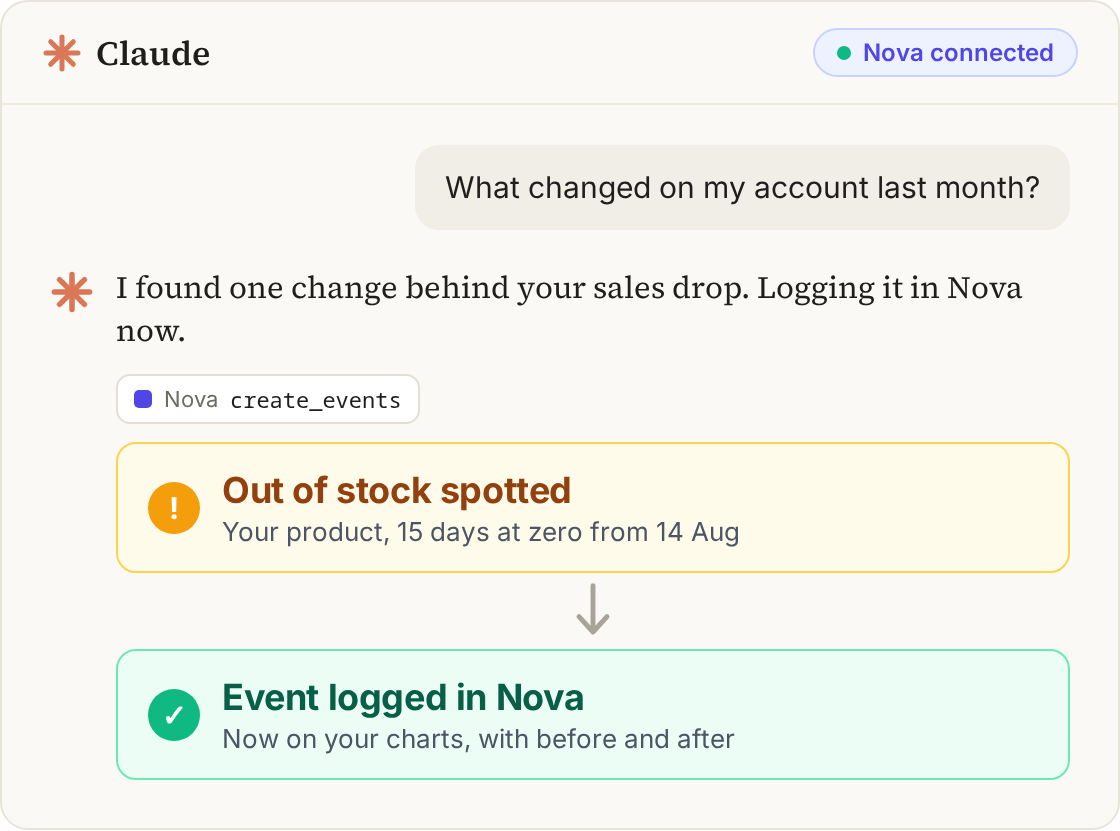
A connected Claude conversation can pair an analysis with an event to revisit.
Search volume, de-duplicated
Naively summing search query rows overstates demand by roughly 2.4x. Nova returns the de-duplicated total.
Like-for-like comparisons
Year on year is computed only over keywords present in both periods. Raw totals can read +34% where the truth is -3%.
Calendars aligned
Amazon search weeks start Sunday, ad weeks start Monday. Nova states the exact days each period covers.
Pools and namespaces separated
Shared FBA pools are flagged, and product, ads and search metrics stay in separate universes so nothing cross-sums.
How to judge a server before you connect it
Five questions separate a server you still use in three months from one you disable after a week.
01
Does it join the data, or hand over silos?
Profit is orders minus every Amazon fee minus your landed cost minus ad spend. A server that returns each of those from a different endpoint pushes the join into the model, which is exactly where it goes wrong.
02
Does it stop the assistant computing a wrong number?
Some Amazon figures must never be summed. Search query volume repeats on every parent ASIN that ranks on it. FBA quantities share pools across SKUs. A good server refuses those additions in the tool contract rather than trusting the model to know.
03
How fresh is the answer?
Daily tables are fine for a monthly review and useless for a stock-out call at 4pm. Ask what the refresh interval is on money metrics specifically, not on the dataset as a whole.
04
Read, or read and write?
A read server informs the decision. An action server executes it. They are not competing products, and most people running assistants daily end up with one of each.
05
Auth and auditability
OAuth with revocable per-account credentials is the baseline. Beyond that, ask whether calls are logged with the reason they were made. Anyone handling client data will be asked this eventually.
Cost is the one people underestimate. A thin API wrapper often needs eight to twenty calls, because the assistant has to page through orders, then settlements, then fees, then join them itself. Amazon also enforces per-operation rate limits, documented in the SP-API usage plans reference, so those calls get slower exactly when the date range gets interesting.
What each category of ecommerce MCP server actually covers
Profit, pricing and inventory decisions, then execution
Amazon Ads MCP (first-party)
Sponsored ads campaigns, bids, reporting
Both
Executing ad changes from chat
Shopify MCP (first-party)
Storefront catalog, cart, store data
Read plus commerce actions
Shopify-native storefront workflows
Research servers
Brands, sellers, categories, competitor keywords
Read
Sourcing and market mapping
Community SP-API wrappers
Raw Selling Partner API endpoints
Read, sometimes write
Developer experiments
Which should you connect?
Find yourself in the left column. Where a competitor is the right answer, it says so.
Private label brand, 7 to 8 figures
Nova, the data + action MCP
The question you ask most is which product is actually making money after fees, and then what to do about it. Nova answers it from one joined data model, and write mode, in beta, lets the assistant carry out the decision too.
Agency or aggregator, many client accounts
Nova
One connection covers every client account, scoped per client, with each call recorded alongside the reason it was made. That is the part a client will ask about.
Wholesale or online arbitrage
SmartScout, plus Nova once your own catalogue matters
Your first question is about the market, not your P&L. Use a research server for sourcing, and add a data server when margin per SKU starts driving decisions.
Vendor Central (1P)
DataDoe
DataDoe covers Vendor Central today. Nova Vendor Central support is live, so you can run both 1P and 3P in one workspace.
Ads-only operator
Amazon Ads MCP, plus Nova as the guard rail
An ads-only agent cannot see margin, stock cover or Buy Box state, so it will bid confidently on a SKU that loses money or is about to run out. The read layer is what stops that.
Our take
Which MCP server should you connect first?
Connect the server that carries your own numbers and can act on them. Nova reads the whole business, and write mode, in beta, lets the assistant execute as well.
Best fit if
•Sellers who make daily pricing, restock or ad-budget calls
•Agencies reporting on several accounts at once
•Teams already using Claude, ChatGPT or Gemini for analysis
Skip if
•Developers who only need raw endpoint access for a build
•Operators whose only question is campaign execution, where the Ads MCP alone is enough
Two things are changing fast. First, client support is converging: remote MCP servers now work across the major assistants, so vendors ship one endpoint rather than one integration per model. Second, the competition is moving from "do you have an MCP" to "how good is your data model", because every vendor can expose tools and very few can expose a reconciled P&L. Read and write are converging too: the servers that win are the ones that answer the question and then carry out the decision.
What operators ask before connecting the first server
An MCP server is a program that exposes data or actions as tools an AI assistant can call. The Model Context Protocol is the open standard that defines how the assistant discovers those tools and calls them. For ecommerce operators it means an assistant can query live store, ad or marketplace data inside a normal conversation instead of reading a pasted export.
Start with the server that carries your own account economics, because that is the layer every decision is made on: profit after fees, PPC, inventory. Nova covers that in one connection, and its write mode, in beta, lets the assistant act on the answer as well. Amazon's Ads MCP remains a useful complement for heavy advertising execution.
Amazon runs an official MCP server for advertising, in open beta since February 2026. It covers campaigns, Sponsored Products, Sponsored Brands, Sponsored Display, DSP and AMC, and it can write. On 23 September 2026 Amazon launched its Selling Partner plugin, live in Amazon Quick for US-store sellers and in beta with Claude (US stores only, waitlist, Professional selling plan). Amazon says it pulls listings, inventory levels and sales analytics. Amazon does not hold your cost of goods, freight, duties or VAT treatment, so profit after those costs still comes from third-party servers.
Yes, two kinds. Amazon's own Ads MCP server is free but scoped to advertising. Amazon has not stated a fee for its Selling Partner plugin (23 September 2026), which is limited to US stores. Community SP-API wrappers on GitHub are free and self-hosted, and you carry the credentials, the rate limits and the maintenance. None of them models profit after your own costs, so neither answers which SKU is losing money.
Community wrappers are published as public repositories. The most visible, mattcoatsworth/AmazonSeller-mcp-server, had 43 stars and was last pushed in April 2025 when we checked on 7 September 2026. Two Minute Reports publishes a Seller Central repository created in April 2026. Treat them as starting points rather than maintained products.
This page lists thirteen a seller can connect today: Nova, Fluvi, Helium 10, DataDoe, SmartScout, Amazon Ads MCP, AgentCentral, PPC Assist, Seller Labs, Zapier MCP, Two Minute Reports, the open source SP-API repositories, and Sellerboard which is reported in closed beta. The official MCP Registry lists further Amazon-related servers focused on scraping and product research rather than seller accounts.
Sellerboard is reported to be in closed beta as of August 2026. We found no official page, documentation or endpoint, so we do not state it as fact. Community scrapers that circulate are third-party tools, not an official server.
Some can. Nova write mode is in beta, so a connected assistant can read your numbers and act on them. Amazon Ads MCP and DataDoe also write, with DataDoe gating writes behind a preview and an approval. Fluvi, Helium 10 and SmartScout are read only.
MCP started at Anthropic but it is an open standard, and remote MCP servers now work across Claude, ChatGPT, Gemini and developer clients such as Cursor. A remote server exposed over HTTP is reachable from any client that speaks the protocol.
Method and changelog, last verified 30 August 2026
Page last updated 7 September 2026. Nova's entry is verified first-hand by introspecting the live server. Other entries come from vendor documentation, the official MCP Registry and public repository metadata, never from testing a competitor account. Where a vendor publishes no figure, the cell says "not published" rather than an estimate. Reviewed quarterly, and corrections from vendors are welcome.
30 August 2026: First publication. All vendors reviewed, Nova verified first-hand by introspecting the live server. Nova rows reflect inbound and 3PL coverage, with write mode in beta and Vendor Central (1P) live. Sellerboard listed as reported only.
7 September 2026: Re-targeted the page on Amazon seller MCP servers. Added AgentCentral, PPC Assist, Seller Labs, Zapier MCP, Two Minute Reports and the open source SP-API repositories, each from vendor documentation, the official MCP Registry or GitHub metadata rather than first-hand testing. Replaced the single overall ranking with a ranking by criterion, in which Nova loses the write-actions row to Amazon Ads MCP and the free row to the open source servers. SellerPPC was checked and left out: no MCP offering could be verified. Merged the Nova-specific comparison article into this page and redirected it.
Ready to Transform Your Amazon Business?
Join thousands of successful sellers who use Nova Analytics to make data-driven decisions and maximize their profits.