
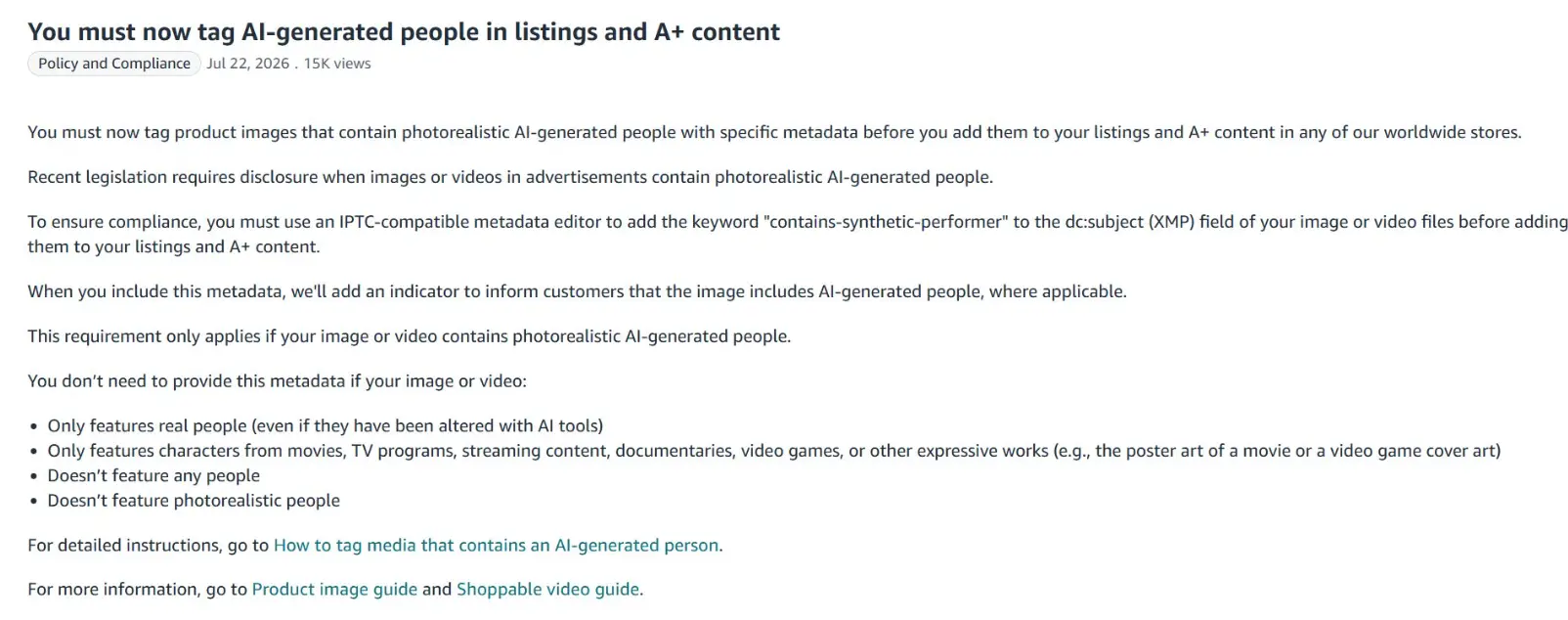
Amazon requires sellers to label AI-generated people in images after NY law
 Claude
 Gemini
 ChatGPT
Quick Summary
- •Amazon requires labeling of AI-generated people in listing photos and videos, marketplace-wide
- •Driven by New York S.8420-A synthetic-performer disclosure law (effective June 9, 2026)
- •A+ Content and Brand Stories are in scope, not just main and secondary images
- •Action: inventory AI-generated assets by ASIN, label them, hold a control cohort and watch conversion for two weeks
Nova surfaces every Amazon fee, refund, and margin shift in your live P&L, across 23 marketplaces. Open the live P&L
The 3-line summary
Amazon is now requiring third-party sellers to label any product photo or video that features an AI-generated person, in response to a New York transparency law that took effect earlier this summer (CNBC, July 23, 2026).
The underlying statute is New York S.8420-A, which mandates disclosure whenever a "synthetic performer" replaces a human actor in advertising shown to New York audiences (Parker-Lambert, June 2026). Amazon is applying the rule marketplace-wide rather than by shopper geography, so any listing that surfaces to a New York shopper effectively has to comply.
Why sellers should care
AI-generated lifestyle models became the default cost-saver in 2025 and 2026. A single mid-tier private-label brand can save $8k to $15k a season by swapping studio talent for prompt-based synthetic models. That maths only works while the listing continues to convert. Adding a visible "AI" tag to a lifestyle image is a real trust variable, especially in apparel, beauty and baby, where the model face carries most of the click.
The policy also drags A+ Content and Brand Stories into scope. Any brand that quietly rebuilt its secondary images with generative pipelines in the last 12 months now owes an audit before the marketplace does it for them.
The 7-day plan
- Inventory every image asset by ASIN. Split main image, secondary lifestyle, A+ modules, Brand Story panels. Flag anything produced with a generative model in the last 18 months.
- Apply the AI-generated label on any asset that includes a synthetic person, following the Seller Central image guidance updated this month.
- Hold a control cohort of 10 to 20 ASINs with the label off (categories with no synthetic model) and measure daily conversion delta on the labeled cohort in the two weeks following the change.
- Rework the main image first if labeled conversion drops more than 5%. Swap synthetic models for real product-on-white or real UGC before touching secondary assets.
How Nova helps
- Day-to-Day Analytics - track sessions, unit-session ratio and conversion by ASIN daily, so an AI-label drop shows up as a real trend, not a hunch.
- Listing Health Scanner - flag listings where a conversion collapse coincides with an image update, so the audit list stays short and focused on real revenue impact.
Frequently Asked Questions
Common questions about this topic
Verified Sources
- CNBC: Amazon makes sellers label AI-generated people in images after NY law (July 23, 2026)
- Parker-Lambert: New York's AI Disclosure Law is Live, What DTC Brands Need to Know (June 2026)
All information verified from official Amazon sources and trusted industry analysts as of publication date.