There is no public Vendor Central rate card. Your bill is the gap between what you invoice Amazon and what Amazon pays, split between deductions on the invoices and further deductions on its payments. Here is how to read each line, separate a cost from money still owed, and see what your vendor terms actually leave you.
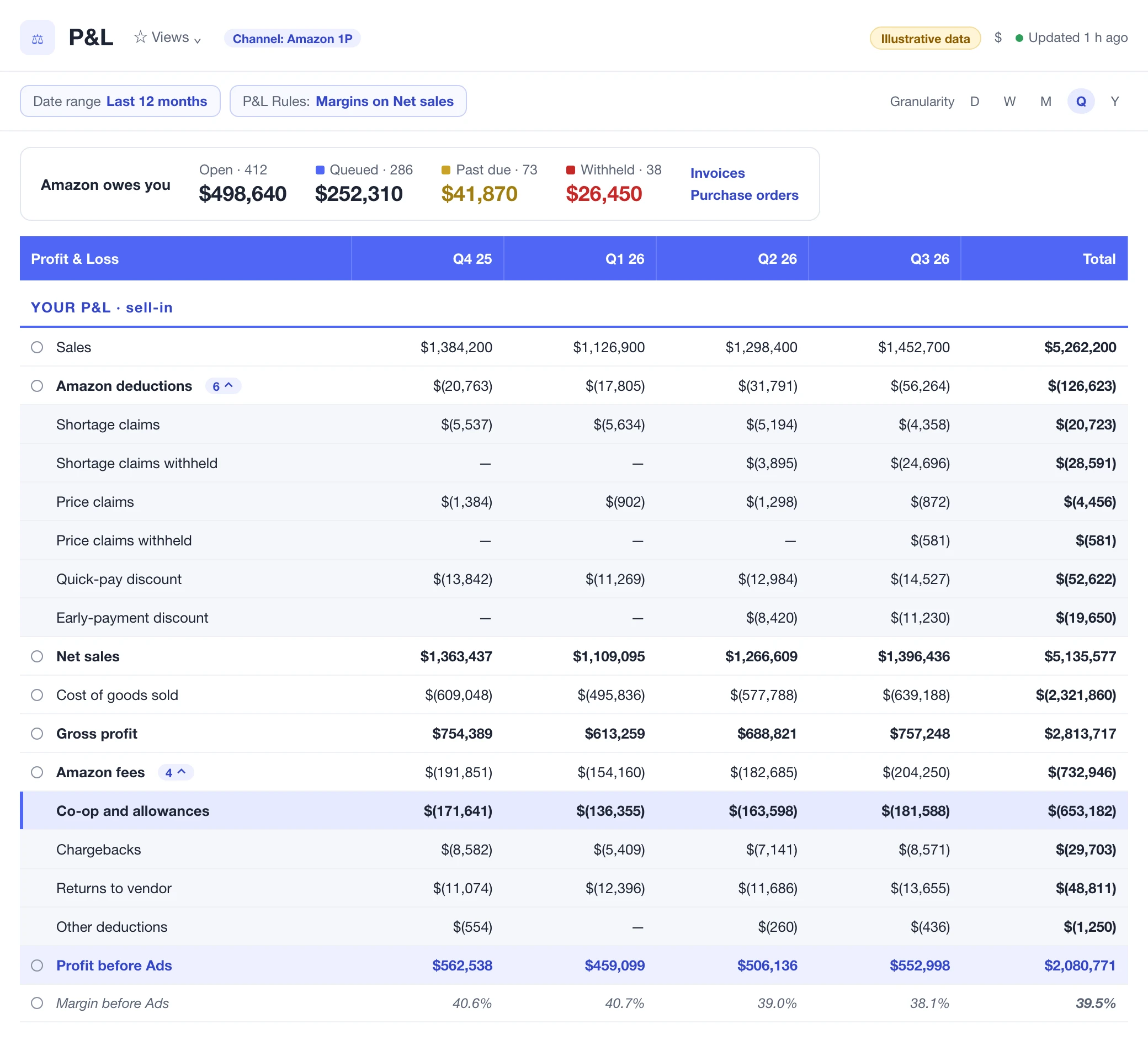
The two families of 1P deductions, line by line, next to what Amazon still owes you. Illustrative data.
TL;DR - Key Takeaways
•Start from what you invoiced Amazon, not what Amazon sold to shoppers. Your vendor P&L runs on sell-in.
•Invoice claims and payment deductions have different causes. Read the invoice and the payment remittance together.
•Co-op and allowances are usually the biggest single line after cost of goods. Check your negotiated terms, not a public percentage.
•Withheld claims are not settled claims. Keep open, queued, past due and withheld invoices visible beside the deductions.
Why Vendor Central has no fee schedule
Vendor Central is a wholesale relationship: Amazon buys from you under negotiated terms, then sells the products itself. Your invoice records your sale to Amazon. Amazon's retail revenue records its sale to the shopper. Those are different transactions, at different prices and dates.
Your vendor agreement determines the commercial deductions. Co-op and allowances are negotiated each year, alongside the terms of the relationship, so another vendor's bill is not a rate card for yours. The useful starting point is the agreement you signed and the deductions Amazon actually took. Advertising is billed separately from these deductions and appears as its own spend line, so it is not part of the gap between invoice and payment.
Read the bill in two families. First, invoice deductions reduce what Amazon pays against the invoice. Second, payment deductions appear on the remittance that explains Amazon's payment. Nova groups them as "Amazon deductions" and "Amazon fees" so you can see both without losing the original Sales line.
For the broader margin calculation, the Vendor Central profit analytics guide connects sell-in, cost of goods, co-op and advertising. This page decodes the amounts between the invoice and the payment.
Deductions off your invoices
Invoice deductions start with a quantity, a price or a payment discount. The question is whether Amazon paid for everything you invoiced, at the price you invoiced, and what it took for paying early.
Line
What it is
Where it comes from
What you can do
Shortage claims
Quantities Amazon paid for below what you invoiced (purchase quantity variance).
Amazon's received quantity against your invoice, credited as a purchase quantity variance (PQV).
Match the invoice and purchase order to receipt and delivery evidence; investigate the disputed units.
Shortage claims withheld
The quantity variance Amazon declares on invoices it has not settled yet.
An invoice Amazon has not settled yet, with a quantity variance declared on it.
Keep the amount separate from settled claims and gather receipt evidence while it is unresolved.
Price claims
Amounts Amazon paid below your invoiced price (purchase price variance).
Amazon's purchase order cost against your invoiced price, credited as a purchase price variance (PPV).
Compare the invoice with the purchase order and agreed cost; resolve the price difference.
Price claims withheld
The same price variance on unsettled invoices.
An unsettled invoice with a price variance declared on it.
Check the purchase order price and agreement before the invoice settles.
Quick-pay discount
The early-payment discount Amazon took on your invoices.
The quick-pay terms you agreed, applied to the invoice.
Check the discount against your agreed invoice terms.
Early-payment discount
The discount Amazon took for paying you early through C2FO.
An early payment you accepted through C2FO, taken off Amazon's payment.
Compare the discount with the early-payment arrangement you accepted.
Amazon's credit-note documentation describes PQV credits as items "billed but not received" and PPV credits as items billed at a higher or lower cost. These are invoice discrepancies, not shipping compliance charges. Amazon's credit-note reference gives the terminology; SPS Commerce's shortage-claims guide explains how to investigate quantity differences.
The two early-payment lines need separate treatment. Quick-pay is the discount taken on invoices. Early-payment discount is the C2FO discount taken off payments. Nova displays both in Amazon deductions, but that grouping does not change where the money was taken. Check each against its own agreement rather than treating them as duplicate charges.
Assign quantity claims to the team that can produce delivery and receipt evidence, price claims to the team that owns the agreed cost, and discounts to the owner of payment terms. For the dispute workflow and operational causes, use the chargebacks and vendor deductions deep dive.
Deductions off Amazon's payments
Payment deductions are the further amounts Amazon takes off what it sends you. Read the remittance, not just the amount that reached your bank: it identifies the agreements, compliance charges and returns behind the payment.
Line
What it is
Where it comes from
What you can do
Co-op and allowances
The agreements Amazon takes off what it pays you, net of what it paid back.
Payment remittances: marketing co-op, SPA, damage and freight allowances, AVS and others.
Match each agreement to your vendor terms and check the net charge after repayments.
Chargebacks
Compliance charges for ASN, labels, prep, routing, purchase order on-time and other requirements.
Compliance charges deducted from Amazon's payments.
Review the evidence and dispute in Vendor Central within its 30-day window.
Returns to vendor
Products Amazon returned to you, and their freight.
Return deductions read from payment remittances.
Match the returned products and freight to the return records and your agreement.
Other deductions
What Amazon took off its payments with no named family.
Items on the remittance outside the named groups.
Read each item in Amazon's own words before assigning an owner or accepting the charge.
Co-op and allowances are usually the largest single cost after the goods, and the one negotiated each year. Read the net amount as a share of what you invoiced, then compare it with the agreement and Amazon's Net PPM. Co-op is your cost and Amazon's gain: the same money improves Amazon's margin while reducing yours.
Net PPM belongs to the sell-out side. Amazon's analytics report documentation defines it as Amazon's net pure product margin on a vendor's items. A healthy Net PPM does not prove your own margin is healthy; your cost of goods still comes out of what the trade leaves you.
Chargebacks are a separate operational problem. SPS Commerce's compliance-chargebacks guide covers requirements such as ASN accuracy and preparation. Check the stated defect against the shipment record before deciding whether to dispute it or fix the process.
Keep other deductions visible until you understand them. A line with no named family is still money taken from the payment. Reading Amazon's item description is more useful than hiding it in a miscellaneous total nobody owns.
Walking the gap on the screen
The screen's illustrative year shows the two families side by side:
Sales, what was invoiced over the year: $5,262,200.
Amazon deductions: $126,623, or 2.4% of what was invoiced. Most of it is the quick-pay discount ($52,622) and shortage claims withheld ($28,591).
Net sales: $5,135,577.
Amazon fees off its payments: $732,946, of which co-op and allowances is $653,182, or 12.4% of what was invoiced. The rest is chargebacks ($29,703), returns to vendor ($48,811) and other deductions ($1,250).
Co-op alone is more than five times every invoice deduction combined. That is why it deserves the yearly negotiation and a monthly check. These are illustrative figures; your own percentages depend on your terms.
Reading the gap: invoiced, net, received
Sales, Net sales and money received answer different questions. Sales is what you invoiced Amazon, dated to the invoice. Subtract Amazon deductions to reach Net sales. The payment deductions then show the further cost of the relationship, while "Amazon owes you" tracks invoices that have not finished their payment journey.
Withheld and settled claims are different. A settled claim records quantities Amazon paid for below your invoice, or a price it paid below the invoiced price. A withheld claim records the variance it declares on an invoice before that invoice settles. Review withheld claims beside the withheld invoices, not as though every amount were a final loss, and check what remains when an invoice settles so the same difference is not counted twice.
Do not subtract cost of goods to reconcile a bank payment: it belongs in the profit calculation, not in Amazon's remittance. Open, queued, past due and withheld invoices explain the rest of the gap. Payments may settle earlier invoices while current invoices are still unpaid, so match invoices to remittances before reading a period's gap as extra fees. Counts alongside amounts show whether an unpaid balance comes from a few invoices or a broad backlog.
Run it in Claude
For my Vendor Central account, show what I invoiced Amazon by quarter for the last 4 quarters, every deduction off my invoices and off Amazon's payments as a share of what I invoiced, and what Amazon still owes me today.
Where Nova fits
Nova puts the two deduction families beside your sell-in P&L and the invoices Amazon still owes you. In the screen above, Sales remains the invoiced amount, Amazon deductions opens the claim and discount lines, and Amazon fees opens co-op, chargebacks, returns to vendor and other deductions.
Co-op and allowances is net of what Amazon paid back. Where remittances have not been read yet, Nova estimates it from Amazon's own accrual and labels the line "(est.)". That label tells you which number is an estimate rather than a deduction read from a payment remittance.
Other deductions stays as one visible line, with each item listed in Amazon's own words. The "Amazon owes you" bar shows open, queued, past due and withheld invoices with counts and amounts, so you can read outstanding invoices beside the cost of the trade.
The Channel filter lets you read 1P on its own or alongside 3P. The vendor lines are available in Nova MCP and Data Share too, with Vendor Data Share tables opened on request. The Nova Vendor Central page shows the product view. Use the 1P profit analytics pillar to carry the deduction review through to margin after your own costs and advertising.
Yes. Amazon takes deductions off invoices and further amounts off its payments. The bill includes quantity and price claims, payment discounts, co-op and allowances, compliance chargebacks and returns to vendor. There is no public Vendor Central rate card: your agreements set the commercial terms.
Co-op is the funding and allowances agreed in your vendor terms, including marketing co-op, SPA, damage and freight allowances, AVS and others. Amazon takes these agreements off what it pays you. Read the cost against your invoiced sales and your own agreement, not a percentage quoted for another vendor.
Co-op is negotiated per vendor in the yearly terms, and there is no public rate. Read yours as a share of what you invoiced, taken from the payment remittances, and compare it with Amazon's Net PPM.
A shortage claim is a purchase quantity variance: Amazon pays for fewer units than you invoiced. A chargeback is a compliance charge for an operational issue such as an ASN, label, prep, routing or purchase order on-time requirement. Compare receipt evidence with the invoice for the first, and the compliance record with shipping evidence for the second.
Vendor Central's chargeback dispute window is 30 days. Review the charge promptly, identify the requirement Amazon says was missed, and submit the relevant shipping evidence through Vendor Central. Do not apply that window to shortage or price claims, which are a different family.
First check the invoice for shortage claims, price claims and quick-pay discounts. Then read the payment remittance for co-op, chargebacks, returns to vendor, other deductions and any C2FO early-payment discount. Finally separate settled amounts from invoices that remain open, queued, past due or withheld. A lower payment can include both deductions and money not yet paid.
The bottom line
Start with the invoice, read both deduction families, and keep unpaid invoices separate from settled costs. Your negotiated terms explain what Amazon can take; the invoice and remittance explain what it did take. That is the bill to review before you decide whether the next purchase order is profitable.
Continue Learning
Explore more expert insights to grow your Amazon business