Best Amazon Accounting Software 2026: Complete Buyer's Guide
Compare top 8 Amazon accounting software solutions with features, pricing, and decision framework. Choose the right platform for accurate P&L, COGS tracking, and financial automation.
If you're serious about your Amazon business, you know that standard accounting software like QuickBooks or Xero wasn't built for the complexity of FBA. Between 40+ fee types, product-level P&L tracking, PPC allocation, period-based COGS, and multi-marketplace consolidation, Amazon sellers need specialized accounting software that understands their unique financial reality.
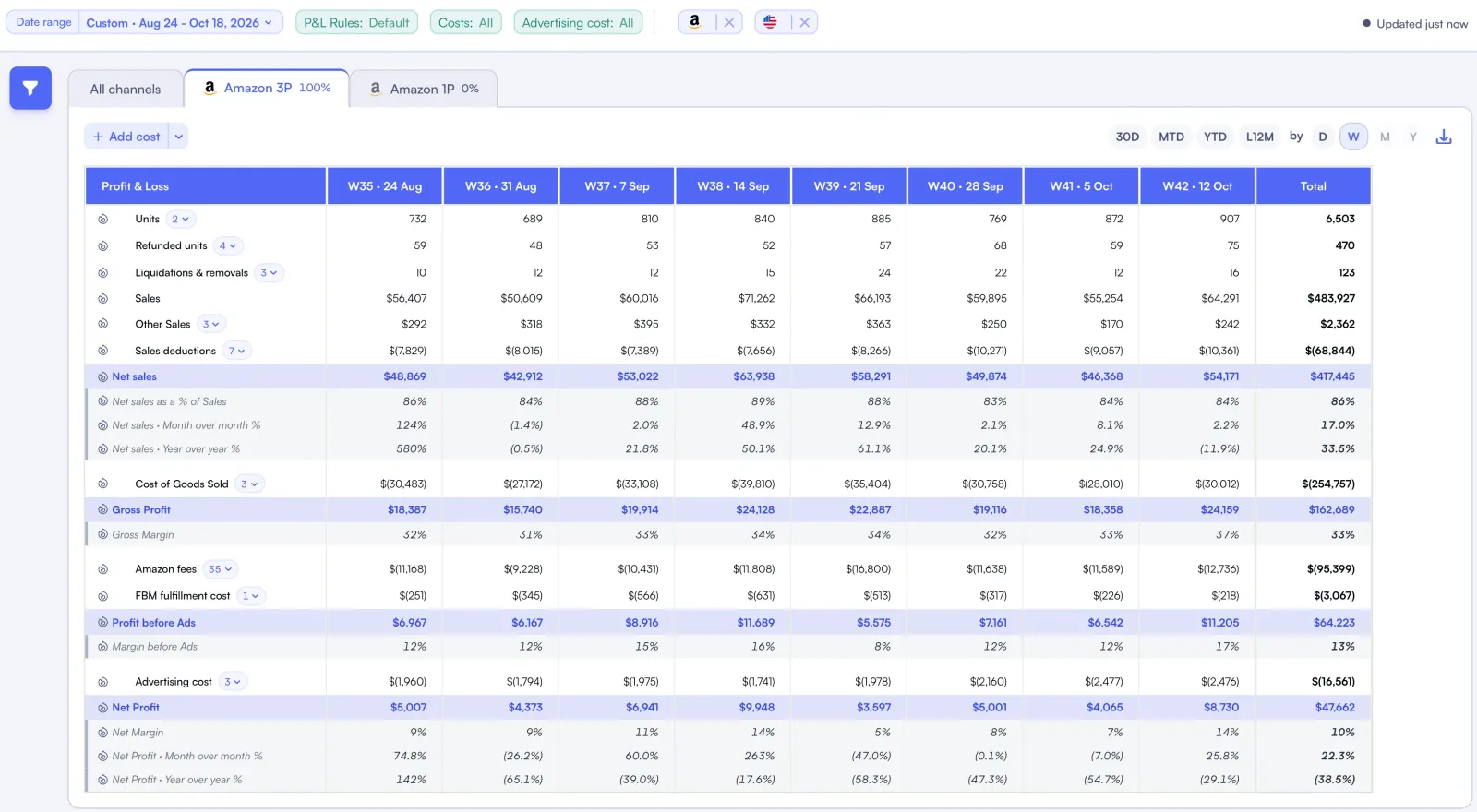
Read sales alongside every cost layer to see how much profit remains.
This comprehensive buyer's guide breaks down the top 8 Amazon accounting software solutions in 2026, compares their features and pricing, and provides a decision framework to help you choose the right platform for your business size and complexity.
What the numbers have to cover
40+ fee types
Amazon does not bill one fee, it bills dozens across referral, fulfilment, storage, placement, returns and advertising. Any tool you pick has to explode a settlement back into those lines and attach them to the right SKU, otherwise the P&L it produces is a summary, not an answer.
Why Amazon Sellers Need Specialized Accounting Software
Generic accounting tools force you to manually categorize hundreds of transaction types, allocate advertising spend by product, track landed costs across currencies, and reconcile fees that change by size tier and season. According to GAAP accounting standards, accurate financial reporting requires proper expense categorization and revenue recognition, something that's nearly impossible to maintain manually for Amazon businesses.
General Accounting Software Limitations
No automatic Amazon fee categorization (9 types)
Manual PPC spend allocation required
No product-level P&L visibility
24-48 hour data delays
Complex multi-marketplace setup
No contribution margin analysis
Requires accounting expertise
Specialized Amazon Software Advantages
Real-time Amazon data sync
Automatic fee categorization (40+ fee types)
Product-level profitability tracking
Built-in PPC allocation logic
Multi-marketplace consolidation
Contribution margin (CM1/CM2/CM3)
No accounting knowledge required
Work out your own payback
Hours per week spent reconciling settlements × your loaded hourly cost = the manual bill. Compare that against the subscription. Nova starts at $49/mo. Then add the part that is harder to price: catching a mispriced SKU in the same week rather than the next quarter.
Top 8 Amazon Accounting Software Solutions for 2026
EDITOR'S CHOICE
1. Nova Data Analytics
Best for: Real-Time P&L & Product-Level Profitability
From €69/mo
14-day free trial
Nova is purpose-built for Amazon sellers who need profit visibility with real-time sales at the product level. Unlike tools that sync data every 24-48 hours, Nova receives orders and units in real time, giving you clarity on which ASINs drive profit and which drain it.
A2X specializes in automated data transfer from Amazon to QuickBooks Online, QuickBooks Desktop, or Xero. It's the bridge between Amazon Seller Central and traditional accounting software, trusted by thousands of ecommerce businesses.
Pros
Excellent QuickBooks/Xero sync reliability
Automatic fee categorization
Daily settlement reconciliation
Multi-marketplace support
Strong accountant/bookkeeper adoption
Cons
No product-level P&L (requires QuickBooks setup)
No built-in analytics or dashboards
Still requires QuickBooks/Xero subscription
Limited PPC integration
24-hour data lag
Best for: Sellers already using QuickBooks/Xero who need reliable data sync ($100K+ revenue).
3. Link My Books
Best for: Budget-Conscious QuickBooks Users
From $9/mo
14-day free trial
Link My Books offers a more affordable alternative to A2X for syncing Amazon data to QuickBooks Online or Xero, with thousands of sellers using the platform.
Pros
Most affordable integration tool
Simple QuickBooks Online sync
Automatic categorization
Multi-channel support (Shopify, eBay)
Cons
Basic feature set
No analytics or reporting
Limited PPC handling
No product-level insights
Best for: Small sellers ($20K-$100K revenue) using QuickBooks Online on a tight budget.
4. Taxomate
From $20/mo
14-day trial
Best for: Xero Users
Xero-focused alternative to A2X with similar functionality but optimized for Xero's chart of accounts structure. Popular with UK and Australian sellers.
Key advantage: Excellent Xero integration with automated bank reconciliation. Limitation: No QuickBooks support, limited analytics.
5. SellerLedger
From $250/mo
Includes bookkeeper
Best for: Full-Service Bookkeeping
Combines software with bookkeeping services, includes human oversight and monthly financial review calls.
Full-service bookkeeping for ecommerce businesses. Each client gets a dedicated bookkeeping team and tax-ready financials, backed by significant venture funding.
Key advantage: Complete financial management, tax-ready statements. Limitation: Premium pricing, less suitable for DIY sellers.
7. Fetcher
From $49/mo
Multi-channel
Best for: Multi-Channel Sellers
Supports Amazon, Shopify, eBay, Walmart, Etsy and more with unified financial reporting. Ideal for omnichannel brands.
Key advantage: Multi-channel consolidation, inventory costing across platforms. Limitation: less Amazon-specific optimization than specialists.
8. QuickBooks Commerce
From $50/mo
+ QBO required
Best for: Existing QuickBooks Ecosystem
QuickBooks' own ecommerce solution (formerly TradeGecko). Integrates directly with QuickBooks Online with inventory management features. Part of the Intuit ecosystem.
Key advantage: Native QuickBooks integration, inventory tracking. Limitation: Generic ecommerce tool, not Amazon-optimized, requires separate QuickBooks subscription.
Comparison Matrix: Features & Pricing
Feature
Nova
A2X
Link My Books
Taxomate
Others
Starting Price
€69/mo
$19/mo
$9/mo
$20/mo
$49-299/mo
Free Trial Period
14 days
30 days
14 days
14 days
Varies
Data Refresh Speed
in real time
24 hours
24 hours
24 hours
24-48 hours
Product-Level P&L
✓ built-in
Manual setup
Manual setup
Manual setup
Varies
Contribution Margin Analysis
✓ CM1/CM2/CM3
✗
✗
✗
✗
PPC Allocation by Product
✓ Automatic
Limited
✗
Limited
Limited
Custom Dashboards
✓ Unlimited
✗
✗
✗
Limited
Multi-Marketplace Support
✓ all Amazon
✓
✓
✓
Varies
Note: Vendor pricing checked September 2026. Most platforms offer volume discounts for larger sellers. Additional costs may apply for QuickBooks/Xero subscriptions where required.
Buyer's Decision Framework: 10 Questions to Ask
Use this framework to systematically evaluate which platform best fits your business needs and growth stage.
1. What's your annual revenue and number of ASINs?
<$50K: DIY with spreadsheets or basic integration tools
$50K-$500K: Nova (best for real-time insights and product-level P&L)
$500K-$5M: Nova for comprehensive accounting intelligence
$5M+: Nova + professional accountant or full-service solution
2. Do you need real-time data or is daily/weekly acceptable?
If you make daily pricing, inventory, or advertising decisions based on profit data, real-time sync (Nova) is critical. If you review weekly, daily sync works.
3. Do you need product-level profit visibility?
If you manage 10+ ASINs and need to know which products drive profit vs. Drain it, product-level P&L is essential. Nova provides this automatically built-in, while integration tools require complex manual setup.
4. Are you already using QuickBooks or Xero for taxes?
If yes, integration tools provide seamless sync, or Nova offers CSV exports that import easily into both platforms. Learn more about tax-deductible business expenses.
5. How important is PPC allocation by product?
If you run significant PPC ($1K+ monthly) and want accurate ROAS by ASIN, automated allocation (Nova) saves hours and improves accuracy vs. Manual spreadsheet allocation.
6. Do you need contribution margin analysis (CM1/CM2/CM3)?
If you want to understand profitability after COGS (CM1), after marketing (CM2), and after all fees (CM3), specialized tools like Nova provide this automatically. General accounting software requires manual calculation.
7. Do you sell on multiple Amazon marketplaces?
Multi-marketplace consolidation with currency conversion and unified reporting is available in most platforms but varies in quality. Nova excels at consolidated multi-region reporting with automatic currency conversion.
8. What's your team structure?
Solo operators benefit from simple, automated tools (Nova, Link My Books). Teams need shared dashboards and consistent definitions (Nova's custom workspaces).
9. What's your monthly software budget?
Various budget options available from basic integration to comprehensive analytics. ROI calculation: compare the hours your team spends reconciling each month against the subscription, and weigh the cost of decisions made on stale numbers.
10. Do you want operational analytics or just accounting sync?
Nova provides complete dashboards, KPI tracking, anomaly detection, and business intelligence for data-driven decision making. If you just need clean books for tax filing, basic integration tools may suffice.
Why Nova Stands Out: Accounting That Understands Amazon
While integration tools like A2X and Link My Books excel at syncing data to traditional accounting software, they don't provide the operational intelligence that Amazon sellers need to make daily decisions. Nova was built from the ground up for Amazon operators who need:
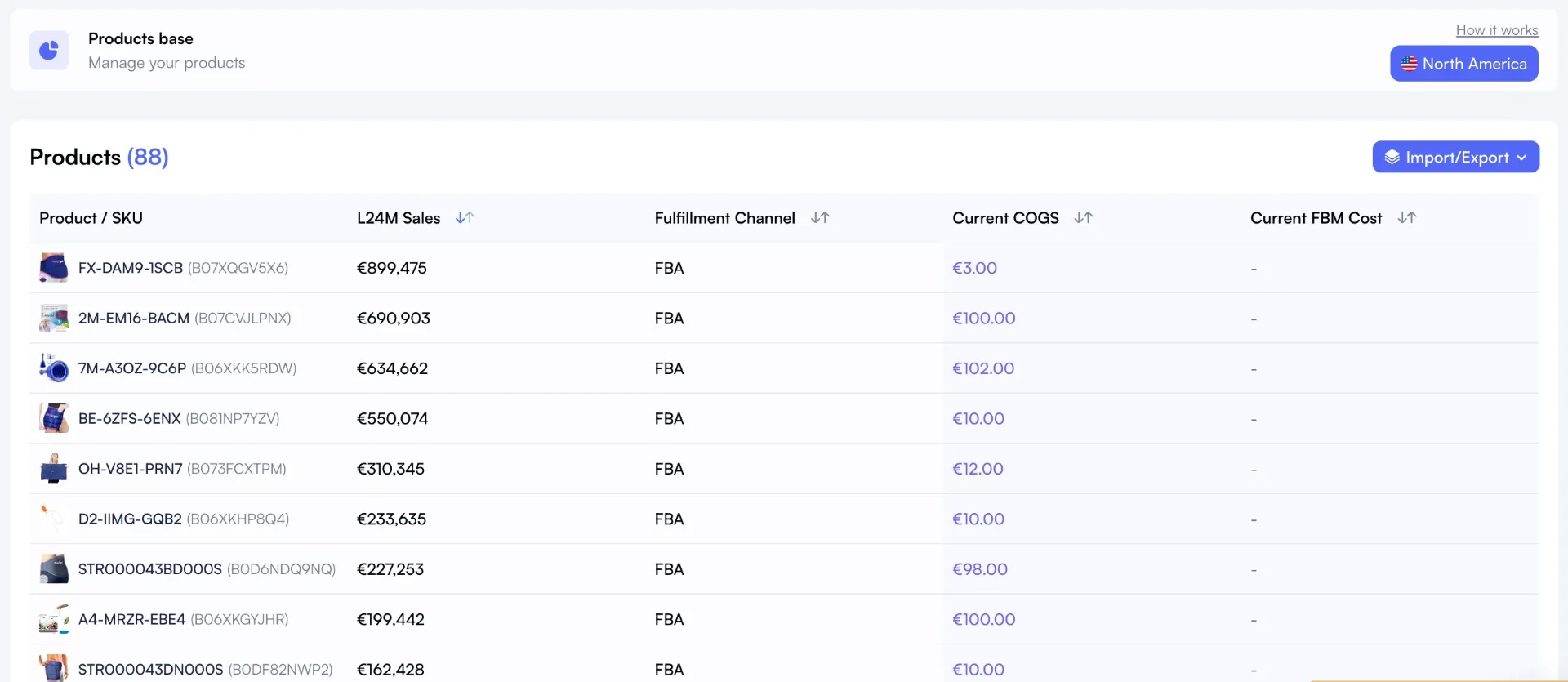
The COGS manager keeps product costs organized by period or inventory batch.
Real-Time Financial Intelligence
Real-time sales means you know your profitability today, not yesterday. Make pricing, inventory, and advertising decisions with confidence using current data.
Every ASIN gets its own P&L with contribution margin analysis. Instantly identify your stars, question marks, and money losers without complex QuickBooks class tracking.
Handle price changes, currency fluctuations, and supplier variations with period-based costing. Ensure your margins are accurate even when input costs change monthly.
Executives see portfolio trends and risk flags. Brand managers get query-level actions. Finance gets reconciliation and variance explanations, all from one consistent data source.
"Nova isn't just accounting software, it's Amazon intelligence."
While traditional tools require manual entry and accounting expertise, Nova automatically tracks every Amazon fee, ad dollar, and cost in real-time, giving you accurate profit data at the product level. It's accounting software that actually understands your Amazon business.
Getting Started: Implementation Checklist
1
Define Your Requirements (Week 1)
List the decisions you need to make weekly, the reports your CFO trusts, and the pain points in your current process.
2
Trial Nova's Platform (Weeks 2-3)
Start a free trial with Nova to evaluate data accuracy, speed, and ease of use. Connect your Amazon account and explore real-time P&L features.
3
Validate P&L Accuracy (Week 3)
Compare platform P&L to your manual calculations for 2 contrasting ASINs (high-volume and long-tail). Verify fee categorization and margin calculations.
4
Test Decision Workflows (Week 4)
Use the platform to answer: "Which ASINs should I promote this month?" and "Where is my ad spend going negative?" If you can't answer easily, it's not the right tool.
5
Choose and Migrate (Week 5)
Select the platform that passed your tests. Most platforms (including Nova) offer migration support and onboarding assistance.
6
Establish Weekly Review Cadence (Ongoing)
Set up recurring meetings to review P&L, contribution margins, and key decisions. Software only helps if you use it consistently.
Conclusion: Choose Software That Matches Your Ambition
If you're building a serious Amazon business, your accounting software should be a competitive advantage, not just a compliance checkbox. The right platform gives you:
Time back: settlement reconciliation and fee categorisation stop being weekly manual work
Clear visibility: know which products drive profit and which drain it, in real-time
Confident decisions: make pricing, inventory, and ad spend choices backed by accurate data
Scalable systems: Grow from $100K to $10M without changing platforms
Everything you need to know about Amazon accounting software
Accounting software like Nova automates data sync and provides analytics. Bookkeeping services with dedicated bookkeepers manage your books but at higher cost. Software is typically better for sellers under $5M who want real-time data and control. Services make sense for complex businesses or sellers who don't want to touch financials.
Technically yes, but each settlement has to be split by hand into the underlying fee types, then allocated to SKUs along with PPC spend and COGS. That work grows with catalogue size and marketplace count, which is why most sellers add a specialised layer above the ledger rather than replacing it.
Nova reconciles against Amazon settlements and categorises 40+ fee types automatically, including returns, reimbursements and promotions, which is where manual entry usually drifts. The gap between an automated reconciliation and a hand-built spreadsheet widens as fee types and marketplaces multiply.
Contribution margin shows profitability at different stages: CM1 (after COGS), CM2 (after marketing), CM3 (after all fees). This reveals which products truly drive profit vs. Just revenue. For example, a product with 40% revenue margin but 10% CM3 after ads and fees is far less valuable than one with 30% revenue margin and 25% CM3.
No. Quality accounting software like Nova consolidates all Amazon marketplaces (US, UK, EU, Canada, Japan, etc.) into unified reporting with automatic currency conversion. You connect each marketplace once and view consolidated or segmented reports.
Initial connection: 10-30 minutes to authorize Amazon Seller Central access. Historical data import: 1-3 days for platforms to sync 6-12 months of history. Full configuration (COGS, tags, custom views): 1-2 weeks. Most sellers see their first accurate P&L within 3-5 days.
Accounting software provides the clean financial records your accountant needs for tax filing: accurate P&L, expense categorization, and deduction tracking. However, you'll still need a tax professional for actual filing and strategy, especially for sales tax nexus and international VAT. Learn more about IRS business expense deductions.
Nova focuses exclusively on Amazon for maximum depth and accuracy. Multi-channel sellers should consider Fetcher or similar platforms that consolidate multiple sales channels. Alternatively, use channel-specific tools (Nova for Amazon, native analytics for Shopify) if you want best-in-class for each platform.
Work it out with your own numbers: hours spent per week on reconciliation and categorisation, multiplied by what an hour of your team's time costs, against the monthly subscription. Nova starts at $49/mo. The second half of the return is decision speed, since a wrong fee allocation quietly misprices a SKU for a whole quarter.
Most platforms offer migration support. Steps: (1) Export historical data from your current system, (2) Connect new platform to Amazon Seller Central, (3) Import historical COGS and custom data, (4) Run both systems in parallel for 2-4 weeks to validate accuracy, (5) Fully transition once confident. Nova provides dedicated migration assistance.
Look for SOC 2 Type II certification, GDPR compliance, encrypted data transmission (SSL/TLS), encrypted data storage, role-based access controls, and regular security audits. Your software handles sensitive financial data, so enterprise-grade security is essential regardless of business size.
Yes, most accounting platforms support multi-account management. This is essential for aggregators, agencies, or sellers with multiple brands. Nova allows unlimited seller account connections with consolidated reporting and per-account segmentation.
Investors and buyers require: (1) Product-level P&L with contribution margins, (2) Historical revenue and profit trends (12-36 months), (3) COGS breakdown and supplier concentration, (4) Customer acquisition costs and LTV, (5) Inventory turnover metrics, (6) Clean reconciliation to bank statements. Exit-ready financials from day one make due diligence faster and increase valuation.
Quality platforms automatically track returns, refunds, and reimbursements from Amazon, adjusting your P&L and inventory accordingly. They reconcile Amazon's settlement reports to ensure every return is properly accounted for, maintaining P&L accuracy even with high return rates.
Cash accounting records revenue when Amazon pays you (every 2 weeks). Accrual accounting records revenue when the sale occurs. For Amazon sellers, accrual provides more accurate profit visibility since it matches revenue with the period's expenses. Most platforms support both methods, but accrual is recommended for businesses over $100K annual revenue. Learn more about GAAP accounting standards.
Disclosure: this guide is published by Nova Data Analytics. While we've made every effort to provide accurate, unbiased information about all platforms mentioned, Nova is our product. We encourage you to evaluate multiple solutions and choose what's best for your business needs.
Ready to See Your Real Amazon Profitability?
Try Nova free for 14 days. No credit card required. See product-level P&L, contribution margins, and real-time financial intelligence in under 5 minutes.