

How Ledge Loungers replaced its Amazon reporting stack
Aaron Snow · Ledge Loungers
Read the case studyNova MCP for AI assistants
Join the agentic commerce revolution
Connect your Amazon data to your favorite AI assistant




Josh Grillo, Founder of Sell Through, on the Nova MCP
Sales and profit58 data points
The average value of an order. This is calculated as total sales divided by orders.
averageOrderValueThe average price of a unit sold. This is calculated as total sales divided by units
itemValueThe percentage of units where your offer won the Buy Box, weighted by units sold
buyBoxPercentageThe percentage of sessions that result in at least one unit being ordered.
conversionRateThe amount customers paid for gift wrapping.
giftwrapSalesthe revenue you keep from sales after subtracting promotions, VAT, refunds, and chargebacks.
netSalesnet sales divided by units sold
netSalesPerUnitproducts the customer actually kept - Units minus Refunded Units.
netUnitsThe number of different products included in customer orders, regardless of how many units of each product were bought.
ordersRevenue that does not come from the product itself, such as shipping and gift wrap.
otherSalesThe total number of times your product detail pages were viewed by customers (B2C traffic).
pageViewsB2cThe revenue from product sales only - calculated as item price multiplied by units ordered. Excludes shipping and gift wrap revenue, which are tracked separately as Other Sales.
salespercentage of total sales from Subscribe & Save
salesPenetrationThe number of unique visits to your product detail pages or store within a selected time period.
sessionsThe amount customers paid for shipping on their orders.
shippingSalestotal revenue including product sales, shipping and giftwrap
totalSalestotal number of units sold
unitsventilation ratio used for cost allocation across child ASINs
weightThe number of units given away through the Amazon Vine programme. Derived from the same orders as Units, so it is always a subset of them.
vineUnitsthe date of the product's first sale (the earliest day it had sold units or product sales); null if it has never sold. Use it to date a launch or measure a product's age.
firstSaleDatepercentage of net sales spent on advertising costs
marketingCostMarginpercentage of net sales spent on total Amazon fees
totalAmazonFeesMarginpercentage of net sales spent on COGS
cogsMarginpercentage of net sales spent on coupon performance fees
couponPerformanceFeeMarginpercentage of net sales spent on deal participation fees
dealParticipationFeeMarginpercentage of net sales spent on disposal fees
fbaDisposalFeeMarginpercentage of net sales spent on FBA fulfillment fees
fbaFulfillmentFeeMarginpercentage of net sales spent on inbound transportation
fbaInboundTransportationFeeMarginpercentage of net sales spent on long-term storage fees
fbaLongTermStorageFeeMarginpercentage of net sales spent on removal fees
fbaRemovalFeeMarginpercentage of net sales spent on FBA storage fees
fbaStorageFeeMarginalso referred to as Gross Margin %, it shows the percentage of net sales remaining after subtracting cost of goods sold (COGS). It is calculated as (net sales - COGS) / net sales
grossProfitMarginalso referred to as Gross Margin, it is the revenue remaining after subtracting cost of goods sold (COGS) from net sales. It is calculated as net (sales - COGS).
grossProfitgross profit divided by units sold
grossProfitPerUnitthe percentage of net sales remaining after subtracting cost of goods sold (COGS) and Amazon fees.
contributionMargin2Marginthe percentage of net sales remaining after subtracting all costs.
netProfitMarginthe revenue remaining after subtracting all costs from net sales
netProfitnet profit divided by units sold
netProfitPerUnitpercentage of sales you keep after subtracting promotions, VAT, refunds, and chargebacks. It is calculated as (net sales / sales).
netSalesMarginthe revenue remaining after subtracting cost of goods sold (COGS) and Amazon fees from net sales.
contributionMargin2profit before ads divided by units sold
contributionMargin2PerUnitpercentage of net sales spent on referral fees
commissionFeeMarginthe inventory cost of units Amazon sold to a liquidator, charged where that cost had not already been expensed - netted against your non-sellable customer returns.
liquidationCostOfGoodsthe inventory cost of units destroyed by Amazon at your request, charged only where that cost had not already been expensed - destructions are netted against your non-sellable customer returns (whose cost stayed expensed at the sale), so nothing is counted twice.
disposalCostOfGoodsNet sales minus variable costs: what your sales leave before the costs of carrying and advertising the product.
contributionMarginContribution margin as a share of net sales.
contributionMarginMarginNet profit before the account costs: contribution margin minus product costs, one-offs and advertising.
productProfitProduct profit as a share of net.
productProfitMarginthe total amount spent on Amazon advertising, including Sponsored Products, Sponsored Brands, Sponsored Brands Video, and Sponsored Display.
marketingCostthe cost incurred by the merchant to store, pick, pack, and deliver the product directly to the customer.
fbmCostthe total number of order items (each distinct product in an order counts as one)
orderItemsfee charged when an order is cancelled
orderCancellationChargetotal advertising costs divided by units sold
marketingCostPerUnitseller reward credits from the SERRAC program
serracSellerRewardsponsored products cost allocated from ScaleInsights
allocatedScaleinsightsSpCostshipping handling fee for preparing/processing shipment
shippingHbtotal shipping price charged to customers
shippingPricefee when a return shipping label is purchased
shippingLabelPurchaseReturn763 documented metrics, fields and cost inputs
Aaron Snow · Ledge Loungers
Read the case study
Josh Grillo · Founder, Sell Through
Read the case study
Jake Zaratsian · Amazon advertising consultant, Zaratsian
Read the case study
Stephen Harris · Sitruna
Read the case study
Yano · Bender Brands
Read the case study
Steve H · Reflex Consultancy
Read the case studyPavel Zadorozhnyi · Supl Corp
Read the case studyNimrod
Read the case study
Alexandr Kachurovskyi
Read the case studyMark Fleming · Brand Connections
Read the case study
Daniel Richman · Tilstar by ZonGuru
Read the case study
Marc Marshing · CEO, Flummox
Read the case studySaurabh Gunjal · l-brothers
Read the case study
Amaru Group
Read the case studyData sources




AI assistants
ClaudeDesktop, Code, webChatGPTConnectors & custom GPTsGeminiMCP-capable clientsCopilot StudioMicrosoft Copilot700+ metrics. Real-time sales. 23 Amazon marketplaces.
| Dimension | Nova MCP | Typical Amazon MCP connector | Edge |
|---|---|---|---|
| 01Data accuracy | 99.9% guaranteed. 370 Amazon transaction lines reconciled into 154 P&L lines | Clean API copies. Fee reconciliation depth rarely documented | Nova |
| 02Data freshness | Orders and units reach Nova within seconds of the sale, with sales estimated until Amazon confirms the exact amounts. Ad spend refreshes every two hours, search term data three times a day, Amazon finance transactions hourly, and the remaining reports daily. | Usually once a day, so answers run on yesterday's numbers | Nova |
| 03Data coverage | SP-API, Ads, Search Query Performance, search terms, inventory, listing health, BSR, plus Vendor Central (1P) | Broad API coverage, served as tables rather than decisions | Nova |
| 04Token consumption | Structured tables and pre-aggregated answers. No raw dumps | Raw tables, so the model burns tokens filtering and aggregating | Nova |
| 05SKU cost allocation | Profit to the cent per SKU, attributed unit by unit | Sales and fees per SKU, no true landed cost | Nova |
| 06Smart data enrichment | COGS per SKU, FBM cost, 24 months of backfilled history, your own tags | Only what Amazon publishes. Your costs live elsewhere | Nova |
| 07Speed of answers | One question, one low-token call against a structured table | Several round trips per question | Nova |
| 08Marketplace coverage | 23 marketplaces, currency-normalized across accounts and regions | Marketplace count and currency normalization rarely documented | Nova |
Nova MCP
99.9% guaranteed. 370 Amazon transaction lines reconciled into 154 P&L lines
Typical Amazon MCP connector: Clean API copies. Fee reconciliation depth rarely documented
Nova MCP
Orders and units reach Nova within seconds of the sale, with sales estimated until Amazon confirms the exact amounts. Ad spend refreshes every two hours, search term data three times a day, Amazon finance transactions hourly, and the remaining reports daily.
Typical Amazon MCP connector: Usually once a day, so answers run on yesterday's numbers
Nova MCP
SP-API, Ads, Search Query Performance, search terms, inventory, listing health, BSR, plus Vendor Central (1P)
Typical Amazon MCP connector: Broad API coverage, served as tables rather than decisions
Nova MCP
Structured tables and pre-aggregated answers. No raw dumps
Typical Amazon MCP connector: Raw tables, so the model burns tokens filtering and aggregating
Nova MCP
Profit to the cent per SKU, attributed unit by unit
Typical Amazon MCP connector: Sales and fees per SKU, no true landed cost
Nova MCP
COGS per SKU, FBM cost, 24 months of backfilled history, your own tags
Typical Amazon MCP connector: Only what Amazon publishes. Your costs live elsewhere
Nova MCP
One question, one low-token call against a structured table
Typical Amazon MCP connector: Several round trips per question
Nova MCP
23 marketplaces, currency-normalized across accounts and regions
Typical Amazon MCP connector: Marketplace count and currency normalization rarely documented
Setup, in one minute
Four steps for Claude below. The same Nova data is available to Claude, ChatGPT, Gemini and Copilot Studio; setup varies by client.
In Claude, open your profile, then Settings, then the Connectors tab. Works on the desktop app and on claude.ai.
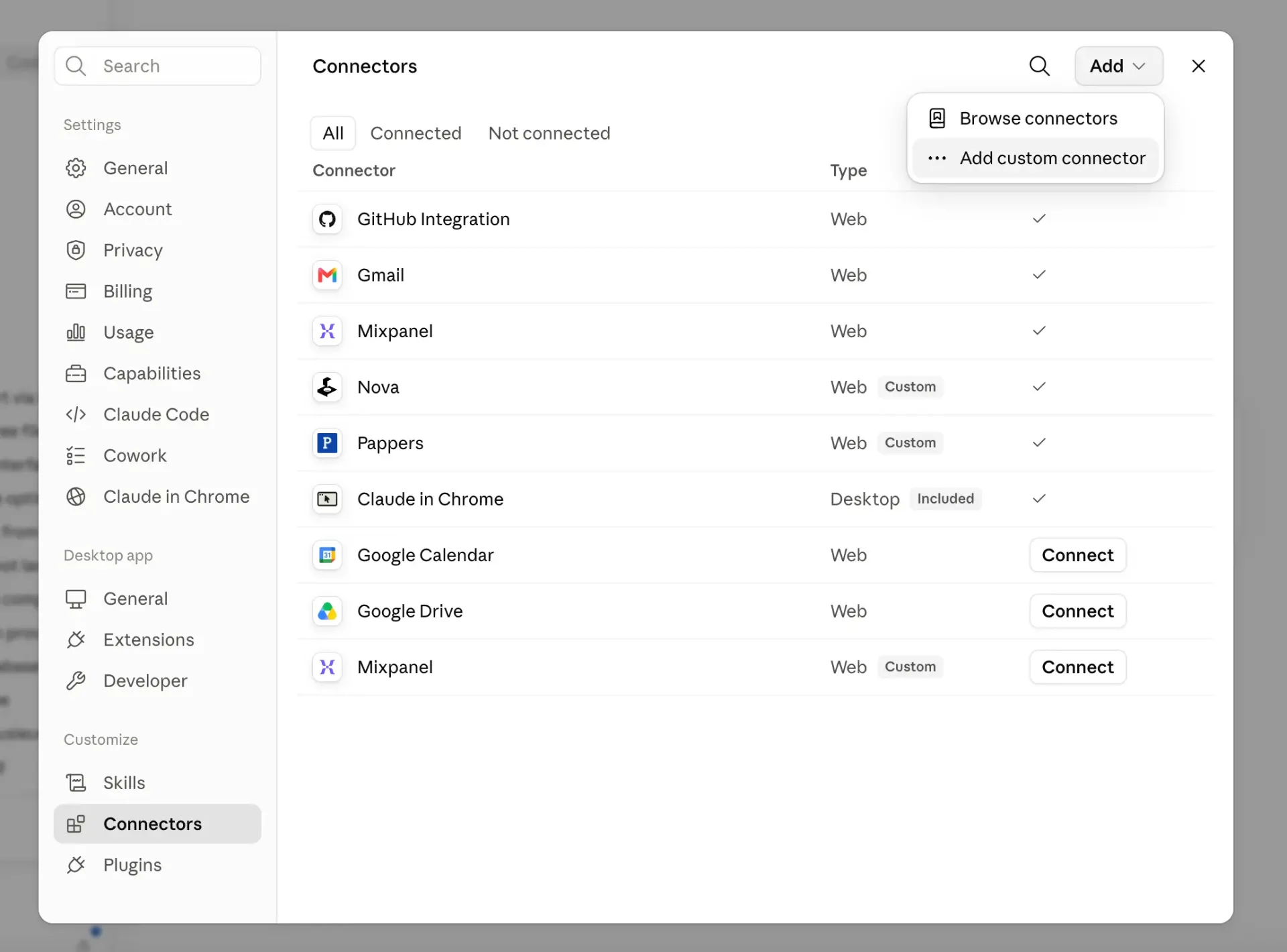
In the Connectors panel, click Add, then Add custom connector. If you do not see the option, check that you are on a Claude paid plan.
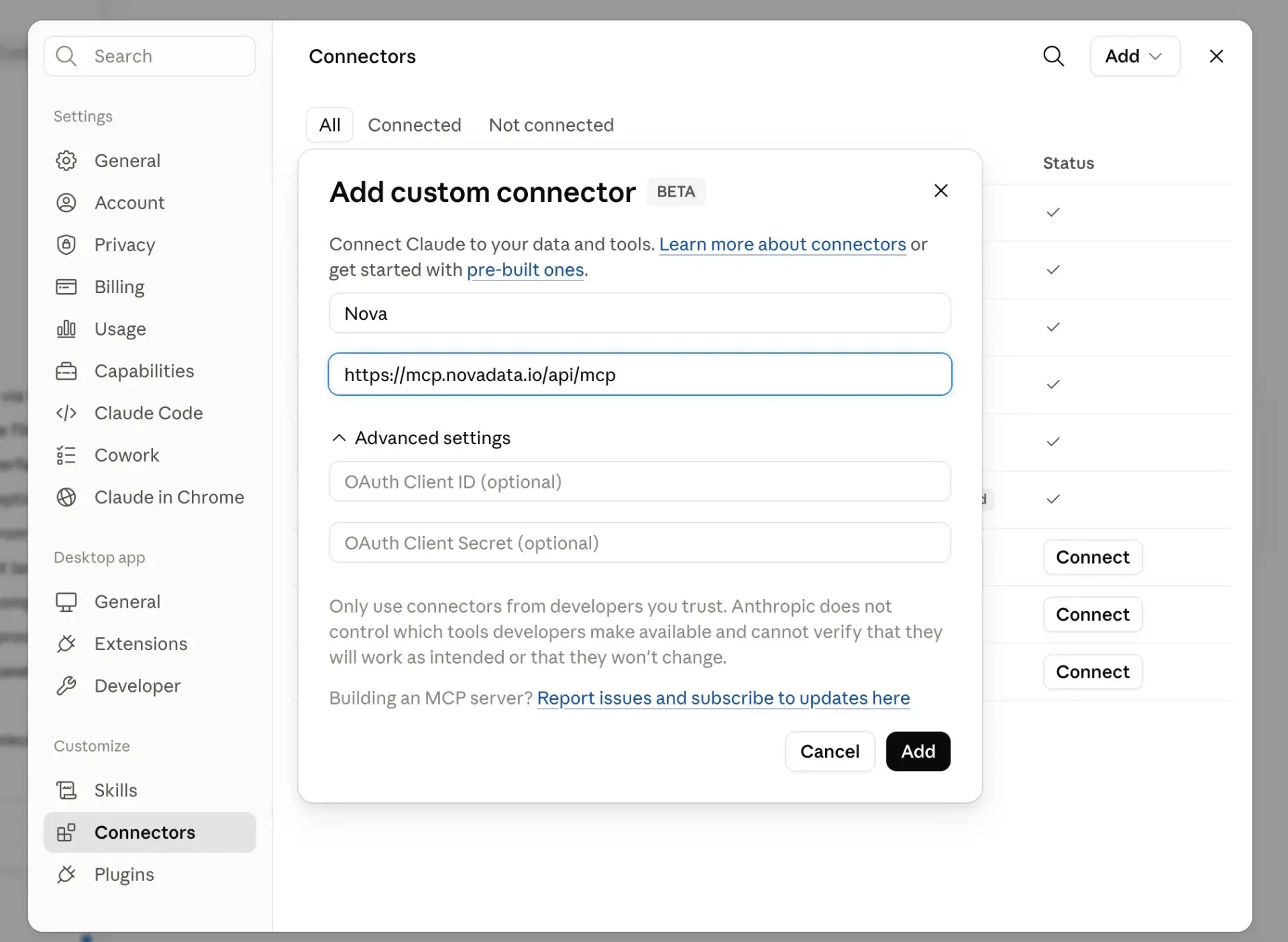
Name
NovaRemote MCP server URL
https://mcp.novadata.io/api/mcpNo authentication is required in the current beta. Click Add, then Save.
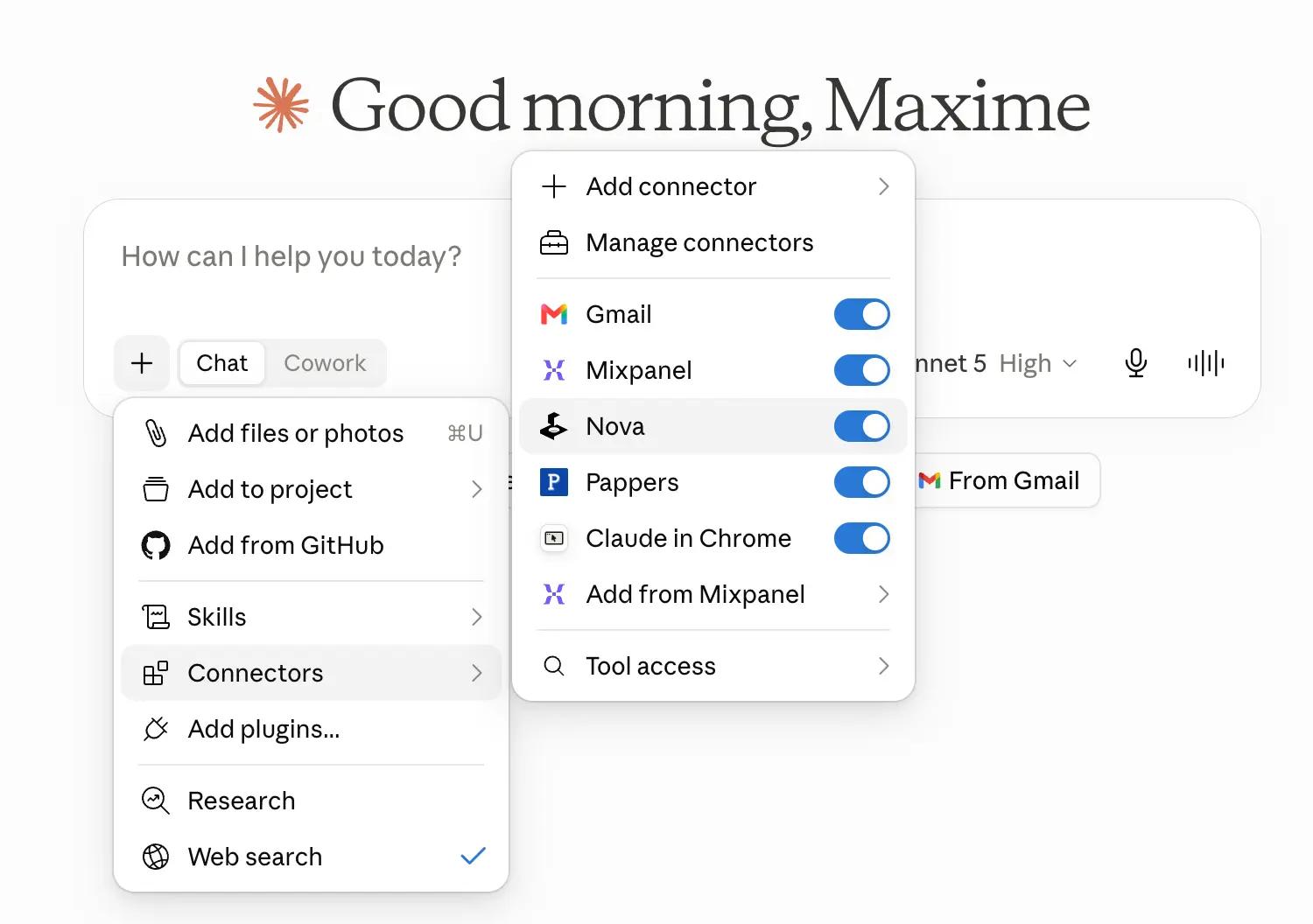
Toggle Nova on, open a new conversation, and ask about your live Amazon business.
Screenshots, troubleshooting and example prompts.
The Nova MCP serves 700+ data points across sales, profitability (including contribution margin), fees with their charged, reversed and corrected split, Amazon DSP cost, PPC across Sponsored Products, Sponsored Brands, Sponsored Brands Video and Sponsored Display, customer search terms, search query performance (SQP), Best Seller Rank, refunds, Subscribe & Save, FBA stock health, listing health and your own cost inputs. Vendor Central accounts add their own P&L, Amazon's shelf, purchase orders and stock at Amazon. All refreshed continuously from SP-API and the Ads API.
MCP-capable clients include Claude, ChatGPT, Gemini and Copilot Studio. Add Nova using your client's connector settings. Microsoft Copilot uses MCP through Copilot Studio; connection availability depends on your organization's configuration.
Connectors that hand the model raw tables force it to filter and aggregate thousands of rows itself, which burns tokens and slows the answer down. Nova returns structured, pre-aggregated tables, so one question is usually one low-token call.
Sales and orders, profitability, PPC and advertising, customer search terms, search query performance, Best Seller Rank, buy box, inventory, fees and reimbursements, refunds, subscribe and save, listing health, and your own cost inputs (COGS, freight, 3PL, and more). The P&L Costs filter is available too, so an assistant can read profit without one-off costs or on variable costs only.
Yes, browse and search the full library freely. Connecting your assistant to live data requires a Nova account (14-day free trial, no card).
Orders and units reach Nova within seconds of the sale, with sales estimated until Amazon confirms the exact amounts. Ad spend refreshes every two hours, search term data three times a day, Amazon finance transactions hourly, and the remaining reports daily. The app and Claude connector read the same data.