Amazon returnless refunds: what they really cost sellers
How Amazon returnless refunds work for FBA and seller-fulfilled orders, how many refunded units actually come back, and how to set your price threshold product by product.
A returnless refund saves you the return shipping and processing, but you lose the unit. Our data says most refunded units were never worth getting back anyway: for the median seller, only about a third come back sellable. Here is how the program works, what each outcome costs, and how to set a price threshold product by product.
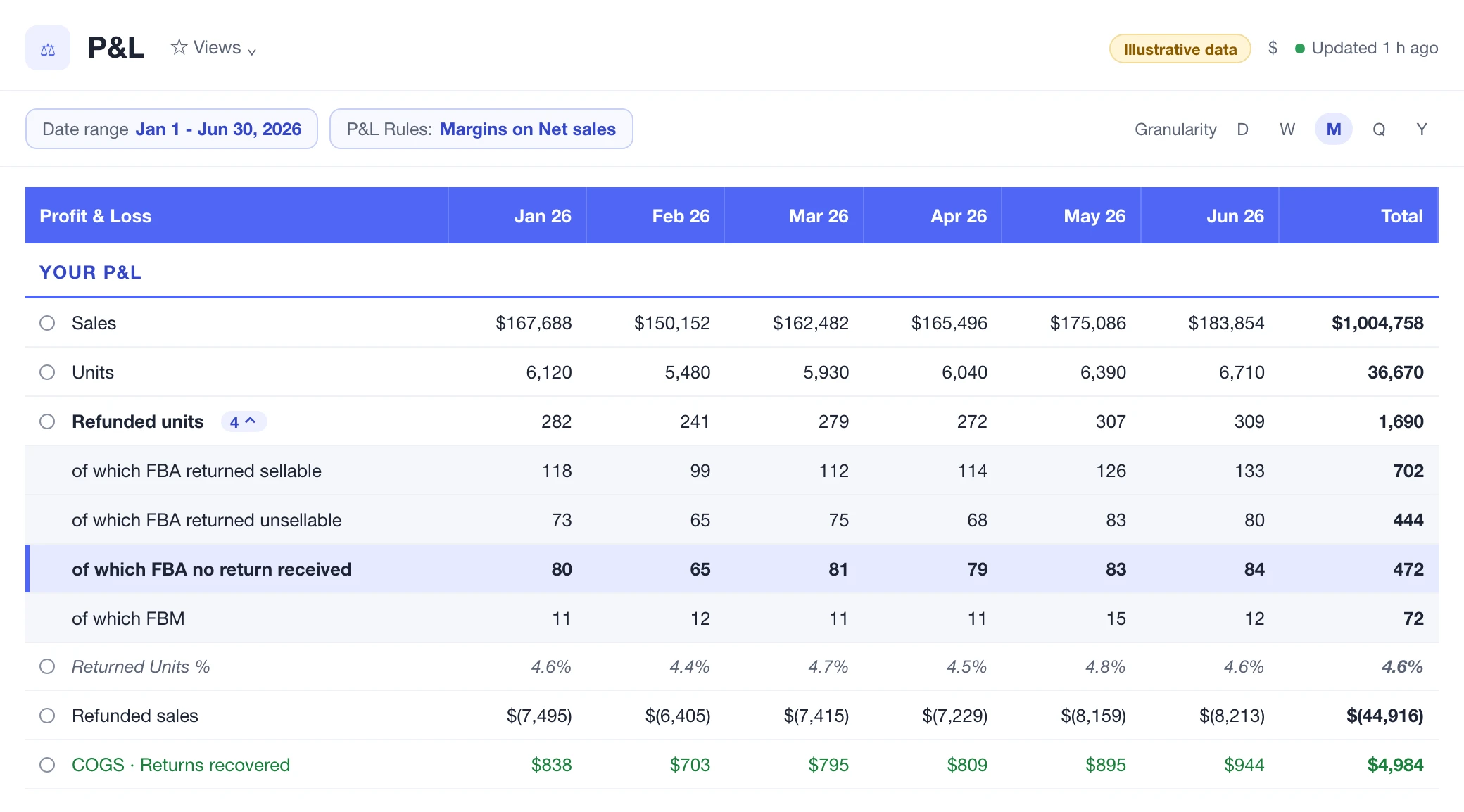
Nova splits every refunded unit by what physically came back. The highlighted line is refunds with no return received. Illustrative data.
TL;DR - Key Takeaways
•US FBA sellers can offer returnless refunds on items up to a maximum price they choose, between $1 and $75. There is no program fee.
•For the median account in a one-off Nova analysis, 34% of refunded FBA units came back sellable and 22% never came back.
•Getting a unit back is worth cost of goods times your sellable rate. If that is below the returns processing fee you would pay, returnless is cheaper.
•Recent refunds look unreturned while parcels are in transit. Judge returnless exposure on refunds at least six months old.
How Amazon returnless refunds work for sellers
A returnless refund gives the customer their money back and lets them keep the item. Amazon launched FBA returnless resolutions in the US on 13 August 2024, Supply Chain Dive reported. Items priced above $75, dangerous goods, heavy and bulky items and customers with a history of returns abuse are excluded. There is no program fee. Gopal Pillai, Amazon's VP of Worldwide Returns and ReCommerce, said it could be particularly convenient for international sellers and businesses with low-cost items.
In November 2025 Amazon let US FBA sellers enroll by price. You choose a maximum item price between $1 and $75 in the FBA returns evaluation and ownership settings, and products at or below that price can be refunded without a return.
Seller-fulfilled orders follow a different path. You set returnless rules for them in your return settings in Seller Central, as Amazon's Returnless resolutions help page explains. If you charge restocking fees on returns you handle yourself, the restocking fee guide covers how they interact with refunds.
The practical difference: on FBA, Amazon decides per refund within the price limit you set. On seller-fulfilled orders, your own return settings decide.
What a returnless refund costs you
A returnless refund costs you the unit and nothing else. The real question is what you would have got back if the customer had returned it. Every refunded unit ends in one of three outcomes:
Returned sellable. The unit goes back into stock, so you recover its cost of goods.
Returned unsellable. The unit comes back damaged or opened. You have nothing to resell, and you may still pay for the return.
No return. Nothing comes back, but there is no return handling, storage or removal either.
The refund itself costs the same in all three cases. Amazon returns the referral fee on a refunded order but keeps a refund administration fee out of it, as the seller fees guide explains. Returnless changes only what happens to the unit.
All figures in this example are illustrative.
Price $14.99.
Cost of goods $4.00.
Sellable rate for this product 34%.
Returns processing fee on this return $2.21.
Expected value of getting the unit back = cost of goods x your sellable rate for that product. If that is lower than the returns processing fee you would pay on the return, returnless is the cheaper outcome.
Here, $4.00 x 34% = $1.36. That is below the $2.21 fee, so letting the customer keep the item saves $0.85 per refund on average. If the same product came back sellable 70% of the time, getting it back would be worth $4.00 x 70% = $2.80, above the fee, and you would want the return.
The returns processing fee does not apply to every return. Apparel and shoes pay it on every returned unit, other categories only above a return-rate threshold; the fee tables have the rates. When no fee applies, the units that come back unsellable still have to be removed or disposed of, so the rule leans toward returnless on cheap items either way.
How many refunds actually come back
Fewer than most sellers assume. We looked at what physically happened to refunded FBA units across Nova accounts.
34%
For the median account, 34% of refunded FBA units came back sellable and 22% never came back at all, for refunds issued October 2025 to March 2026.
Pooled across all units: 43% sellable, 28% unsellable, 29% no return received. One-off analysis of anonymised, aggregated Nova data, measured 8 October 2026, covering Seller Central accounts with at least 50 refunded FBA units. Not a benchmark. Source: Nova analysis.
Every month in that window had at least six months to settle. That matters, because the same accounts' refunds issued in September 2026 still read 49% "no return received", against roughly 29% for refunds six months old or more. Parcels in transit look like returnless refunds until they arrive.
So never judge returnless exposure on the last few months. A spike in unreturned units in a recent month is usually returns that have not landed yet. If units stay unreturned long after the refund, check whether a lost return qualifies for a claim with the reimbursement guide.
Run it in Claude
For refunds older than 6 months, show refunded units by SKU split into returned sellable, returned unsellable and no return received, and list the SKUs where more than 30% of refunds never came back.
Setting your returnless price threshold
Set the threshold from your products, not from a catalogue-wide guess. Take the sellable rate per SKU from settled refunds, multiply it by cost of goods, and compare the result with the returns processing fee that SKU would pay.
Sort the SKUs by price. Products where returnless wins usually cluster at the low end, where cost of goods is small. Set the maximum price just above the most expensive product that still passes the rule. If a product priced below the line fails it, because it comes back sellable often, that tells you where the threshold is costing you money.
Re-check the threshold each quarter. Sellable rates move with packaging, listing accuracy and the mix of customers, and a product that was cheap to lose can become worth recovering after a cost increase. Products with a high share of unreturned refunds also deserve a look at the listing itself; the return rate analytics guide covers that side.
Tracking returnless refunds in Nova
In the Nova P&L, Refunded units opens into four lines: of which FBA returned sellable, of which FBA returned unsellable, of which FBA no return received, and of which FBM. Nova matches each refund to Amazon's FBA returns report by order, so the three FBA lines add up exactly to the refunded FBA units.
"No return received" means FBA units refunded with no physical return received to date: the customer kept the item through a returnless refund, or the parcel never reached the warehouse. Recent months are still settling, and Nova flags periods younger than 180 days.
FBM refunds sit in their own line because Amazon's FBA returns report cannot see seller-fulfilled orders. Nova does not count them as unreturned.
"COGS · Returns recovered" credits back the cost of goods of units that came back sellable, dated the day the return reached the warehouse. A refund with no return recovers nothing, so returnless refunds show up in your margin exactly as they cost you.
The same split is in Nova MCP as returnedSellableUnits, returnedUnsellableUnits and notYetReturnedUnits, and in Data Share, so you can run the threshold test above per SKU in Claude.
There is no program fee. You still refund the customer and lose the unit, and Amazon returns the referral fee minus a refund administration fee, as on any refund. What you save is the return shipping, the returns processing and any storage or removal of the returned unit.
Since November 2025, US FBA sellers can enroll in returnless resolutions by price and choose a maximum item price between $1 and $75. Items above $75, dangerous goods, heavy and bulky items and some other products are not eligible.
For orders you ship yourself, returnless rules are set in your return settings in Seller Central, separately from the FBA program. Amazon's Returnless resolutions help page explains the options.
Amazon does not label each refund as returnless in your reports. Nova matches every FBA refund to Amazon's FBA returns report by order and splits refunded units into returned sellable, returned unsellable and no return received. Units with no return include returnless refunds and parcels that never reached the warehouse.
Returns take time to reach the warehouse, so recent refunds look unreturned until the parcel arrives. Nova flags periods younger than 180 days. Judge returnless exposure on refunds that are at least six months old.
The bottom line
Most refunded units were never coming back sellable. Measure the sellable rate per product on settled refunds, compare cost of goods times that rate with the return fee, and set your price limit where returnless stops paying.
Continue Learning
Explore more expert insights to grow your Amazon business