Amazon Creator Connections: The New P&L Expense to Track
Amazon Creator Connections is not a marketing line. It is a per-order commission on creator-attributed sales that stacks on top of the referral fee and reverses on refunds. Here is how to model it inside SKU-level contribution margin before the reconciliation becomes a spreadsheet project.
By AntoinePublished Jul 20, 20269 minProfitability
Amazon Creator Connections is not a marketing line. It is a variable cost of revenue that stacks on top of the referral fee, gets charged per creator-attributed order, and reverses on refunds with a lag. Most brands read it out of the Creator Connections dashboard, book it inside a marketing budget, and never see it inside SKU-level contribution margin. This guide covers how the cost actually behaves, how to model it in the P&L, and what to reserve before Q4.
TL;DR - Key Takeaways
•Creator Connections is a per-order commission on creator-attributed sales, additional to (not a replacement for) the standard Amazon referral fee.
•The commission stacks: on a $29.99 SKU in a 15% category with a 10% creator commission, Amazon takes roughly $7.50 before FBA and COGS.
•The Creator Connections dashboard and the Payments report use different date logic (order-date vs. payment-date), so they never reconcile without a manual join.
•The correct P&L grain is SKU-marketplace, applied only to creator-attributed units, in the settlement period the units shipped. Do not spread it across the whole SKU like a marketing budget.
•Refunds reverse the commission in a later settlement. Read contribution margin on a 60-day rolling window during active campaigns; a single week will misprice returns lag.
Our take
If you only do one thing this quarter
Pull the last 90 days of Creator Connections attributed sales, join them against your Payments report, and compute one number per active campaign: contribution margin per creator-attributed unit after commission, referral fee, FBA, and COGS. If the number is under your portfolio floor, cut the commission rate or pause the campaign. Nova is shipping this join as a native line inside the P&L so it becomes a review, not a spreadsheet project.
Best fit if
•Brand managers running Creator Connections campaigns above ~$2k/month in commission
•Finance leads who close monthly P&L across multiple Amazon marketplaces
•Agencies who bill on contribution margin and need creator cost inside the same view
Skip if
•Sellers who have never enrolled a creator campaign (start with Amazon's help doc first)
Why Creator Connections is a P&L problem, not a marketing problem
Most brands book Creator Connections spend the same way they book influencer sponsorships: a monthly line inside a marketing budget, reconciled once a quarter. That worked when creator commission was a rounding error. It stops working the moment commissions cross a percent or two of category revenue, because the cost has three properties that a marketing line does not:
It is per-order. Every creator-attributed order carries the commission. Spend scales with revenue, not with a budget cycle.
It is SKU-attributable. Amazon reports the attributed order down to the ASIN, which means the cost has a natural home inside SKU-level contribution margin. Treating it as a shared marketing bucket destroys the attribution Amazon just handed you.
It reverses on refunds. Returns claw the commission back in a later settlement, so the cost is time-shifted. A one-week margin view will overstate cost during a promo peak and understate it two weeks later.
Read Amazon's own program description on the Creator Connections help hub and it is clear the program was designed as a variable, per-order commission, not a fixed retainer. The finance work is to book it that way.
How the fee actually works
The brand configures a campaign in the Amazon Advertising console, sets a commission rate (commonly 5 to 20 percent), and picks the ASINs in scope. Creators opt into the campaign, publish content, and get an attribution link Amazon controls. Every order that lands through that link and ships successfully triggers the commission at settlement. The mechanics are documented in Amazon's Creator Connections Getting Started Guide.
The fee stack on a $29.99 unit in a 15% referral category with a 10% creator commission looks like this:
Gross unit revenue: $29.99
Amazon referral fee (15%): -$4.50
Creator commission (10%): -$3.00
FBA fulfillment (small standard illustrative): -$4.75
COGS + inbound (illustrative): -$8.00
Contribution margin per unit: about $9.74 (32% CM)
Model the same unit without the creator commission and CM is around $12.74 (42%). A 10 percentage-point contribution-margin swing per creator-attributed unit is the number that determines whether the campaign compounds or bleeds. The rate is not the mistake; the mistake is not reading it against contribution margin at the SKU grain before the campaign runs.
Modeling shortcut
Before launching a campaign, run one row per candidate ASIN with the commission rate baked into the fee stack. If contribution margin drops below the portfolio floor at the commission rate you would need to attract creators, the ASIN is not a Creator Connections candidate at all. Pick a different SKU, or accept that the campaign is a promo, not a margin play.
Where the cost lives in Seller Central today
Two systems of record, three definitions of "cost":
Creator Connections dashboard. Attributed sales, attributed units, and creator payouts. Uses order-date. Best for campaign performance, worst for finance close.
Payments report (settlement). Creator commission appears as a deduction line inside each settlement period. Uses payment-date. Best for cash reconciliation, but does not carry the ASIN grain the campaign dashboard has.
Business Reports. Sessions and units at the ASIN level, no view of which units were creator-attributed. Useful for sanity-checking whether Creator Connections is lifting sessions on the ASINs in scope.
Reconciling these three is where the manual work happens. The Creator Connections dashboard says you spent $4,200 in commission in July on order-date; the Payments report shows $3,100 on payment-date because half of July's commissions settle in early August. Neither is wrong. They answer different questions. If your finance team has ever asked "why does the marketing dashboard not match the settlement?", this is the answer.
Modeling Creator Connections into contribution margin per SKU
The correct grain is SKU-marketplace-week, allocated only to creator-attributed units in that window. Not spread across the SKU, not booked as a monthly marketing lump. The formula:
Creator cost per SKU-week = attributed_units × unit_price × commission_rate, deducted from that SKU's contribution margin in the week the units shipped, with a claw-back adjustment in the week the refund settled.
Two implications operators miss:
Marketplace-level rates. If you run the same ASIN in the US and DE with different commission rates (currency, category referral differences, campaign strategy), the SKU carries two different creator-cost figures depending on the marketplace. Roll up at your peril.
Refund lag. A 20 percent return-rate SKU with a 10 percent creator commission has a materially different economic profile than a 5 percent return-rate SKU with the same commission, because Amazon reverses the commission on refunds. The gross number lies; the net-after-refund number is the one that goes on the P&L.
Get Creator Connections spend inside your SKU-level P&L
Nova ships Creator Connections cost as a native line in the P&L view, joined against settlements and refunds. 14-day free trial, no card.
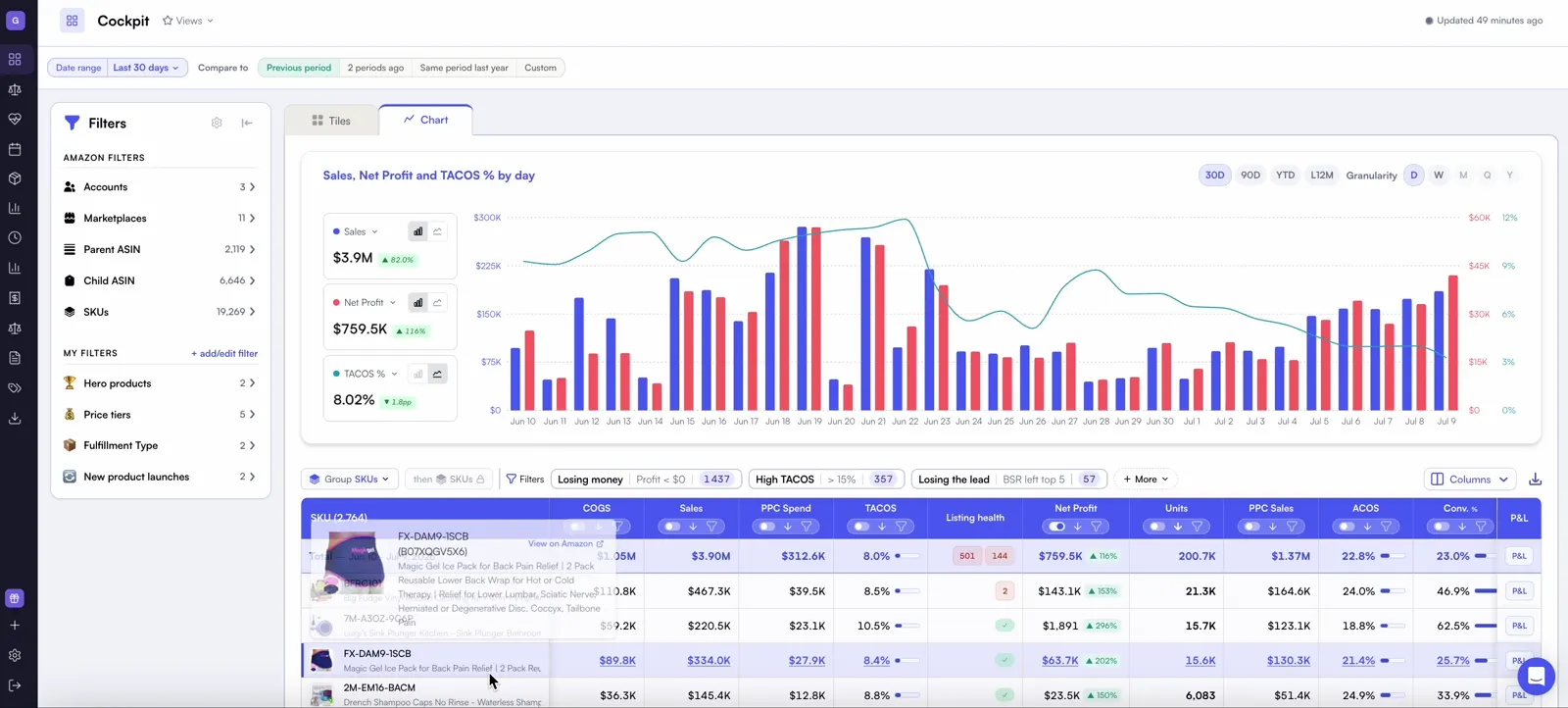
Creator Connections spend lands as a native P&L line alongside referral fees and FBA, at SKU-marketplace grain.
Nova is adding Creator Connections spend as a native cost line inside the Amazon P&L. The join runs at SKU-marketplace-week: attributed units from the campaign feed, commission from settlements, refund reversals from the returns feed, all rolled into the same contribution-margin row already used for referral fee and FBA. Segment by campaign, brand, or portfolio using Custom Breakdowns. The point is not a separate creator dashboard; it is that contribution margin per SKU includes creator cost by default rather than as a spreadsheet reconciliation.
Forecasting spend for Q3 and Prime Big Deal Days
Creator spend does not behave like PPC. It cannot be capped at the account level the way a Sponsored Products daily budget can, and creators publish on their own schedule. Two forecasting rules that hold up in practice:
Reserve as a percentage of category revenue. If your Creator Connections attribution has been running at 3 to 6 percent of covered-ASIN revenue year-to-date, reserve 6 to 10 percent for a Q4 or Prime Big Deal Days push. Peaks pull creator volume forward.
Set the pause rule before you set the budget. Write down the SKU-level contribution-margin floor that triggers a campaign pause, and make sure the operator watching the dashboard has authority to pause without a meeting. A campaign that misses the floor for two weeks in a row is unlikely to recover inside the same quarter.
For agencies running the same discipline across a portfolio, the brand manager view is the natural home for the pause rule, because the person who owns the SKU also owns the commission call.
Common mistakes that mask the real cost
Booking Creator Connections inside "marketing" instead of "cost of revenue". The line moves gross margin, not marketing spend. Booking it as marketing overstates gross margin and understates true CM every month.
Reading the dashboard, not the settlement. Dashboard order-date figures inflate current-month spend and hide the refund reversal that lands two weeks later.
Uniform commission rates across a mixed catalog. A 10 percent rate on a 42% CM SKU is fine; on a 22% CM SKU it is a loss. Rate by SKU, not by campaign.
No pause rule. Campaigns run until someone gets around to reviewing them. Set the SKU-level CM floor that triggers a pause and put the authority to pause with the operator, not a monthly meeting.
Ignoring refund lag on short windows. A weekly CM view during a promo will misprice returns. Read on a 60-day rolling window while a campaign is active.
What to reserve for Q4
If your creator-attribution mix is climbing quarter over quarter, do not model Q4 off the Q3 average. Reserve 6 to 10 percent of covered-ASIN revenue for Q4 and Prime Big Deal Days windows and treat the reserve as consumed, not saved, until the settlement lands. Creator volume follows the promo calendar; the commission line does the same.
Where this connects in the wider Nova stack
Creator Connections cost sits alongside Amazon Vine and Subscribe & Save as one of the variable cost lines most brands under-report inside their contribution margin. The pattern is the same across all three: the program is Amazon-native, the attribution is at the ASIN level, and the cost only becomes visible when it is joined into the P&L instead of read from a separate dashboard. Once creator cost is inside contribution margin, the monthly P&L template gets a new line and the number that finance closes on finally matches the number ops has been seeing.
Frequently asked questions
A percentage. The brand sets a commission rate per campaign, and Amazon charges that rate on every creator-attributed order that ships and is not refunded. No platform fee, but the commission stacks on top of the standard referral fee and FBA charges.
No. The commission is additional. On a $29.99 unit in a 15% referral category, a 10% creator commission means roughly $7.50 goes to Amazon (referral plus creator commission) before FBA fees and COGS.
In the Creator Connections dashboard as attributed sales and payouts, and in the Payments report as a deduction line inside each settlement. The two views do not reconcile without a manual join because the dashboard uses order-date and settlement uses payment-date.
Amazon reverses the commission when a creator-attributed order is refunded, but the reversal lands in a later settlement. Over a 60-day rolling window it nets out; inside a single week the return lag can distort contribution margin per SKU.
The bottom line
Creator Connections is a variable cost of revenue, per-order, SKU-attributable, and time-shifted by refunds. Book it inside contribution margin at the SKU-marketplace grain, reconcile the dashboard against the settlement on a 60-day window, and set the pause rule before you set the budget. Nova is adding it as a native P&L line so the reconciliation stops being a spreadsheet project.
Ready to Transform Your Amazon Business?
Join thousands of successful sellers who use Nova Analytics to make data-driven decisions and maximize their profits.

 Claude
 Gemini
 ChatGPT