Orders P&L vs Cash P&L on Amazon: Why Your Profit Never Matches Your Payout
The reference on the two bases of an Amazon P&L: what the orders P&L and the cash P&L each count, how an order's money travels to your bank under DD+7, the six reasons the two never match, the walk from settlement profit to payout, and how to reconcile every settlement to the cent.
Every Amazon business has two P&Ls, whether it knows it or not. One counts what you sold. The other counts what Amazon paid you. They hold the same lines, they describe the same business, and for the same month they never show the same profit. Most reconciliation pain on Amazon comes from reading one while expecting the other.
In short
•The orders P&L dates every amount on the day the order was placed. The cash P&L dates it in the period Amazon released it. Same lines, same rules, different calendar.
•Amazon holds an order's money until seven days after delivery (DD+7) and pays on cycles of about 14 days, so a month's cash always carries earlier orders and leaves later money out.
•A payout is not a profit: it never deducts cost of goods, it carries ad invoices instead of ad spend, and it moves taxes, reserves and transfers that are not profit at all.
•Read the orders P&L to run the business and the cash P&L to close the books. A settlement is reconciled when what is in your P&L plus what is out of it equals the deposit, to the cent.
Two P&Ls, one business
The difference is a single rule: which date an amount belongs to. Everything else follows from it.
The orders P&L puts every amount on the day the order was purchased. A sale placed on 31 October is October revenue, with its referral fee, its FBA fee and its cost of goods, even if Amazon has not charged the fees yet. Until Amazon posts them, those fees are estimates. The last days of the period are brought up to the live orders, which makes this the P&L you can read today, about today.
The cash P&L puts every amount in the period Amazon released it to your balance. Only released money counts. A posting Amazon still holds back is a reserve, not cash, so it waits for the period in which it is released. There is no live overlay: the current period stays open until its settlements close. In exchange, this P&L ties to Amazon's settlement reports one by one, which no orders P&L ever can.
Neither is more correct. They answer two different questions: what did the business sell and earn, and what did Amazon pay for it. A finance team needs the second to close the month. Everyone else runs the business on the first.
Orders P&L and cash P&L at a glance
Orders P&L
Cash P&L
Each amount is dated
The day the order was placed
The period Amazon released it
Sales it holds
Every order of the period
Released postings only, whenever ordered
Amazon fees
Estimated at the order until Amazon posts them
As Amazon charged them
Money held as a reserve
Counted with its order
Left out until released
The last days
Live, up to today's orders
Open until the settlement closes
Cost of goods
Follows the units ordered
Follows the units released
Advertising cost
Spend from the Ads reports
The same spend
It ties to
Orders, sales and ad reports
Each settlement report, to the cent
Read it for
Pricing, ads, margins, daily decisions
Month-end close, cash planning, payouts
How Amazon moves money from an order to your bank
To see why the two never agree, follow one order. Take a unit ordered on 28 October, shipped on 29 October and delivered on 31 October.
Ordered, 28 October. The orders P&L counts the sale and estimates its fees. Nothing has reached your balance.
Shipped, 29 October. Amazon posts the sale and its fees to your account, but as a deferred transaction: the money is there and you cannot have it yet.
Released, 7 November. Under Amazon's delivery date policy, known as DD+7, an order's funds are released seven days after delivery. North American marketplaces moved to it on 12 March 2026. The cash P&L counts the sale now, in November.
Settlement closes, 20 November. Most sellers are paid on a cycle of about 14 days. Everything released between 6 and 20 November is grouped under one settlement.
Deposited, 22 November. Amazon wires the settlement's balance, less what it keeps back. The bank sees it a few days later.
One order, three months of meaning: October revenue in the orders P&L, November revenue in the cash P&L, and a deposit that also contains orders from mid-October and leaves out orders from mid-November. Multiply that by every order of the month and the two P&Ls drift apart by design.
How the data shows it
Amazon's own Finances API labels every transaction with its status: RELEASED, DEFERRED, or DEFERRED_RELEASED once a deferred amount has been paid out. A cash P&L is built from the released postings only; the deferred ones are a reserve that waits for its release. That one field is the difference between money posted and money you can spend.
Why the two P&Ls of the same month never match
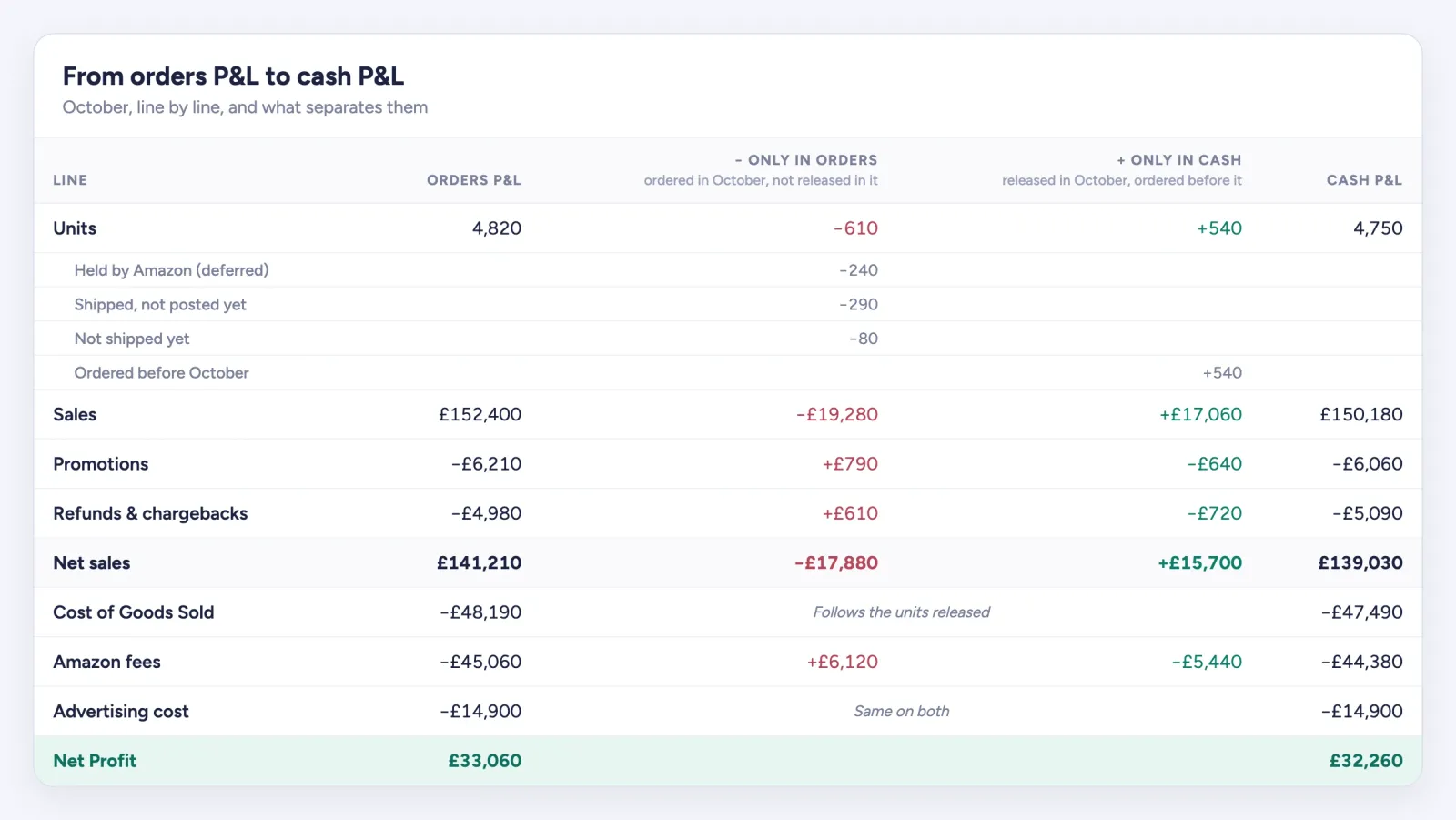
Put October's two P&Ls side by side and every gap falls into one of two columns. Only in orders: ordered in October, not released in it. Only in cash: released in October, ordered before it. Six mechanisms fill those columns.
Units Amazon holds back. Delivered late in the month, released next month under DD+7.
Units shipped but not posted yet, and units not shipped yet: in October's orders, in nobody's cash.
Earlier orders paid now. September orders released in early October appear in October's cash and in September's orders.
Fees estimated against fees charged. The orders P&L estimates fees at the order; the cash P&L reads what Amazon charged. Any difference between the two is a line of its own.
Exchange rates. A sale in euros is converted at the rate of the order day in one P&L and of the posting day in the other.
Lines with no order. Account-level charges and other postings that belong to no order exist only on the cash side.
Two lines move only with the units. Cost of goods follows the units released, so it shifts with them, never on its own. Advertising cost is the same on both sides, because both read the spend from your Ads reports.
October read both ways, made-up figures. 4,820 units ordered, 4,750 released: 610 are only in orders (240 held by Amazon, 290 shipped but not posted, 80 not shipped yet) and 540 are only in cash, ordered in September. Net profit: £33,060 on orders, £32,260 on cash.
Notice what the example does not say. The cash P&L is not "lower because money is missing". The £800 between the two net profits is timing, fees and rates, every pound of it explained. Next month, most of the units held back in October come back on the cash side.
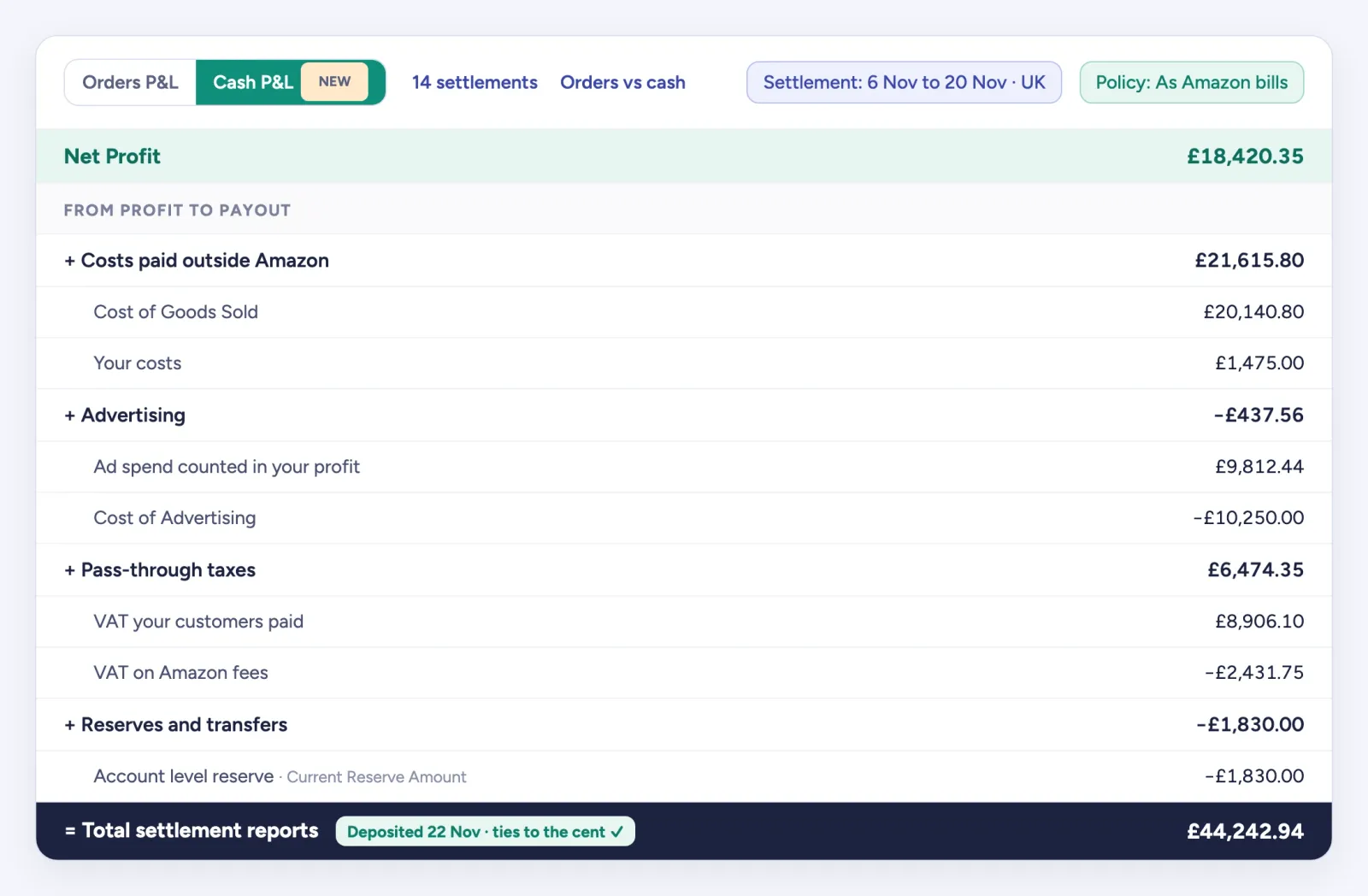
Even on the cash basis, the profit of a settlement is never the amount Amazon wires. A payout is money moving through your Amazon balance, and some of that money is not profit while some of your costs never pass through it. Five groups separate the two:
Costs paid outside Amazon. Cost of goods and your own costs lower your profit, but you paid your supplier, your team and your 3PL yourself. Amazon never deducts them, so they are added back.
Advertising. Your profit counts the ad spend of the period. The payout carries Amazon's ad invoices instead, which arrive in blocks when spend reaches a billing threshold. Add back the spend, take out the invoices, and the difference evens out from one payout to the next.
Fees you excluded. If your P&L leaves a fee out on purpose, such as inbound freight you already count in cost of goods, Amazon still took it from the payout. It becomes a reconciling line.
Pass-through taxes. VAT your customers paid, sales tax Amazon collects and remits for you, VAT Amazon charges on its own fees, tax withheld at source. None of it is profit; all of it moves through the payout.
Reserves and transfers. Money held back at account level, a previous negative balance recovered, amounts charged to your card, transfers between your marketplaces, failed bank transfers, Amazon Lending repayments.
When a settlement is read in another currency than Amazon paid in, a sixth line, exchange rate differences, closes the walk. On a closed settlement, anything still unexplained shows as one line, unallocated, so it can be looked at instead of hidden in a total.
One UK settlement, made-up figures. Net profit £18,420.35. Add back £21,615.80 of costs paid outside Amazon, take £437.56 for ad invoices above the spend, add £6,474.35 of pass-through VAT, take £1,830.00 of reserve: £44,242.94, the amount deposited.
How to reconcile a settlement to the cent
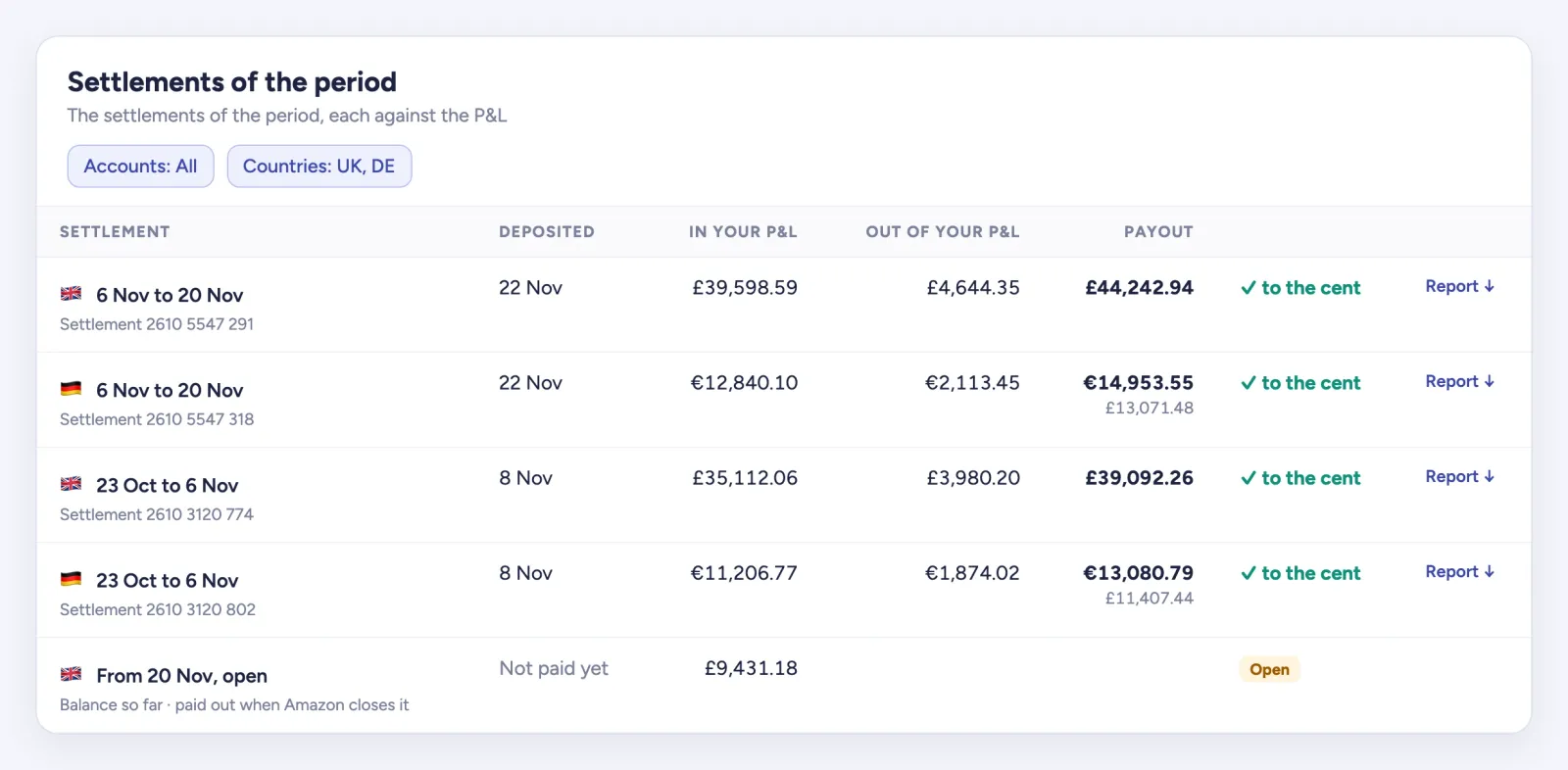
A reconciliation is finished when one equation holds for every settlement: what is in your P&L plus what is out of it equals the payout. The method:
Read the P&L of that settlement alone, on the cash basis, in the settlement's own currency. Applying an exchange rate twice never lands on the cent.
Walk from net profit to the deposit through the groups above: costs paid outside Amazon, advertising, excluded fees, pass-through taxes, reserves and transfers.
Check the total against the settlement report, not the Payments summary. The report is the only file with every posting on its own row.
Treat open settlements separately. A settlement Amazon has not closed has a balance so far, not a deposit. Its lines still move.
Name what does not tie. A posting Amazon filed under another settlement, a line with no P&L category: list it, never absorb it.
Every settlement of the period against the P&L, made-up figures. Each paid settlement ties; the open one shows its balance so far.
Which team should read which P&L
Operators, brand and advertising teams read the orders P&L. A price change, a deal or a campaign shows on the day it happens, with the margin it earns, and the last days are live. Waiting for settlements would mean steering two weeks late.
Finance teams read the cash P&L. Month-end close, cash planning and the conversation with the bank all start from what Amazon released and paid, settlement by settlement. It is also the P&L to hand an auditor, a lender or a buyer in due diligence, because every figure traces to an Amazon report.
Agencies and groups with many accounts need both, and the bridge between them, because the question "why does your report not match our books?" is asked every month.
One note on accounting. An orders P&L is a management view dated by order. Statutory accrual accounts usually recognise revenue when the sale is fulfilled, which is neither the order date nor the release date. That choice belongs to your accountant; the cash P&L is what reconciles to the deposits whichever policy they follow.
Five mistakes that break the reconciliation
Adding settlements up by month. A 14-day settlement straddles two months. Split it by the days it covers, or read the month on the cash basis directly.
Comparing a cash month with order-date fees. Estimated fees on one side and charged fees on the other create a gap that is not real.
Counting advertising twice. Ad spend from the Ads reports and ad invoices from the settlement are the same money seen twice. Keep the spend in profit and the invoices in the walk.
Reading deferred money as lost money. A reserve is cash that has not arrived yet. It belongs to the period in which Amazon releases it.
Mixing currencies. A settlement is paid in one currency. Reconcile it in that currency first, then convert the result once.
How Nova shows both
Nova's P&L has an Orders P&L and a Cash P&L switch. Same lines, same P&L rules, every Amazon fee on its own line. On the cash side, pick a settlement and the P&L walks from net profit down to the payout; open the settlements of the period and each paid one is checked to the cent, with Amazon's report a click away; open Orders vs cash and the two P&Ls of the month sit side by side with what separates them. The cash P&L covers Seller Central accounts.
AI assistants connected to Nova read the same two bases: any P&L line on the cash basis, and the bridge between the orders and the cash P&L, month by month or settlement by settlement. The order vs cash playbook gives Claude or ChatGPT the steps to close a month.
The P&L dated by the day each order was placed, live for the last days.
Cash P&L
The P&L dated by the period Amazon released each amount, released money only.
Settlement
The postings released over one payment cycle, usually about 14 days, and the amount deposited at its close.
Deferred transaction
Money posted to your account that Amazon holds as a reserve until it releases it.
DD+7
Amazon's delivery date policy: an order's funds are released seven days after delivery.
Cost of Advertising
Amazon's name for the ad invoices taken from a payout when ads are charged to your Amazon balance.
Pass-through tax
Tax that moves through a payout without being profit, such as VAT collected or sales tax Amazon remits.
Frequently asked questions
Both list the same lines, from sales to net profit. The orders P&L puts every amount on the day the order was placed, so it shows what you sold in a period. The cash P&L puts every amount in the period Amazon released it, so it shows what Amazon actually paid you and ties to your settlement reports.
Because a payout is not a P&L. It holds money from orders placed in earlier periods, leaves out sales Amazon still holds as a reserve, carries ad invoices and taxes that move through your Amazon balance, and never deducts your cost of goods or your own costs. Walk from net profit to the deposit line by line and the gap is explained to the cent.
Use the cash P&L to tie the month to what Amazon paid and to your bank, settlement by settlement. Use the orders P&L for pricing, advertising and daily decisions. How revenue is recognised in your statutory accounts is your accountant's choice, but either way the cash P&L is what reconciles to the deposits.
A deferred transaction is money Amazon has posted to your account but holds back as a reserve. Under Amazon's delivery date policy, often called DD+7, an order's funds are released seven days after delivery. Until then the money is not cash, so a cash P&L leaves it out and counts it in the period it is released.
Most sellers are paid on a settlement cycle of about 14 days, so one settlement often starts in one month and ends in the next. A monthly cash P&L counts each released amount on its own day, and a settlement that runs past the month is split between the two months it covers.
Ad spend is the same: both read it from your Amazon Ads reports, by day and by product. What differs is the payout. When ads are charged to your Amazon balance, the settlement carries Amazon's ad invoices, which arrive in blocks when spend reaches a billing threshold. So one payout can hold several weeks of ads and the next none, while your profit still counts the spend of the period.
Read the P&L of that settlement alone, on the cash basis. Then add back what lowers your profit but never leaves with the payout (cost of goods, your own costs), swap your ad spend for the ad invoices the payout paid, and add the taxes, reserves and transfers that pass through your Amazon balance. The result is the amount deposited. What is in your P&L plus what is out of it equals the payout.
Only its timing. In the cash P&L, cost of goods follows the units Amazon released in the period, so a unit sold on the last day of October and released in November carries its cost in November. The unit cost itself does not change.
The bottom line
The orders P&L tells you what the business earns; the cash P&L tells you what Amazon paid for it. Both are right. The work is in the bridge between them: timing, reserves, fees, rates, and the money that moves through a payout without being profit. Once every settlement ties to the cent, the two P&Ls stop being a debate and become two views of one business.