Amazon Seller Flex in 2026 - The Operator P&L Guide
Amazon Seller Flex (and its US/EU sibling Seller Fulfilled Prime) trades FBA fees for your own labor, rent, and SLA responsibility. Here is how the P&L actually changes line by line, the SLA gates that decide viability, and the migration checklist for brands weighing the switch.
Amazon Seller Flex is not a fee discount. It is a trade: you take back the warehouse, the labor, and the SLA, and Amazon takes back the FBA fulfillment fee. Whether the trade compounds or bleeds depends on one number that most brands never compute at the SKU grain. This guide covers what Seller Flex actually is in 2026 (across India, the US, and the EU), how the P&L changes line by line, the SLA gates that decide whether the program is even viable, and the operator checklist that separates a Prime-badge win from a labor-cost trap.
TL;DR - Key Takeaways
•Seller Flex (India) and Seller Fulfilled Prime (US, UK, EU, JP) are the same program with two labels. Same P&L mechanics: no FBA fees in exchange for owning the operations.
•Amazon gates enrollment on ~99% on-time ship rate, under 0.5% cancellation, and 95%+ valid tracking across a qualifying trial. Miss the SLA on rolling 14 to 30 days and you lose Prime status.
•Below ~500 Prime-eligible orders per day per warehouse, the fixed labor and rent overhead usually beats the FBA fee savings. Do the unit-cost math before you enroll, not after.
•The correct P&L comparison is contribution margin per SKU-marketplace on the FBA offer versus the SFP offer, at the same demand, over 60 days. Anything shorter mis-prices returns lag and demand seasonality.
•Most brands who win with Seller Flex use it as an overflow lane (Q4 capacity, restock limits, oversized SKUs) rather than a full replacement for FBA.
Our take
Who Seller Flex is actually for
Run the SKU-level P&L both ways before you enroll. If FBA contribution margin beats SFP at your current volume, Seller Flex is not the answer to your fee problem. If SFP beats FBA on 20+ SKUs by more than 3 points of margin, pilot on those SKUs for one quarter with the SLA and unit-cost tracked weekly. Anything in between, do not touch it yet.
Best fit if
•Brands doing 500+ Prime-eligible orders per day per warehouse, with existing DTC operations
•Portfolios with oversized, hazmat-adjacent, or high-velocity single-SKU lines where FBA fees are punitive
•Aggregators consolidating warehouse capacity across acquired brands and looking to unify fulfillment cost
Skip if
•Sellers under 500 orders/day per site (the labor overhead will not amortize)
•Long-tail catalogs where each SKU moves slowly (fixed labor per pick kills the economics)
•Teams without a WMS, an SLA-grade carrier account, or a warehouse manager on payroll
Amazon Seller Flex is a hybrid fulfillment program. The brand keeps inventory in its own warehouse (or a contracted 3PL), receives orders through Amazon's routing, and ships them under Amazon's Prime SLA. The Prime badge stays on the listing. FBA storage and fulfillment fees do not apply. In exchange, the brand owns the pick, pack, labeling, and hand-off to the carrier, and Amazon controls (and often arranges) the outbound leg.
The name changes by marketplace. In India, Amazon runs the program as Seller Flex, with Amazon staff often auditing (and in some cases co-managing) a partitioned zone inside the seller's warehouse. In the US, UK, EU, and JP, the equivalent is Seller Fulfilled Prime (SFP), which Amazon reopened to new enrollment in late 2023 after a multi-year freeze, with tighter SLAs and a mandatory trial period.
For finance and operations, the two labels behave the same way inside the P&L. Amazon books charges (transportation chargebacks, program fees, refund reversals) inside the settlement report. Everything else (labor, rent, packaging) is your cost of goods to load in.
Why Seller Flex is back on the radar
Three pressures pushed hybrid fulfillment back into the operating conversation in 2026:
FBA fee inflation. Fulfillment fees, inbound placement service fees, and low-inventory-level fees have layered on year after year. For high-velocity or oversized SKUs, the FBA total cost per unit now exceeds what a well-run 3PL can deliver at the same SLA.
Capacity risk. Restock limits, storage caps, and the PBI3 Florida closure earlier this month all reinforced that FBA capacity is not guaranteed inventory placement. A Seller Flex lane is a hedge.
SLA maturity. The carriers most SFP sellers use (regional Prime-eligible carriers, plus Amazon's own outbound network) have caught up to the on-time performance the badge requires. The operational bar is high but no longer moving.
This is the section every "what is Seller Flex" article skips. Below is the delta a mid-price consumable SKU experiences moving from FBA to Seller Flex at 3,000 units/month of Prime-eligible demand. Numbers are illustrative and depend on category, size tier, region, and warehouse. The point is the shape of the change, not the specific figures.
Line
FBA
Seller Flex
Unit price
$24.99
$24.99
Referral fee (15%)
-$3.75
-$3.75
FBA fulfillment fee
-$4.75
$0.00
FBA monthly storage (per unit)
-$0.35
$0.00
Inbound placement service fee
-$0.30
$0.00
Pick-pack labor (own warehouse)
$0.00
-$1.20
Warehouse rent per unit
$0.00
-$0.40
Packaging
$0.00
-$0.55
Amazon-arranged transportation (chargeback)
$0.00
-$3.10
COGS (illustrative)
-$6.50
-$6.50
Contribution margin per unit
$9.34 (37%)
$9.49 (38%)
The headline: at these assumptions, Seller Flex wins by roughly 15 cents per unit, or about $450/month on 3,000 units. That is a real number, but it is not the story. The story is what the assumptions are doing.
Pick-pack labor scales inversely with volume. At 3,000 units/month the labor line is $1.20; at 500 units/month it is closer to $3.50 because the warehouse fixed cost has fewer units to spread across. Below a volume floor, Seller Flex loses cleanly.
Warehouse rent per unit is a portfolio question. If Seller Flex only carries 5 SKUs at 3,000 units each, rent per unit is high. Load 20 SKUs into the same warehouse and it drops. This is why aggregators tend to win on SFP: they have the SKU density.
Amazon-arranged transportation is not optional. In most US SFP configurations, you cannot bring your own carrier for the Prime leg. The chargeback lands on the settlement report and is roughly comparable to (sometimes cheaper than) the FBA fulfillment fee it replaces.
The number that decides it
Contribution margin per SKU-marketplace at expected volume, over 60 days, both ways. Do not compare on gross margin, do not compare on fee total, do not compare on a single week. If the SFP number does not beat the FBA number by at least 2 to 3 points of margin, the operational risk (SLA misses, seasonal capacity crunch, staffing swings) is not worth the trade.
SLA gates: what actually breaks first
Amazon's 2023 SFP relaunch tightened the qualifying bar and the thresholds have not loosened since. In the US, you need to hit these across a 30-day qualifying trial and maintain them after enrollment:
On-time shipment rate: 99%+
Cancellation rate: under 0.5%
Valid tracking rate: 95%+
Delivery on the promised date: 93.5%+
Weekend pickup and delivery coverage across the eligible ZIPs
The one that usually breaks first is on-time shipment. It is not the carrier that misses; it is the warehouse cut-off. A same-day Prime order placed at 2:47 PM local for a 3:00 PM cut-off leaves 13 minutes to pick, pack, label, and stage. Any team without live order routing, WMS wave management, and a manager who can shift labor by the hour will miss the SLA inside a quarter.
Miss the SLA on a rolling 14 to 30 days and Amazon suspends SFP eligibility for the account. The ASINs revert to standard FBM, lose the Prime badge, and conversion craters (typically a 30 to 50% session-to-order drop, depending on category). Getting back in requires a new qualifying trial. This asymmetry (slow to enter, fast to lose, slow to recover) is the reason the operational bar exists.
See Seller Flex profitability at the SKU level
Nova reads settlement charges (transportation chargebacks, program fees, refund reversals) and combines them with your own warehouse cost per unit for true SFP contribution margin. 14-day free trial, no card.
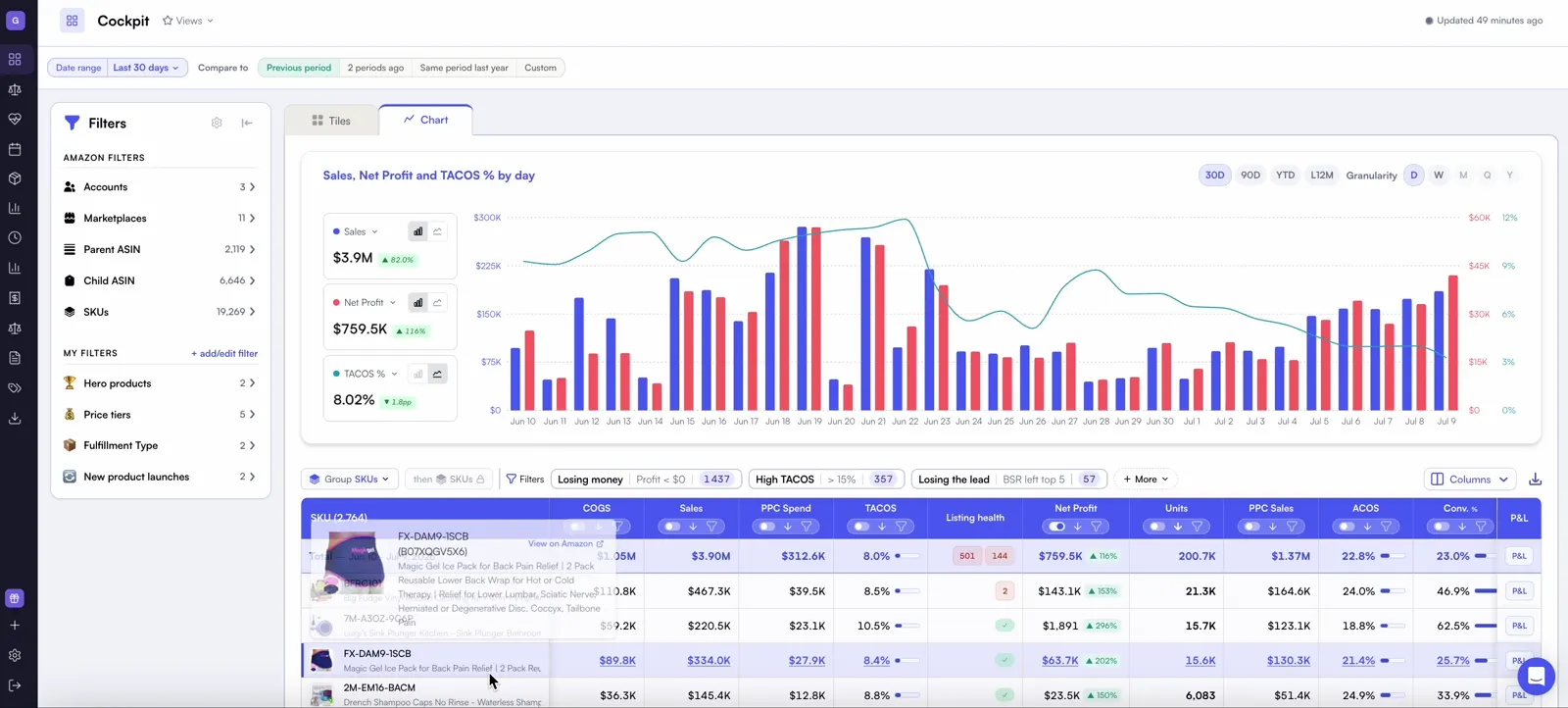
FBA fees, SFP transportation chargebacks, and warehouse cost per unit land as separate P&L lines at SKU-marketplace grain.
Nova reads the settlement report which is where Amazon posts the SFP-related lines (transportation chargebacks, program fees, refund reversals). Combined with SKU-level COGS and a warehouse cost-per-unit line you load in as an overhead allocation, contribution margin per SKU reflects the actual Seller Flex economics rather than the FBA-only view most P&L tools default to. Slice by fulfillment channel using Custom Breakdowns to compare FBA vs SFP on the same SKU side by side.
The point is not a Seller Flex dashboard. The point is that the Seller Flex offer and the FBA offer for the same ASIN show up on the same P&L row, at the same grain, so the pause-and-scale decisions can happen weekly rather than after the quarterly close.
When Seller Flex beats FBA
Oversized or heavy SKUs where the FBA size-tier fee is disproportionate to the pick complexity in your own warehouse.
Hazmat-adjacent goods where FBA acceptance is restricted or slow, and your own facility already handles the compliance.
High-velocity single-SKU brands (subscription supplements, seasonal apparel) where a dedicated pick line beats the FBA multi-SKU average.
Q4 overflow. Run FBA year-round for the base, spin up SFP capacity for October to January to sidestep restock limits.
Aggregator warehouse consolidation. One warehouse serving 15+ acquired brands has the SKU density to make the labor and rent lines work.
When Seller Flex loses
Long-tail catalogs where each SKU moves slowly. Fixed labor per pick kills the economics before Amazon does.
Multi-marketplace expansion. Every SFP program is per-marketplace; running SFP across 23 marketplaces means 21 warehouses or 21 3PL contracts. FBA scales cross-border more cleanly.
Small teams. SFP needs a WMS, a warehouse manager with SLA authority, and a labor plan that flexes intra-day. If the warehouse manager also does invoicing, do not enroll.
Categories with high return rates. Returns processing inside your own warehouse is a real cost line that FBA absorbs into the fulfillment fee.
A four-stage migration checklist
Evaluate. Pull 90 days of unit-level orders for candidate SKUs. Compute contribution margin under FBA (actuals) and under Seller Flex (modeled: strip FBA fees, add labor, rent, packaging, and estimated Amazon-arranged transportation). If margin does not improve by 2+ points, stop here.
Apply and trial. Enroll in the SFP qualifying trial. Ship the pilot SKUs from your warehouse for 30 days. Track on-time ship rate, cancellation, valid tracking, and delivery-on-promise daily. Fix the warehouse cut-off before anything else.
Pilot at grain. Once enrolled, run SFP on 5 to 10 SKUs for a full quarter. Read contribution margin weekly at the SKU-marketplace grain. Compare against the FBA equivalent for the same SKU-marketplace over the prior quarter.
Scale or pause. If SFP wins by more than 2 points of contribution margin AND the SLA is above threshold with slack, add the next tranche of SKUs. If either fails, pause and re-evaluate the labor model. Write the pause rule down before this stage, not after.
Pilot-stage watchouts
Do not pilot on your top revenue SKUs. If SFP fails the trial, losing Prime on your bestseller is a quarter of lost sessions. Pilot on SKUs that are profitable but rank 20 to 40 in your catalog. Failure there is a lesson; failure on the top 5 is a P&L event.
Common mistakes that mask the real cost
Comparing on FBA fees saved, not contribution margin. Saving $4.75 in fulfillment fees means nothing if you add $5.20 in labor, rent, packaging, and transportation.
Ignoring warehouse fixed cost. Rent, WMS licenses, and warehouse manager salary do not scale with orders. Below the volume floor, the fixed cost per unit is worse than the fee it replaces.
Reading SLA on a monthly average. Amazon reads on a rolling window. A great month with one bad week can still cost you SFP eligibility.
Loading warehouse cost as a monthly overhead lump. Load it as cost per unit on the SKU-marketplace P&L or the comparison to FBA is not fair.
Assuming Amazon-arranged transportation is optional. In US SFP, in most configurations, it is not. Model the chargeback line into the P&L before enrollment.
Where this connects in the wider Nova stack
Seller Flex profitability lives in the same layer as settlement reconciliation, FBA storage fee analysis, and multi-marketplace expansion. All three are decisions about fulfillment cost and capacity, and all three need the same underlying view: contribution margin per SKU-marketplace, with the true cost of each fulfillment channel loaded in. Once that view exists, the Seller Flex question stops being "does it save fees" and becomes "at what volume and on which SKUs does it improve contribution margin more than the operational risk it introduces". That is a question a weekly review can answer.
Frequently asked questions
Seller Flex is Amazon's hybrid fulfillment program where a brand stores inventory in its own warehouse and ships Prime-badged orders under Amazon's SLA. Called 'Seller Flex' in India and 'Seller Fulfilled Prime' in the US, UK, EU, and JP. Same P&L mechanics: no FBA fees, in exchange for owning the operations.
For P&L purposes, yes. Seller Flex is the India label; Seller Fulfilled Prime is the US, UK, EU, and JP label. Eligibility rules differ by marketplace, but the cost structure is identical.
Amazon gates on order volume, on-time ship rate (~99%), cancellation rate (under 0.5%), and valid tracking (95%+) across a qualifying trial. Brands under ~500 Prime-eligible orders per day rarely clear the operational bar cost-effectively.
FBA charges fulfillment, storage, inbound placement, and long-term storage. Seller Flex removes those and adds pick-pack labor, warehouse rent per unit, packaging, and outbound transportation (Amazon-arranged, billed on settlement). Above ~100k units/month per SKU family, Seller Flex typically undercuts FBA.
Yes, but only one offer wins the Buy Box at a time. Most operators use Seller Flex as an overflow lane for FBA capacity or restock-limit constraints.
When contribution margin per SKU on the SFP offer drops below the FBA baseline for two consecutive months, or when SLA compliance costs (overtime, expedited freight) start eating the fee savings.
The bottom line
Seller Flex is a labor and rent trade for FBA fees, gated by an SLA that punishes misses fast. It wins for high-velocity, oversized, or aggregator-density portfolios and loses for long-tail catalogs and small teams. Read the decision on contribution margin per SKU-marketplace, over 60 days, both ways. Nova puts the SFP chargebacks and warehouse cost per unit on the same P&L row as FBA so the comparison stops being a spreadsheet project.
Ready to Transform Your Amazon Business?
Join thousands of successful sellers who use Nova Analytics to make data-driven decisions and maximize their profits.

 Claude
 Gemini
 ChatGPT