Comparing general-purpose ETL tools against Amazon-specialized data providers. Real cost analysis, feature gaps, and decision framework for choosing the right solution.
Comparing Airbyte, Fivetran, Stitch, and specialized Amazon data providers to help you choose the right ETL solution for your seller data needs.
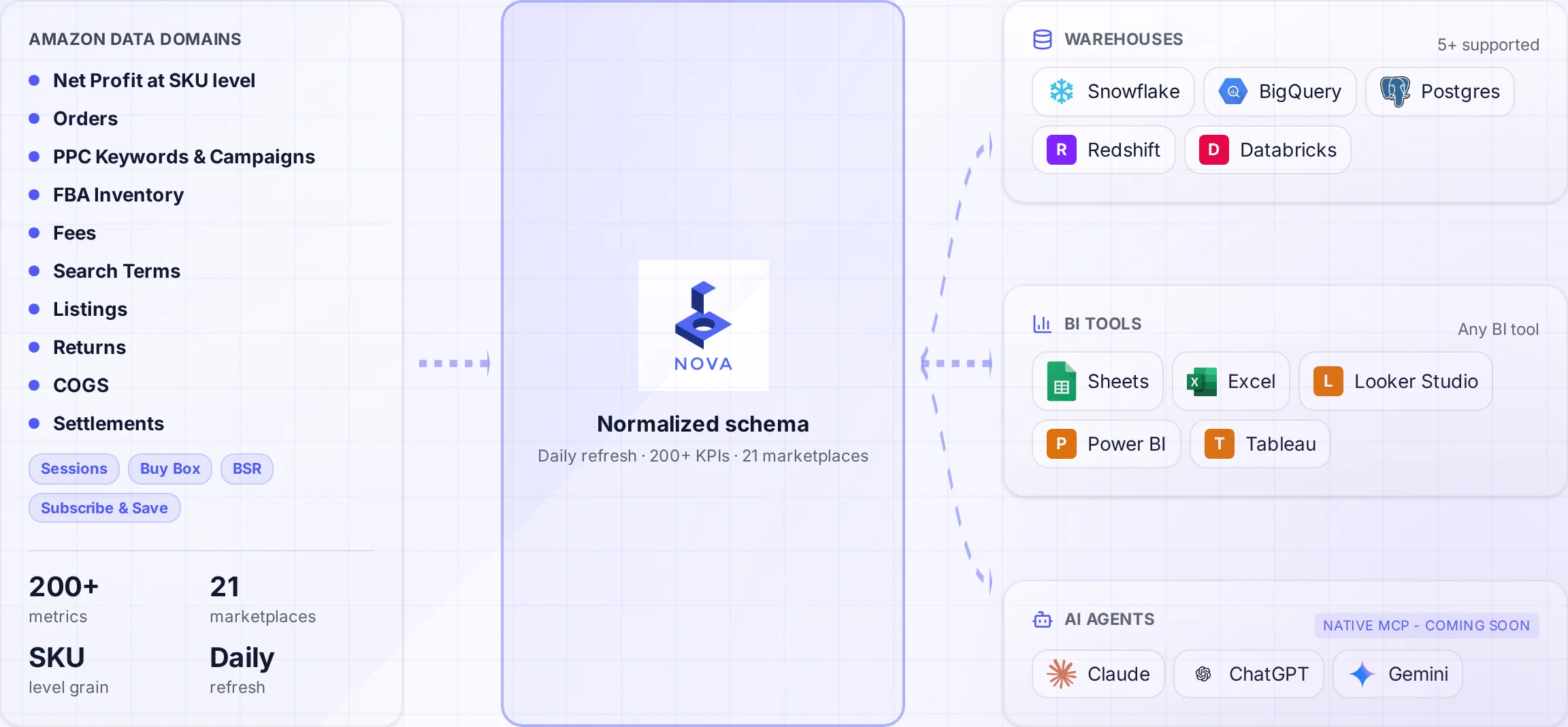
A normalized schema connects Amazon data to the warehouses and tools your team uses.
Moving Amazon seller data from Seller Central to your data warehouse sounds simple. Connect the API, extract the data, load it into Snowflake or BigQuery. Done, right?
Not quite. Amazon's SP-API has 40+ endpoints, aggressive rate limits, and data structures that change without warning. Generic ETL tools weren't built for this complexity. Specialized Amazon data providers were. But which approach actually works for your business?
This comparison breaks down the real differences between general-purpose ETL platforms and Amazon-specific data services. We'll cover costs, capabilities, maintenance burden, and the hidden gotchas that only surface after you've committed to a solution.
The Amazon Data ETL Landscape in 2026
Three categories of solutions compete for your Amazon data pipeline:
Category 1: General-Purpose ETL Platforms
Tools like Airbyte, Fivetran, and Stitch connect hundreds of data sources to warehouses. They offer Amazon connectors as part of broader data integration suites.
Best for: Teams already using these platforms for other data sources who want consolidated tooling.
Category 2: Amazon-Specialized Data Providers
Purpose-built services like Openbridge, DataHawk, and Nova focus exclusively on Amazon ecosystem data. They handle SP-API complexity, normalize data models, and often include pre-built analytics.
Best for: Amazon-heavy businesses needing deep marketplace data without building custom pipelines.
Category 3: Custom-Built Pipelines
In-house solutions using AWS Lambda, Airflow, or custom code to extract and transform Amazon data. Requires engineering resources but offers maximum flexibility.
Best for: Large organizations with unique requirements and dedicated data engineering teams.
According to Gartner's analysis, the ETL market continues growing as companies prioritize data-driven decision making. But for Amazon sellers, the question isn't whether to move data. It's which approach minimizes ongoing headaches.
General-Purpose ETL: Airbyte vs Fivetran vs Stitch
Let's compare the three major general-purpose ETL platforms on Amazon-specific capabilities:
Feature
Airbyte
Fivetran
Stitch
Amazon Connector
Community-maintained
Official connector
Limited support
SP-API Endpoints
15-20 endpoints
20-25 endpoints
10-15 endpoints
Pricing Model
Open source / Cloud tiers
Per MAR (monthly active row)
Per row replicated
Multi-Marketplace
Manual per region
Supported
Manual per region
Data Normalization
Raw only
Raw only
Raw only
Rate Limit Handling
Basic retry
Managed
Basic retry
Est. Monthly Cost
$0-500+
$500-2,000+
$100-500+
Airbyte: Open Source Flexibility
Airbyte's Amazon connector is community-maintained, which means updates depend on contributor availability. The open-source model keeps costs low but shifts maintenance burden to your team.
Airbyte Strengths
Cost: Free self-hosted option, cloud starts at reasonable tiers
Flexibility: Modify connectors to add missing endpoints
Ecosystem: 300+ connectors for consolidating data sources
Control: Self-host for data sovereignty requirements
Airbyte Limitations for Amazon Data
Connector gaps: Missing endpoints for advertising, settlements, FBA inventory
No normalization: Raw SP-API responses require significant transformation
Update lag: Community connectors trail SP-API changes by months
Fivetran: Managed Reliability
Fivetran offers the most comprehensive Amazon connector among general ETL tools. Their managed approach handles rate limits and schema changes automatically. But that reliability comes at a premium.
Fivetran Strengths
Reliability: 99.9% uptime SLA with proactive monitoring
Managed updates: Connector maintained by Fivetran engineering
Schema handling: Automatic schema drift detection and handling
Support: Enterprise support with dedicated account managers
Fivetran Limitations for Amazon Data
Cost: MAR pricing escalates quickly with high-volume sellers
No transformation: Still delivers raw data requiring dbt or similar
Amazon Ads: Advertising data requires separate connector and cost
Black box: Limited visibility into extraction logic
Stitch: Budget Option with Tradeoffs
Stitch (now part of Talend) sits at the low end on price, and its published Amazon connector documentation covers a narrower set of reports than the larger platforms, so more of the Amazon modeling falls on your team.
When Stitch Makes Sense
Stitch works for sellers who only need basic order and inventory data, have limited budgets, and don't require advertising analytics. If you're doing under $500K annually and just need order history in a warehouse, Stitch delivers at the lowest cost.
Amazon-Specialized Data Providers
Purpose-built Amazon data services take a fundamentally different approach. Instead of generic connectors, they offer deep SP-API expertise, pre-normalized data models, and often include analytics layers.
SP-API Coverage
40+
Endpoints typically supported
Setup Time
Hours
vs weeks for custom builds
Data Freshness
Near Real-Time
Hourly or better refresh
What Amazon-Specialized Providers Offer
Unlike general ETL tools, Amazon-focused providers handle the complexity that makes SP-API challenging:
Here's how general ETL platforms stack up against Amazon-specialized providers across key dimensions:
Capability
General ETL
Amazon Specialized
SP-API Endpoint Coverage
15-25 endpoints
40+ endpoints
Data Normalization
None (raw data)
Pre-normalized schemas
Advertising Data
Separate connector/cost
Unified with sales data
Multi-Marketplace
Manual configuration
Unified automatically
Fee Attribution
Not included
SKU-level attribution
Historical Backfill
API limits only (2 years)
Extended history available
Calculated Metrics
Build yourself
Pre-computed (TACoS, margins)
Time to Value
Weeks to months
Hours to days
Ongoing Maintenance
High (your responsibility)
Low (provider managed)
True Cost Analysis
Comparing ETL options purely on subscription cost misses the full picture. Here's what a realistic total cost of ownership looks like:
General ETL Platform: Hidden Costs
Year 1 Cost Breakdown (Mid-Size Seller)
ETL Platform (Fivetran)$12,000
dbt Cloud for transformations$6,000
Data engineer time (setup + maintenance)$40,000
Warehouse compute (transformations)$3,600
Total Year 1$61,600
Amazon-Specialized Provider: All-In Pricing
Year 1 Cost Breakdown (Mid-Size Seller)
Data provider subscription$6,000-18,000
Setup and onboarding$0-2,000
Additional transformations$0-5,000
Total Year 1$6,000-25,000
According to Levels.fyi salary data, a mid-level data engineer costs $150-200K annually. Even dedicating 25% of their time to Amazon pipeline maintenance equals $37-50K in labor costs alone.
Our team has helped 200+ Amazon sellers evaluate their data pipeline options. Get a personalized recommendation based on your specific requirements, budget, and technical capacity.
Use this framework to identify the right approach for your situation:
Choose General ETL (Airbyte/Fivetran) If:
You already use these tools for other data sources
You have data engineers who can build and maintain transformations
Amazon is one of many sales channels (not primary)
You need basic order and inventory data only
Budget allows for transformation layer investment
Choose Amazon-Specialized Provider If:
Amazon is your primary or only sales channel
You need unified sales + advertising analytics
SKU-level profitability matters for decisions
You sell across multiple Amazon marketplaces
You want to minimize engineering investment
Time to insight is critical
Choose Custom Build If:
You have unique data requirements no provider covers
Regulatory compliance requires full data control
You have a dedicated data engineering team
Integration with proprietary systems is critical
You're building data as a competitive advantage
Implementation Considerations
Data Quality and Completeness
The biggest differentiator isn't feature lists. It's data quality. General ETL tools deliver what the API returns. Amazon-specialized providers clean, validate, and reconcile data before delivery.
Data Quality Differences
Fee reconciliation: Specialized providers match fees to orders (general ETL doesn't)
If you're already using a general ETL tool and considering a switch, here's the typical migration approach:
Migration Steps
1. Audit current state: Document what data you're extracting and how it's transformed
2. Gap analysis: Identify what's missing from current solution
3. Parallel run: run new solution alongside existing for validation
4. Data reconciliation: Verify numbers match (or understand differences)
5. Downstream updates: Update dashboards and reports to use new source
6. Cutover: Deprecate old pipeline after validation period
Pro Tip: Parallel Running
Always run parallel systems for at least one full month before cutting over. Amazon data has timing quirks (settlement delays, fee adjustments, inventory reconciliation) that only surface over time.
Frequently Asked Questions
Can I use Airbyte for Amazon data and add transformations later?
Yes, but plan for significant dbt development work. You'll need to build fee attribution, currency conversion, multi-marketplace unification, and metric calculations. Budget 2-4 months of data engineering time for a production-ready transformation layer.
Why is Fivetran so expensive for Amazon data?
Fivetran's MAR (monthly active row) pricing compounds quickly with Amazon's high-volume, granular data. A seller with 10,000 orders/month across multiple reports can easily hit 500K+ rows monthly. Add advertising data and costs escalate further.
Do Amazon-specialized providers support custom data destinations?
Most support major warehouses (Snowflake, BigQuery, Redshift) directly. Some offer API access for custom integrations. Check specific provider capabilities for your target destination.
How do I evaluate data quality between providers?
Request a trial period and reconcile numbers against Seller Central reports. Pay special attention to fee totals, order counts, and revenue figures. Discrepancies reveal how providers handle edge cases.
What happens when Amazon changes their API?
With general ETL tools, you're dependent on connector update timelines. With specialized providers, updates are typically faster since Amazon data is their core focus. Custom builds require your team to implement changes.
Making Your Decision
The right ETL solution depends on your specific context. General tools like Airbyte and Fivetran work well when Amazon is one of many data sources and you have engineering capacity. Specialized providers shine when Amazon is your primary channel and you need depth over breadth.
Consider the total cost of ownership, not just subscription prices. Factor in engineering time, transformation development, and ongoing maintenance. Often, the "cheaper" option becomes more expensive when you account for hidden costs.
For Amazon-focused businesses, specialized data providers typically deliver faster time to value and lower total cost. For multi-channel retailers with existing data infrastructure, augmenting general ETL tools may make more sense.
Next Steps
Audit your current Amazon data needs and gaps
Calculate true total cost of ownership for each approach
Request trials from top candidates in each category
Reconcile trial data against Seller Central as validation
Factor in your team's capacity for ongoing maintenance