Building Amazon data pipelines costs $300K+ and takes 18 months. DaaS delivers normalized, analysis-ready Amazon data to your warehouse in days. Learn what DaaS is, who needs it, and how to evaluate providers.
Building Amazon data pipelines from scratch costs $300K+ and takes 18 months. Data-as-a-Service (DaaS) delivers the same result in days. This guide explains what Amazon DaaS actually is, who needs it, and how to evaluate providers without getting locked into the wrong solution.
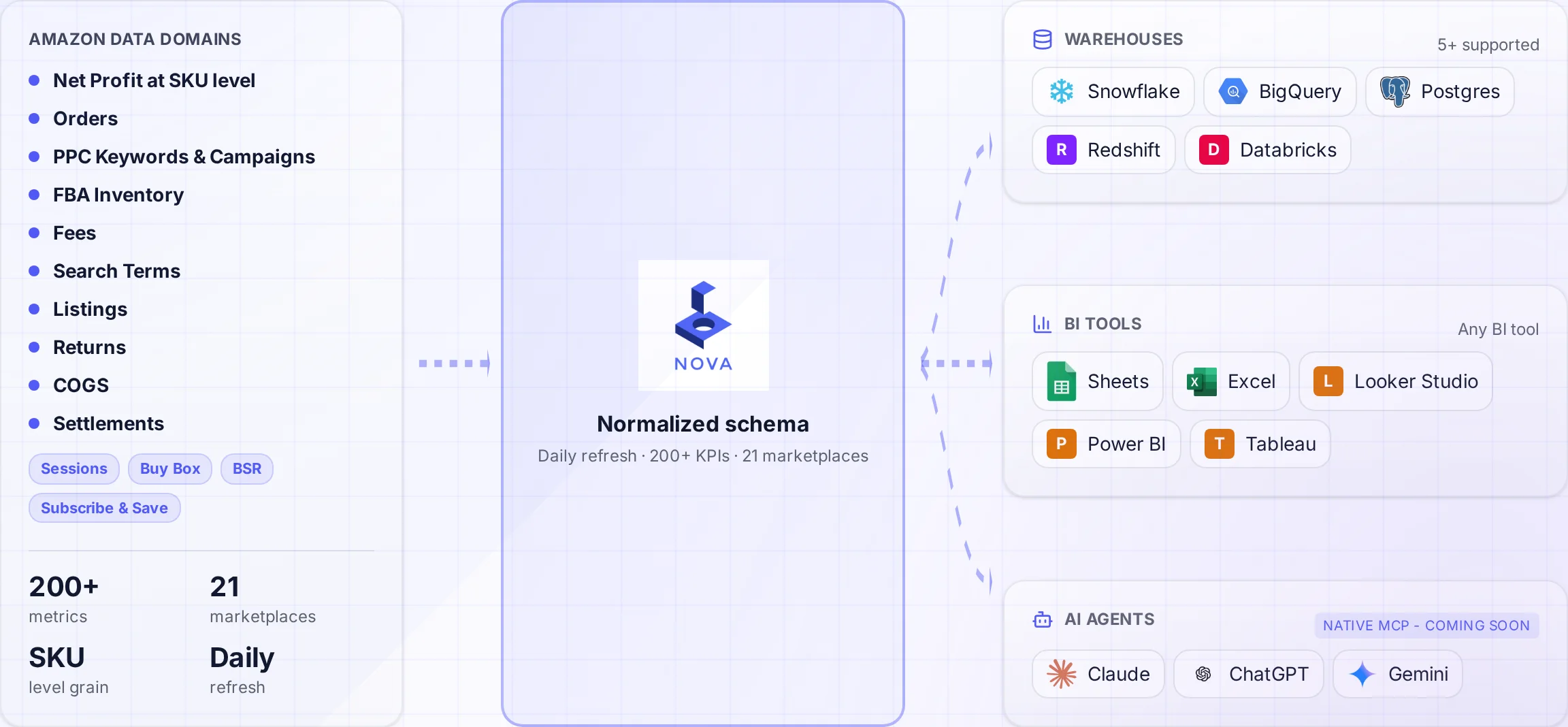
A normalized schema connects Amazon data to the warehouses and tools your team uses.
Every Amazon brand, aggregator, and agency eventually hits the same wall. Seller Central reports are too limited. Spreadsheets break at scale. The obvious solution is to build a data pipeline. The not-so-obvious reality is that 80% of those projects fail, according to Gartner research on data quality initiatives.
Amazon Data-as-a-Service solves this by delivering clean, normalized Amazon data directly to your warehouse or BI tools. You skip the build entirely and start analyzing data in days instead of months.
What Is Amazon Data-as-a-Service?
Amazon DaaS is a category of service that extracts, transforms, and delivers Amazon seller data without requiring you to build or maintain any infrastructure. Think of it as outsourcing your entire Amazon data engineering function to specialists who understand the Selling Partner API inside and out.
Traditional Approach
Build SP-API integration (3-6 months)
Create data models (2-4 months)
Handle rate limits and errors
Maintain schema changes forever
Debug failures at 2 AM
DaaS Approach
Connect Amazon accounts (15 minutes)
Receive clean data in your warehouse
Pre-calculated KPIs ready to query
Automatic schema updates
99.9% uptime SLA
The core value proposition is simple: you get all the benefits of a custom data pipeline without any of the engineering burden. A provider handles the extraction, normalization, and delivery. You handle the analysis and drive business decisions with your P&L analytics.
Who Actually Needs Amazon DaaS?
Not everyone needs DaaS. If you're a single-brand seller doing $500K/year, Seller Central reports plus a spreadsheet probably works fine. But at a certain scale, the math changes dramatically.
Aggregators
50+
Brands under management
Agencies
20+
Client accounts to report on
Brands
$10M+
Annual Amazon revenue
You Need DaaS If You...
Manage multiple Amazon accounts and need unified reporting across all of them with custom analytics
Already use a data warehouse (Snowflake, BigQuery, Redshift) for other business data
Need custom KPIs that Seller Central or dashboard tools don't support
Want to combine Amazon data with Shopify, paid media, or warehouse inventory
Have data engineering bottlenecks and need to ship insights faster
Require audit-ready financials for investors, acquirers, or compliance
Pro Tip: The Build vs Buy Math
A senior data engineer costs $180K/year on average. Building an Amazon pipeline takes 1.5-2 FTE for 18 months. That's $405K-$540K before maintenance. DaaS providers typically charge $500-$5,000/month depending on data volume. The math is clear unless you have very specific requirements that no provider supports.
DaaS vs ETL Tools vs Dashboard Software
Understanding the landscape helps you avoid buying the wrong solution. Here's how DaaS compares to alternatives you might consider for your daily performance tracking:
Dashboard tools show you data. ETL connectors move data. DaaS delivers analysis-ready data. The distinction matters because most teams don't need raw API dumps. They need normalized, calculated, ready-to-query datasets for their product performance analysis.
What Amazon DaaS Actually Delivers
A quality DaaS provider doesn't just replicate Seller Central reports. They transform Amazon's chaotic data into a structured, reliable foundation for analysis. Learn more about the specifics in our normalized Amazon data guide.
Normalized Data Model
Amazon's 200+ fee types get mapped to consistent categories. Multiple identifiers (ASIN, SKU, FNSKU) get unified. Currency conversions happen automatically.
Consistent naming across marketplaces
Unified product identifiers
Standardized date/time formats
Clean NULL handling
Pre-Calculated KPIs
Instead of calculating TACoS from raw ad and sales data, you get it as a column. Same for contribution margin, return rate, and hundreds of other metrics.
Revenue, profit, margin at SKU level
TACoS, ACoS, ROAS calculated
Inventory health scores
Cohort and trend metrics
Fresh Data
DaaS providers refresh data on fixed intervals. Better providers offer hourly refresh. This enables same-day decision making for your advertising cost analysis.
Hourly refresh cycles
Historical backfills (2+ years)
Incremental updates
Change data capture
Data Quality
Amazon's data has gaps, duplicates, and inconsistencies. A DaaS provider handles reconciliation and validation so you get clean datasets. See our guide on why Amazon numbers don't match.
Automated reconciliation
Duplicate detection
Gap filling where possible
Data quality monitoring
Data Delivery Options
DaaS providers typically support multiple delivery destinations. Your choice depends on your existing stack:
Destination
Best For
Typical Setup Time
Snowflake
Enterprise teams with existing Snowflake investment
Most providers support all major warehouses. Nova delivers to Snowflake, BigQuery, and via API for custom integrations.
How to Evaluate DaaS Providers
Not all DaaS providers are equal. Industry research on data governance shows the key differentiators are data quality, freshness, and pre-built value. Here's a framework for evaluation:
Provider Evaluation Checklist
1. Data Completeness
Does it cover all SP-API endpoints you need?
Are advertising, inventory, and financial data all included?
How far back does historical data go?
2. Data Freshness
What's the refresh frequency? (hourly is ideal, 24 hours is outdated)
Is there near real-time streaming for critical metrics?
How quickly are schema changes reflected?
3. Data Quality
What's the claimed accuracy rate? (99%+ is table stakes)
How is reconciliation handled between report types?
Is there documentation for the data model?
4. Pre-Built Value
How many KPIs come pre-calculated?
Are there ready-to-use dbt models or SQL templates?
Is multi-marketplace normalization included?
Pro Tip: Ask for a Test Dataset
Before committing, ask providers for sample data from their schema. Review the actual tables and columns. Check if P&L calculations match your expectations. The difference between providers becomes obvious when you see real data.
An aggregator managing 75 brands uses DaaS to consolidate all Amazon data into Snowflake. Their finance team runs standardized P&L reports across the entire portfolio without logging into 75 Seller Central accounts.
Result: Weekly financial reporting that previously took 40 hours now takes 2 hours.
Agency: Client Reporting at Scale
A 30-person Amazon agency uses DaaS to power client dashboards. Each client gets a custom Looker Studio view built on the same underlying data model. New clients onboard in hours instead of days.
Result: reduced client onboarding from 5 days to 4 hours.
Brand: Cross-Channel Attribution
A $50M DTC brand combines Amazon data with Shopify sales and Meta ads spend in BigQuery. They finally understand how TikTok campaigns affect Amazon organic rank and overall CAC.
Result: Identified that 22% of Amazon sales were driven by off-Amazon marketing spend.
Ready to Skip the Pipeline Build?
Our team can assess your data requirements and show you exactly how Nova delivers normalized Amazon data to your warehouse. Get a custom quote based on your specific needs.