The "gold-rush" era is gone. In 2025, the brands that keep compounding on Amazon do three things better than everyone else: they control their demand, control their costs, and control their risk. That sounds simple until you try to do it at the level where tiny, unsexy advantages (hour-by-hour bidding, inventory placement rules, query-level leakage) add up to defensible profit. Use the short playbook below as a practical starting point.
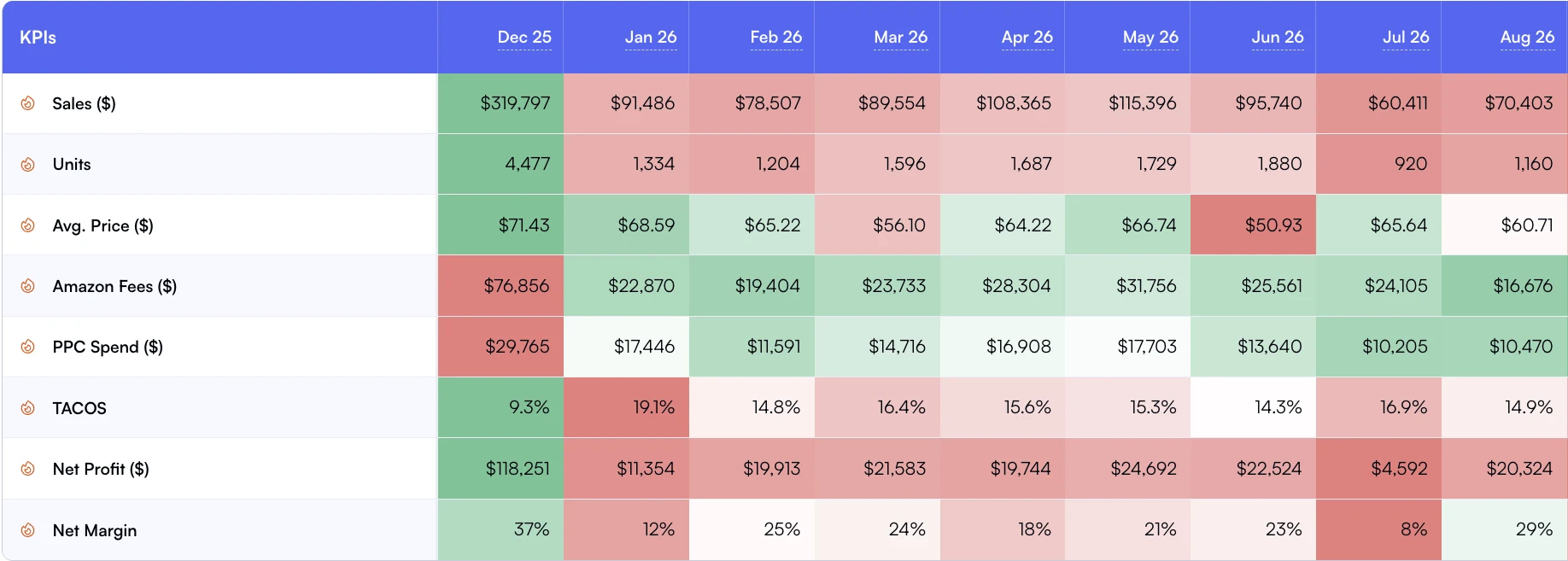
Monthly trends show whether sales growth is keeping pace with profit.
This guide shows you how to build those advantages, with the exact tools and decision rules you'll use week after week. It's written for the operator who opens Seller Central before coffee. With millions of active sellers competing on Amazon, the operators who win are those who build systematic advantages.
1. Make your brand hard to copy
If your product can be knocked off by a cheaper factory or a flashier main image, you don't have a business. You have a trend. Durable brands on Amazon earn two forms of protection: legal + data. Strong brand differentiation consistently delivers higher margins than commodity competitors.
Start with the legal: get into Amazon Brand Registry. That unlocks A+ Content, Brand Stores, more effective IP enforcement, and critically, Brand Analytics, the internal data suite Amazon gives to registered brands.
Now the data: the Search Query Performance (SQP) reports show how shoppers move from impressions → clicks → carts → purchases for the exact queries tied to your brand and ASINs. It's a microscope on where you're bleeding demand. If "stainless steel lunch box" sends you tons of impressions but few clicks, that's a creative/positioning problem; if clicks are strong but baskets are weak, that's an offer/price/pack issue. SQP turns vague "we need better SEO" convos into concrete, query-level fixes. (You can even programmatically pull these via the SP-API report types.)
Real Example
A food-storage brand saw "bento box adult" delivering clicks without baskets. Rather than cut CPCs, they rebuilt the above-the-fold with portion-size callouts, swapped the hero to show the divider tray, and added an A+ comparison chart stacking their 3-pack against 1- and 5-packs. The next SQP cycle showed cart-adds converge to category median; Share of Conversions rose despite flat bids because the shelf got fixed, not the ad.
How to apply this week
Run SQP, pick five high-impression queries where you under-convert, and fix only what the data implicates:
Image and title if CTR lags
Price/pack/promo and social proof if basket lags
Shipping promise and returns if purchase lags
Re-measure in four weeks.
2. Win operationally where others look away
"Lower fees" and "faster delivery" aren't slogans; they're specific choices upstream. Supply chain resilience separates thriving businesses from those that collapse during disruptions. Modern supply chain optimization uses technology and data analytics to create competitive advantages that compound over time.
In 2025, Supply Chain by Amazon plus Amazon Warehousing & Distribution (AWD) matter because they simplify replenishment and mute the single biggest conversion killer: stockouts. Stockouts cost Amazon sellers billions annually in lost sales and degraded rankings. AWD is low-cost bulk storage that includes FBA inbound placement in its pricing and can auto-replenish your FBA nodes. That means fewer split shipments, steadier delivery speeds, and less hand-wringing about placement fees on every inbound.
Fee clarity also improved. Amazon's 2025 guidance emphasized stability and targeted adjustments; critically, there are specific exemptions and reductions around the Inbound Placement Service Fee (for example, New Selection windows and large/bulky scenarios). If your margin model hasn't been refreshed with those 2025 notes, you're piloting with last year's map.
Real Example
A home-fitness brand moved long-lead SKUs into AWD, turned on auto-replenishment to FBA, and modeled inbound placement under the current fee structure. Their out-of-stock days dropped by half. They didn't sell more because they "scaled ads." They sold more because customers stopped seeing a gray "Currently unavailable."
How to apply this week
Pick one hero ASIN and run a simple scenario: AWD bulk inbound + auto-replenish vs. Your current mixed 3PL/FBA flow. Layer the 2025 inbound placement rules and your historic split-shipment rate.
If AWD eliminates two split inbounds per month, what does that do to CM1 after returns?
If it avoids 6 stockout days in Q4, what does that do to rank recovery?
Put hard numbers on it.
3. Spend advertising like an owner, not a tourist
Ads don't build moats; efficient ads do because efficiency funds the things that are moats (R&D, packaging, service). Advertisers who use real-time data see significantly better ROAS than those relying on daily aggregates. The lever you probably aren't using yet is Amazon Marketing Stream, Amazon's hourly feed of performance signals. Instead of guessing when CPCs surge or conversion dips, you can day-part, cap, or even pause based on real patterns, then re-enter when the fish are biting.
Here's the bigger unlock: marry Stream with your SQP findings. When you know which queries leak at which funnel stage, you can shift bids only during the hours when your listing converts on that query. That's how you reduce TACOS and grow. Not by "spending less," but by buying the right hours for the right searches.
Real Example
A supplements brand discovered "ashwagandha gummies" converted 30% worse during late-night mobile traffic (Stream) and leaked at the "basket" step (SQP). They capped late-night bids and rebuilt the hero image with a gummy count overlay and third-party certification in frame. Weekday daytime CPCs rose slightly, but net CM2 improved because they abandoned the hours where they historically lost money.
How to apply this week
Pick one winning exact match keyword from SQP, pull a two-week Stream view, and create two bid schedules (peak vs. Off-peak) with different placement multipliers. Re-invest the off-peak savings into top-of-search during your peak hours. Re-check CM2, not ACOS.
4. Design for trust and attach rate (not just clicks)
You can't be "sustainable" if every order is a one-night stand. Trust and attach turn traffic into a franchise. Increasing customer retention through personalized experiences can dramatically boost long-term profitability.
First, put your story and comparisons where shoppers actually look. A+ Content lets you bring in comparison tables, explainer images, and video. Use it to answer the specific objections your SQP diagnostics revealed. If "leakproof" is the query theme driving clicks, your A+ needs a visual proof (spill test, cutaway, or certification), not another vibe paragraph. Specific visual proof points significantly increase conversion rates compared to generic claims.
Second, grow basket depth. Market Basket insights in Brand Analytics show which ASINs are commonly bought together; use that to create virtual bundles or redesign packs that mirror real behavior. This is sustainability in finance terms: higher revenue per session without higher ad spend.
Third, if your products qualify, earn credibility with programs buyers already recognize. Climate Pledge Friendly isn't a vanity leaf; for many categories, the badge rides alongside price and delivery as a tie-breaker. Sustainability initiatives create measurable business value when authentically implemented. Many consumers actively seek and pay a premium for sustainable products. You qualify via approved third-party certifications or by meeting Compact by Design criteria (i.e., better product-to-packaging efficiency). You don't "apply" like a coupon; you meet the standard and Amazon ingests certification feeds. Build it into packaging and PDPs once: benefit for years.
How to apply this week
In your top ASIN's A+, replace one lifestyle panel with a comparison chart against your own variants and the obvious substitute. For basket depth, pick the top co-purchased ASIN and launch a virtual bundle built around the most common use case (e.g., "Lunch Box + Ice Pack").
Measure Store → ASIN attach and Repeat Purchase in Brand Analytics over 30–60 days.
5. Protect the downside like an adult business
Two risks end profitable brands: policy lapses and single-threaded supply. Most business leaders experience at least one major crisis within a five-year period, yet fewer than half have crisis preparedness protocols in place.
On policy: in the U.S., the INFORM Consumers Act forces marketplaces to verify "high-volume" sellers and requires annual re-certification. If you treat verification as an ad-hoc task, you'll eventually meet a suspension at the worst possible time (usually Q4). Put INFORM artifacts, claim restrictions, and Brand Registry enforcement into a quarterly compliance checklist. It's boring - until it saves your year.
On supply: if you depend on one factory or one port, volatility owns you. Companies with diversified supply chains recover significantly faster from disruptions than single-source competitors. AWD helps by giving you a stable downstream pipe into FBA, but upstream you still need alternate sources or at least alternate lanes. Dual-source components, and keep a small non-Amazon 3PL warm to ride out policy hiccups or peak caps.
How to apply this week
Write down the single riskiest dependency for your hero SKU (one supplier? One compliance file? One mold?). Then design a cheap "Plan B" you can trigger in under 10 days:
A second mold quote
A standing PO template with a backup supplier
A pre-approved documentation packet for re-verification
Review it quarterly like you review ads.
Track What Matters with Nova Analytics
Get real-time visibility into your margins, demand position, and operational health. Make data-driven decisions that compound over time.
6. The numbers that predict who's still here next year
Stop celebrating revenue. Durable operators watch CM1 → CM2 → Operating Margin by SKU and by portfolio, then balance that against demand position and resilience. Profit is a far better predictor of long-term success than revenue growth. Track these metrics with Nova's comprehensive profit tracking.
Demand position: from SQP, track Share of Clicks and Share of Conversions on your top five category queries. If both are flat while spend rises, you're not compounding - you're treading water.
Resilience: Days of cover split by AWD vs. FBA, supplier concentration, and open compliance items (INFORM, claims).
A quick cadence that works
Weekly
90-minute "exceptions only"
Stockouts
SQP leakage on top queries
Stream-driven bid adjustments
Monthly
Portfolio review
P&L (CM2 by SKU)
Returns root-cause
AWD replen plan under current placement rules
Quarterly
Strategic health check
Policy audit
Diversification readout
Are Walmart/TikTok tests actually moving?
Nova's Profit & Loss dashboard helps you track CM1 and CM2 automatically, while our Amazon Data Library gives you access to 1,600+ KPIs to measure your demand position and operational health. Data-driven companies consistently outperform competitors in customer acquisition and retention.
7. What a sustainable flywheel actually looks like
It isn't "launch more" or "bid higher." It's this loop. The concept of business flywheels was popularized by Jim Collins, who showed that sustainable momentum comes from compounding small wins, not single breakthrough events.
You fix the shelf (A+, images, offer) exactly where the data shows leakage.
3
You buy media surgically with Marketing Stream so spend matches your best-converting hours.
4
You stabilize ops with AWD/placement savvy so delivery speed and availability lift conversion without raising CPCs.
5
Savings and smoother cash flow fund small product innovations and packaging that qualify you for trust signals (e.g., Climate Pledge Friendly), further improving conversion at the same traffic.
Do that loop faster than the brand next to you, and you don't fear volatility. You benefit from it.