Quick Summary
- Amazon Ads MCP Server is now in open beta. Any AI tool supporting Model Context Protocol can connect to seller ad accounts
- Campaign creation is instant (seconds), but reporting is async and limited to 60-95 days of historical data
- The MCP Server operates in an advertising-only silo. It can't see inventory, margins, COGS, or FBA fees
- PPC agencies face the biggest disruption. Value shifts from campaign execution to profit-aware strategy
Nova surfaces every Amazon fee, refund, and margin shift in your live P&L, across 21 marketplaces. Check the SKU-level breakdown
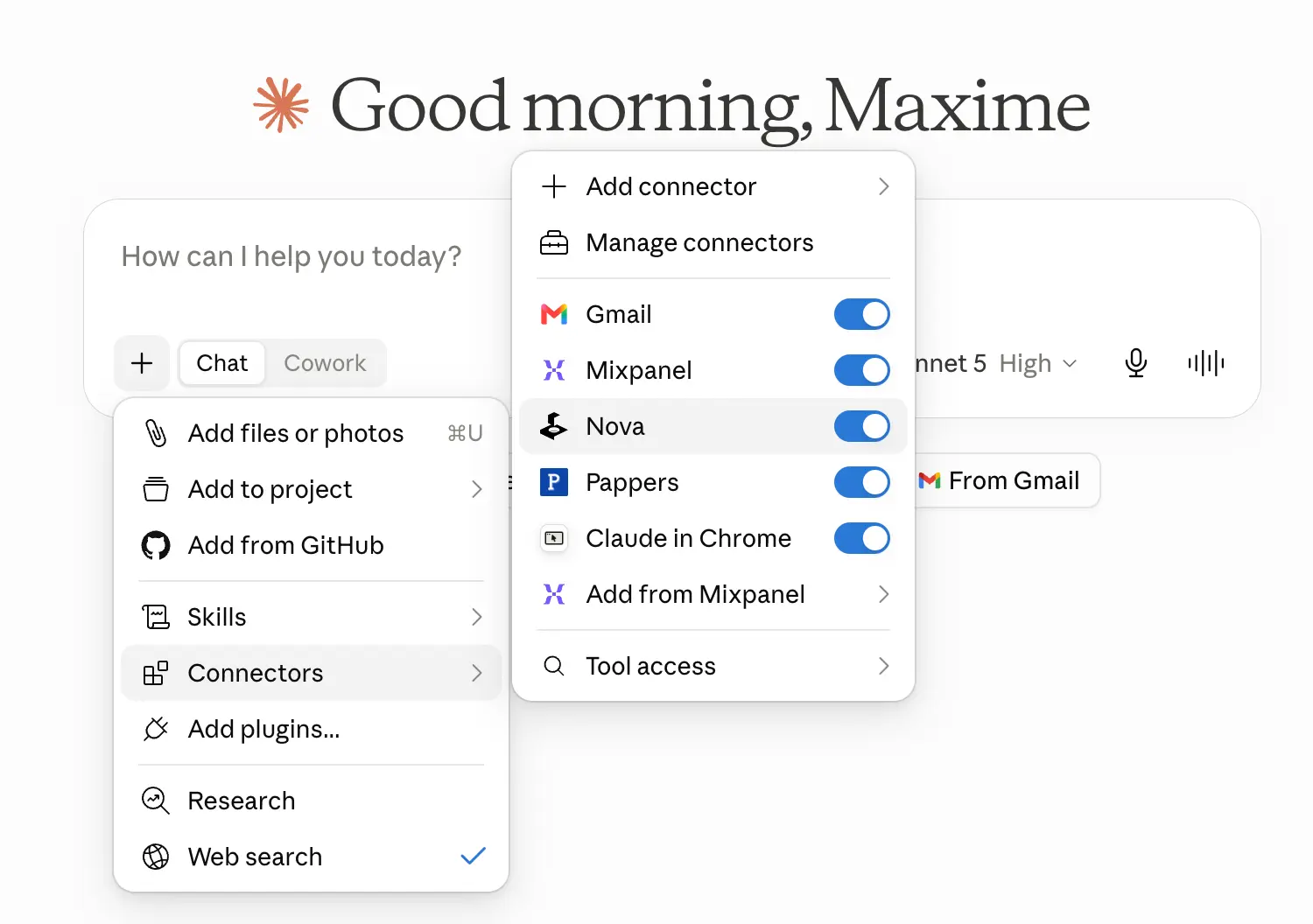
Nova MCP for Claude is live
Connect your full Nova dataset (ads, P&L, inventory, fees) to Claude and other MCP clients. Free for users signing up before 07/31.
March 6, 2026: Amazon Ads MCP Server is now in open beta. This is the protocol layer that lets external AI tools connect directly to your ad account. It's separate from Amazon's own Ads Agent (announced at unBoxed 2025).
What's Happening
Amazon just opened the doors to its Ads MCP (Model Context Protocol) Server. In practical terms, this means any AI assistant that supports MCP can now plug directly into your Amazon advertising account. Claude, ChatGPT, Gemini, custom-built agents: they all get the same access. One prompt can create a full Sponsored Products campaign, adjust bids, or pull performance data.
This isn't Amazon's own AI managing your ads (that's the Ads Agent announced at unBoxed 2025). The MCP Server is the open protocol that lets any third-party AI connect. Think of it as the API layer between your ad account and whatever AI tool you prefer. It's a fundamental shift in how PPC management works.
For the bigger picture on where MCP is heading for seller analytics, beyond just the ad layer, see our POV on why the data model is the real moat and the dedicated AI agent for Amazon sellers Page.
Key Dates & Deadlines
MCP Server Open Beta Launch
Amazon Ads MCP Server released as open beta. Any AI tool supporting Model Context Protocol can now connect to seller ad accounts.
Third-Party Integrations Expected
AI assistants like Claude, ChatGPT, and Gemini expected to offer Amazon Ads integrations via MCP.
What AI Can Do Through MCP (and How Fast)
The MCP Server exposes campaign management and reporting capabilities, but they don't perform equally. Campaign creation is near-instant. Reporting is async and slow. Here's the breakdown:
| Capability | Speed | Notes |
|---|---|---|
| Create SP Campaigns | Instant (seconds) | Full campaign with ad groups, keywords, bids in one prompt |
| Adjust Bids | Instant (seconds) | Bulk bid changes across campaigns |
| Pause/Enable Campaigns | Instant (seconds) | State changes applied immediately |
| Pull Performance Reports | Slow (async, minutes) | Must poll for completion. Not real-time. |
| Historical Data Access | 60-95 day window | No access to data older than 95 days |
The speed gap is significant. You can spin up 20 campaigns in under a minute, but pulling last month's ACoS data requires an async request that could take several minutes to resolve. For sellers managing high-volume PPC operations, the reporting bottleneck matters.
Data Limits You Should Know
| Constraint | Limit |
|---|---|
| Reporting lookback window | 60-95 days maximum |
| Report delivery | Async only (poll for results) |
| Data granularity | Campaign/ad group level |
| Rate limits | Standard SP-API throttling applies |
If you're used to pulling 12 months of keyword-level data for seasonal analysis, the MCP Server won't help. It's designed for operational execution, not deep historical analytics. For that kind of analysis, you still need a dedicated Amazon analytics platform that stores your data long-term.
What the MCP Server Can't See
This is where it gets interesting. The MCP Server operates in an advertising-only silo. It has zero visibility into the rest of your Amazon business:
- ✗Inventory levels: Your AI can bid aggressively on a product that's about to go out of stock
- ✗Profit margins: No COGS, FBA fees, or profit and loss data to inform bid decisions
- ✗FBA fees: Can't factor in fulfillment costs, storage fees, or fee changes when optimizing bids
- ✗Organic rankings: No insight into organic vs. PPC sales split
- ✗Return rates: Your AI doesn't know if a product has a 30% return rate eating into profits
Pro Tip
An AI that can create campaigns in seconds but can't see your margins is a fast way to lose money. The MCP Server is a powerful execution tool, but it needs to be paired with profit-aware analytics to make smart decisions. Speed without context is just faster mistakes.
Who Is Affected
PPC Agencies
High Impact
Clients will expect AI-powered management. Agencies need to adapt or lose accounts.
Solo Sellers ($50K-$500K/mo)
Medium Impact
Can now automate campaign creation without expensive tools. But risk blind optimization.
PPC agencies Face the biggest disruption. When any AI can create and manage campaigns, the value shifts from execution to strategy and profit optimization. Agencies that already offer product-level ROI tracking are better positioned than those selling campaign management hours.
What You Should Do Now
- 1.
Don't hand AI your ad account without guardrails
Set budget caps, bid ceilings, and campaign naming conventions before connecting any AI tool via MCP. An AI that can create campaigns instantly can also waste budget instantly.
- 2.
Audit your TACoS baseline before and after
Track your Total ACoS before enabling any MCP-connected AI. If TACoS rises after AI takes over campaign creation, the AI is optimizing for the wrong metrics.
- 3.
Keep profit data separate from AI execution
Since MCP can't see your margins, maintain a P&L analytics layer that feeds context back into your bidding decisions. Let AI execute, but let your analytics decide what to execute.
- 4.
Watch for SP-API rate limit Issues
MCP requests count against your standard API throttling limits. If you're already running other integrations, adding AI-driven MCP calls could trigger rate limiting on your reporting.
Ready to Transform Your Amazon Business?
Join thousands of successful sellers who use Nova Analytics to make data-driven decisions and maximize their profits.
Get More Amazon Seller Tips
Subscribe to our newsletter for weekly insights, strategies, and market updates.
Frequently Asked Questions
Common questions about this topic
Verified Sources
- Amazon Advertising: MCP Server Open Beta Announcement
- Adweek: Amazon Opens Ad API to AI Agents via MCP
- Seller Labs: What Amazon MCP Means for PPC Management
- Futurum Group: Amazon Advertising MCP Analysis
All information verified from official Amazon sources and trusted industry analysts as of publication date.
Never Miss a Critical Amazon Update
Get breaking news, policy changes, and time-sensitive updates delivered to your inbox.
Deep Dive: Related Guides
For more comprehensive analysis on these topics:
Advanced Amazon PPC strategies for experienced sellers in 2026. Master query-level optimization, dayparting, placement bidding, and portfolio management to improve ROAS by 25-40%.
→ TACoS Explained: Total Advertising Cost of Sale vs ACoSMost Amazon sellers track ACoS religiously. But if you're not watching TACoS, you're missing the bigger picture of your business health.
→ How to Track Amazon PPC ROI Per Product (Not Just Campaign)Campaign-level PPC metrics hide critical insights. Learn exact methodology to calculate true ROAS per ASIN and identify which products subsidize others.
→ Amazon SP-API Rate Limits: The Complete 2026 GuideAmazon's Selling Partner API powers every third-party tool. But between rate limits, throttling, and burst quotas, most developers spend more time fighting the API than building features. This guide covers everything you need to know.
Gemini
ChatGPT