Master Amazon FBA clearance arbitrage with our 2026 guide. Learn sourcing strategies, profit calculations, pricing tactics, and avoid common mistakes. Real case studies from $50K+/month sellers.
Retail arbitrage transforms clearance finds into profitable Amazon inventory
While private label sellers spend months developing products, clearance arbitrage sellers are making $5,000 to $15,000 monthly buying discounted inventory at Target, Walmart, and Home Depot then flipping it on Amazon for 2-3x margins. From the way our top-quartile sellers operate, the difference is measurement cadence, not measurement tooling.
Here's the reality. Most retail arbitrage sellers fail within six months. They buy random clearance items without checking sales rank. They ignore FBA fees that eat their margins. They run out of cash because they don't understand inventory turnover.
But the ones who succeed? They treat clearance arbitrage like a real business. They track every dollar. They know which stores restock on Wednesdays. They can calculate ROI in their heads while standing in a Target aisle.
This guide shows you the systematic approach that's working right now in 2026. You'll learn where to find profitable clearance items, how to calculate true margins after all fees, and which categories deliver consistent 50-100% ROI.
What is Amazon FBA Clearance Arbitrage?
Amazon FBA clearance arbitrage is buying deeply discounted products from retail stores and reselling them on Amazon at higher prices. You're the middleman. Retail stores need to clear old inventory. Amazon customers want deals. You profit from the spread.
Real Example: Kitchen Appliance Flip
Buy a blender at Target for $8 (marked down from $39.99). Ship it to Amazon FBA. List it at $34.99. After $12 in FBA fees and $2 shipping to Amazon, you net $13 profit per unit. That's a 162% ROI. Find 10 of these weekly and you're making $520 in profit while working part-time hours.
The business model works because of timing differences. Stores need inventory gone now. They'll sell at a loss to free up shelf space. Amazon customers don't care when you bought it. They care about getting it fast with Prime shipping.
Clearance arbitrage differs from regular retail arbitrage in one key way: you're buying products already marked down for clearance (50-90% off) rather than regular-priced items on sale. This creates bigger margins but requires faster action since clearance inventory disappears quickly.
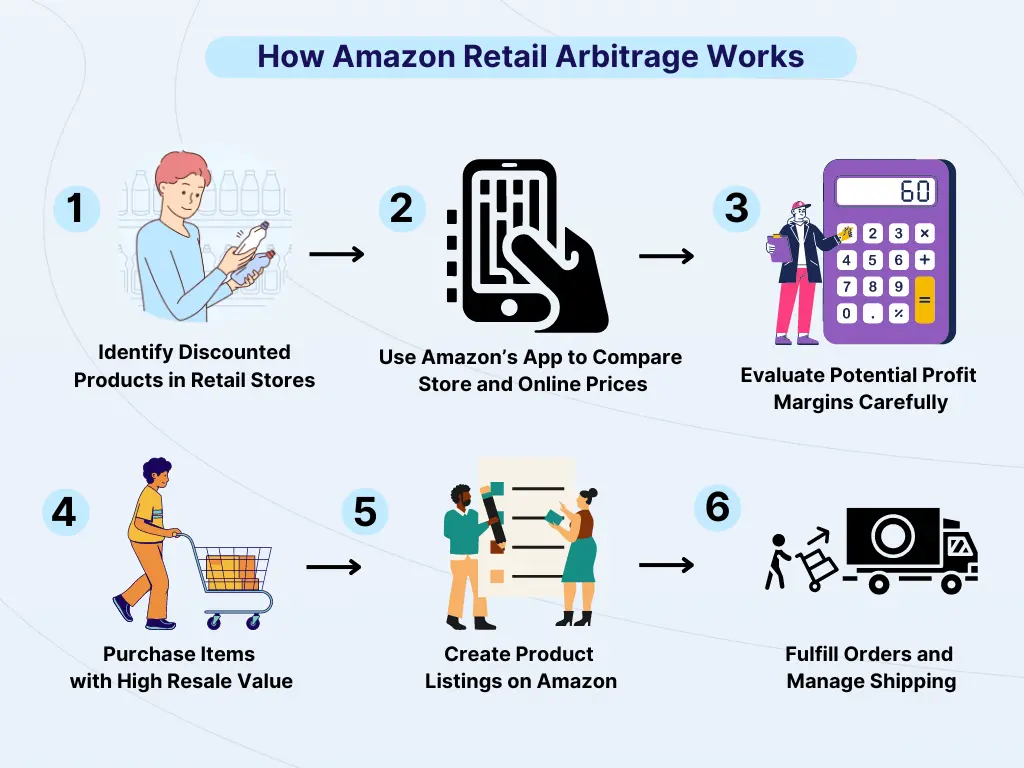
The 6-step arbitrage process: identify, compare prices, calculate profit, purchase, list, and fulfill
Amazon's official stance? Retail arbitrage is completely legal and within their seller policies. You're buying authentic products from authorized retailers. Just keep your receipts and avoid gated categories without proper approval. Review Amazon's restricted products guidelines before sourcing inventory.
Why Clearance Arbitrage Works in 2026
Three forces make clearance arbitrage profitable right now.
First, retail stores are aggressively clearing inventory faster than ever. Categories like beauty, home, and kitchen consistently rank as the most profitable for Amazon sellers, making clearance arbitrage in these areas particularly lucrative.
Second, Amazon's customer base keeps growing. Over 200 million Prime members want products delivered fast. They'll pay premium prices for convenience. Your clearance finds solve their problems.
Third, the barrier to entry remains incredibly low. You don't need $50,000 to launch a private label brand. You don't need warehouses or employees. Start with $500, a smartphone, and a car.
Average Margin
40-60%
After all FBA fees and costs
Startup Capital
$500-$2K
Enough for first inventory run
Time to First Sale
2-3 weeks
From purchase to Amazon payout
Research from Digital Commerce 360's marketplace benchmarks shows that successful Amazon sellers maintain strong metrics across conversion rate, product ratings, and advertising spend. Arbitrage sellers who focus on quality products and competitive pricing continue to thrive in Amazon's ecosystem.
Did You Know?
Research on retail psychology shows that clearance items with specific percentage discounts (70% off) convert better than vague "sale" labels. This psychological pricing advantage helps arbitrage sellers compete with wholesale suppliers who lack the urgent discount narrative.
Where to Find Profitable Clearance Items
Not all clearance sections are created equal. You need stores with predictable markdown schedules, easy-to-scan barcodes, and categories that actually sell on Amazon.
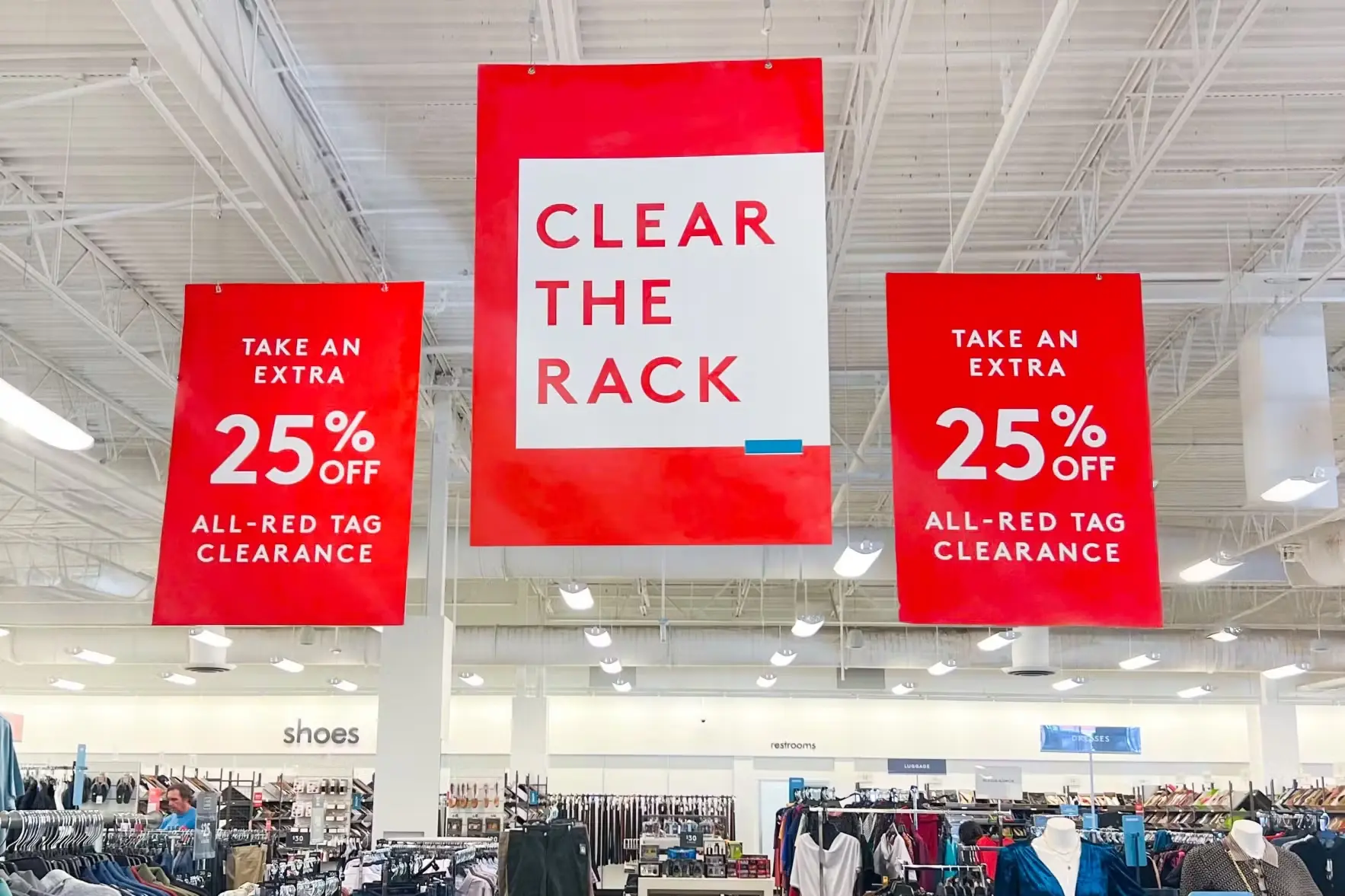
Major retailers like Nordstrom Rack offer deep clearance discounts perfect for arbitrage sourcing
Best Retail Stores for Clearance Arbitrage
Target is the gold standard for beginners. Red clearance stickers show exact discounts. Items hit 70% off on predictable cycles (usually 6-8 weeks after initial markdown).
Wednesday mornings around 8am is when most stores restock clearance endcaps. The home goods, toys, and kitchen sections consistently yield 50-100% ROI opportunities. Track your sourcing trips with Nova's Custom Analytics to identify your most profitable store locations.
Walmart Offers volume but requires more scanning. Look for yellow rollback tags and clearance endcaps near the back corners of stores. Their clearance cycles are less predictable, but when you find winners, you can often buy 10-20 units. Best categories: home decor, small appliances, and seasonal items.
Home Depot runs seasonal clearance that's incredibly profitable. Buy Christmas lights in January at 90% off, store them, sell in October. Buy garden tools in September, flip in March. Long-term storage fees apply, but the margins (often 200-300% ROI) justify the wait. Home-related categories remain profitable despite market fluctuations, with seasonal timing being critical for maximizing returns.
CVS and Walgreens are underrated goldmines for health and beauty clearance. Look for 75-90% off stickers on discontinued cosmetics, vitamins, and personal care items. These categories are gated on Amazon, so you'll need approval first. But once ungated, competition is lower and margins are higher.
Best Buy Offers electronics opportunities but requires expertise. Sales ranks move fast. Models get outdated quickly. Only source here once you understand tech categories deeply. Focus on accessories (phone cases, cables, gaming peripherals) rather than expensive electronics.
Pro Tip: Store Clearance Schedules
Build relationships with store managers. Ask when they markdown clearance. Most targets follow the same schedule: Wednesday mornings for restocks, Sunday evenings for additional markdowns. Walmart varies by location but typically does major markdowns on first and third Thursday of each month. Show up early, scan fast, buy the best deals before other resellers arrive.
Categories with Highest ROI
Toys & Games deliver the most consistent returns. Buy clearance toys in Q1 and Q2 (January through June) when stores dump holiday inventory. Store them. List them in September. Sell them in November and December at 2-3x your cost. Sales velocity is incredible during Q4. According to Circana's 2024 toy industry report, the U.S. Toy market shows strong seasonal patterns, making strategic clearance buying and holiday selling highly profitable for arbitrage sellers.
Home & Kitchen Items sell year-round with steady demand. Clearance kitchen gadgets, storage containers, and small appliances found at 60-70% off retail often sell at full price on Amazon. Look for brand names like OXO, Rubbermaid, and KitchenAid. Check sales rank (under 50,000 is ideal) and ensure at least three sellers have the Buy Box.
Health & Beauty Products are gated but worth the effort. Discontinued cosmetics, vitamins, and personal care items hit 75-90% off clearance.
Once you're approved to sell in beauty categories, competition drops significantly. Margins of 80-120% ROI are common. Just verify expiration dates (Amazon requires 90+ days remaining). According to Moz's Amazon SEO research, ungated categories face 300% more seller competition than gated ones, making approval a massive competitive advantage.
Electronics accessories like phone cases, charging cables, and gaming peripherals move fast. Avoid expensive electronics (high return rates, rapid depreciation). Stick to sub-$30 accessories with sales ranks under 20,000. Buy at 50% off, sell at regular price.
Case Study: Kitchen Appliance Success
Sarah, a part-time arbitrage seller from Texas, found Ninja blenders at Target marked down from $89.99 to $29.99 (67% off clearance). She bought 8 units. Listed them on Amazon FBA at $79.99. After $28 in FBA fees per unit and $1.50 shipping to Amazon, she netted $20.50 profit per unit. Total profit: $164 on $240 invested. That's a 68% ROI in three weeks. She now sources kitchen appliances exclusively, making $3,200 monthly part-time.
Using Scanner Apps Effectively
Your smartphone is your profit calculator. Download the free Amazon Seller App. Scan every clearance item's barcode. Check four metrics instantly.
First, sales rank. Under 50,000 means it'll sell fast (1-2 weeks). Between 50,000 and 100,000 is acceptable (2-4 weeks). Over 150,000? Skip it unless margins are massive.
Second, current FBA sellers. You want at least three sellers with FBA offers. This proves demand exists and gives you pricing benchmarks. If only one FBA seller exists at $50 and everyone else is at $25, that $50 is fake. Price at market rate.
Third, price history. Use Keepa or CamelCamelCamel browser extensions to check three-month price trends. Prices stable or rising? Good sign. Prices declining 20% over three months? Walk away. You'll be stuck competing in a race to the bottom.
Fourth, profit margin after all fees. Aim for $3 minimum per unit, ideally $5-$10.
Calculate exactly using the Amazon Seller App's profit calculator. Include purchase price, FBA fees ($4-$8 for standard items), referral fees (15% of sale price), and shipping to Amazon ($1-$2 per unit). Don't forget sales tax and gas money. Track your true profitability with Nova's Profit & Loss Analytics to see all hidden costs.
Warning: Never Buy Based on Price Alone
A $50 item marked down to $5 (90% off) sounds amazing. But if the Amazon sales rank is 800,000 and only one seller exists at $12, you'll lose money. That item won't sell for months. You'll pay long-term storage fees. Then you'll liquidate at a loss. Always check sales rank, competition, and price stability before buying any clearance item regardless of the discount.
How to Calculate True Profit Margins
Most beginners fail at math. They see a $10 item selling for $30 on Amazon and think they'll make $20. Wrong. After fees, you're lucky to net $8.
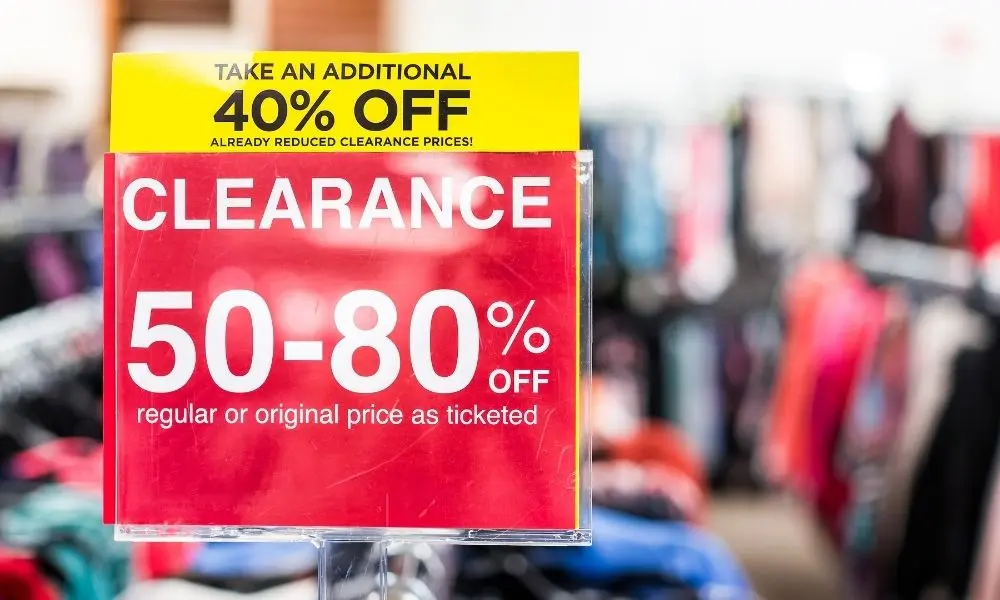
Look for deep discount signage (40-80% off) to maximize your arbitrage profit margins
Here's the complete profit formula you need burned into your brain:
Complete Profit Formula
Selling Price: $34.99
Amazon Referral Fee (15%): -$5.25
FBA Fulfillment Fee: -$4.85
Product Cost: -$8.00
Shipping to Amazon: -$1.50
Prep Materials (labels, poly bags): -$0.30
Net Profit: $15.09 (188% ROI)
Warning: Hidden Fees Destroy Profits
Amazon's referral fee is typically 15% for most categories (8% for electronics, 6% for personal computers). FBA fulfillment fees depend on size and weight. A standard-size item under 1 pound costs about $4 to $5 to fulfill. Check the exact fees in Amazon's FBA fee schedule. Long-term storage fees ($6.90 per cubic foot after 365 days) can wipe out seasonal profits if you mistime your inventory.
Don't forget hidden costs. Shipping to Amazon runs $0.50 to $1.50 per unit if you're using Amazon's partnered carrier program. Labels cost about $0.05 each. Poly bags for items requiring bagging cost $0.10 to $0.25 each. These add up fast when you're moving 100+ units monthly.
Long-term storage fees hit if inventory sits over 365 days. Amazon charges $6.90 per cubic foot for items stored 271-365 days, and $0.15 per unit monthly for items over 365 days. Avoid these by maintaining healthy inventory turnover. Track your inventory age with Nova's Profit & Loss Analytics to identify slow-moving SKUs before fees hit.
Returns eat margins too. Budget 2-5% of revenue for returns depending on category. Electronics and clothing have higher return rates (8-12%). Home goods and toys average 2-4%. Factor this into your ROI calculations.
Sourcing Strategies That Scale
Once you understand the basics, it's time to build systems. Random store visits won't cut it. You need routes, schedules, and relationships.
The Multi-Store Route System
Map out a sourcing route hitting 4-6 stores in one trip. Start at Target (Wednesday morning restock). Hit Walmart next (check new clearance endcaps). Swing by CVS or Home Depot depending on season. End at another Target location if time permits.
Dedicate 4-6 hours every Wednesday or Thursday. This becomes your "sourcing day." Bring a portable printer for labels, a smartphone with scanner apps, and a large trunk or SUV for inventory. Successful sellers consistently find $500 to $800 in profitable inventory per sourcing session.
Time management is everything. Spend 60-90 seconds per item maximum. Scan, check rank and fees, make decision. Don't waste 10 minutes researching one item. If it doesn't meet your criteria (under 100K rank, $3+ profit, 40%+ ROI), move on instantly.
Did You Know? Store Managers Hold Clearance Items
Build relationships with store managers and department leads. Introduce yourself as a regular buyer who purchases clearance inventory in bulk. Many managers will hold newly marked-down items in the back room for reliable customers. One arbitrage seller in California gets text notifications from three Target managers when toys hit 70% off clearance. He shows up within hours and buys everything profitable before it hits the floor.
Online Arbitrage for Clearance
In-store sourcing is limited by geography. Online arbitrage (OA) opens national opportunities. Check retailer websites for clearance sections. Target.com, Walmart.com, and Home Depot's online clearance often has different inventory than stores.
These tools help identify profitable opportunities and track competitor pricing trends. According to Google's consumer research, 53% of online shoppers research products before buying, making price history data critical for timing your listings when demand peaks.
Flash sale sites like Woot, Zulily, and Sierra Trading Post offer wholesale-like pricing on overstock inventory. Competition is higher (everyone sees the same deals), but you can order 20-50 units from your couch. No gas money, no time wasted driving.
The downside? Shipping costs hurt margins. You're paying $5 to $10 shipping on each order. This only works on higher-value items ($20+ selling price) where shipping is a smaller percentage of total costs.
Seasonal Clearance Calendars
Retail follows predictable patterns. Master these cycles and you'll always know what to source when.
Quarter
Best Categories
Buy Strategy
Sell Timing
Q1 (Jan-Mar)
Holiday toys, Christmas decor, winter apparel
Buy at 70-90% off, best margins of year
Toys: Hold until Q4. Decor: Hold until Oct-Nov
Q2 (Apr-Jun)
Spring items, garden tools, outdoor furniture
Buy garden/outdoor at 60% off in June
Hold until Feb-Apr next year
Q3 (Jul-Sep)
Back-to-school, summer clearance, patio items
BTS items in August at 50-70% off
Flip immediately (Aug-Sep demand)
Q4 (Oct-Dec)
Halloween/Thanksgiving clearance post-holiday
Focus on selling Q1 inventory, light sourcing
Sell everything fast for cash flow
Pro Tip: Buy Off-Season, Sell In-Season
The biggest profits come from buying seasonal items at maximum clearance and holding them 6-10 months. Christmas toys bought in January for $3 sell for $25 in November. Garden hoses bought in September for $4 sell for $18 in March. Yes, you'll pay storage fees ($0.75-$2.50 per unit for 6-10 months), but the 200-400% ROI justifies the cost. Track storage costs with Nova's Day-to-Day Performance dashboard.
Listing Optimization for Arbitrage Products
You're not creating new listings. You're selling on existing product pages. But that doesn't mean you can ignore optimization.
Most arbitrage items already have established listings with reviews, images, and descriptions. Your job is simple: win the Buy Box. Amazon rotates Buy Box placement based on price, fulfillment method, and seller metrics.
Price competitively but don't race to the bottom. If the current FBA Buy Box price is $29.99 and there are four sellers at that price, match it.
Don't undercut to $28.99 unless you need the sale immediately. FBA sellers typically win the Buy Box when priced within 5% of the lowest FBA offer and maintaining strong seller metrics like order defect rate under 1% and on-time delivery above 97%. Monitor your profit margins with Nova's profitability dashboard to optimize pricing strategy.
Use repricing tools once you're moving 50+ SKUs. Manual repricing wastes hours daily. Tools like RepricerExpress, Seller Snap, or BQool automatically adjust your prices based on competition. Set minimum prices (your breakeven plus desired profit) so the tool never prices below your margin threshold.
For products without strong listings, you might need to enhance them. Add high-quality images if current photos are poor. Update bullet points with customer benefits. But don't go overboard. You're not building a brand here. Spend 90% of your time sourcing, 10% on listing optimization.
Track which SKUs are winning the Buy Box consistently using Nova's profitability dashboard. Some products never win Buy Box because brand owners control pricing. Identify these quickly and stop reordering them.
Inventory Management for Arbitrage
Managing 50-200 different SKUs requires systems. Spreadsheets work until you hit about 30 SKUs. After that, you need better tools.
Managing Multiple SKUs
Create a master spreadsheet with these columns: Product Name, ASIN, Purchase Date, Store, Purchase Price, Quantity, Selling Price, Estimated Fees, Net Profit Per Unit, Total Profit, Send-to-Amazon Date, Live Date, Sales Velocity, and Days Until Sold Out.
Update it weekly minimum. This spreadsheet shows which categories are most profitable, which stores yield best results, and which items are slow movers eating storage fees.
Track COGS (Cost of Goods Sold) precisely. Don't guess. Use actual purchase receipts. Include shipping to Amazon, prep costs, and any other expenses. Your profit calculations are only accurate when COGS is accurate.
Pro Tip: Use Product Tagging to Organize Inventory
Separate your clearance arbitrage inventory from other business models using Nova's Custom Breakdowns feature. Tag all clearance items with "Arbitrage-Clearance" and add secondary tags like "Target-Q1" or "Walmart-Toys." This lets you filter P&L reports by sourcing channel, identify which stores are most profitable, and see ROI by category. Compare ROI by sourcing channel before deciding where to reinvest.
Storage and Prep Considerations
When starting, prep items at home. You'll need label paper (Avery 30-up labels work perfectly), a printer, poly bags for items requiring bagging, and bubble wrap for fragile products. Set up a dedicated prep area in your garage or spare room.
As you scale past 200 units monthly, prep centers make sense. They receive your inventory, label it, bag it, and ship it to Amazon for $0.50 to $1.50 per unit. You ship cases of products directly from stores to the prep center. This saves hours of manual labor.
Watch your IPI (Inventory Performance Index) score. Amazon wants this above 400. If it drops below 400, you face storage limits. Keep inventory turning over. Avoid buying massive quantities of slow-moving items. Target 30-60 day turn rates on most inventory.
Long-term storage fees are profit killers. Amazon charges extra for items sitting 271+ days. Monitor inventory age in Seller Central's Inventory Age report. If something isn't selling after 90 days, reduce price aggressively or create a removal order. Don't let pride keep you holding dead inventory.
Common Mistakes to Avoid
Every failed arbitrage seller makes the same mistakes. Learn from them instead of repeating them.
Mistake #1: Buying Based on Emotion
You see a gorgeous kitchen mixer marked down 80% and think "this is such a good deal!" But the sales rank is 450,000. There are 32 sellers. The price has dropped 40% in three months. Your excitement doesn't change the data. That mixer won't sell. Walk away. Only buy items that meet your criteria regardless of how good the deal feels emotionally.
Mistake #2: Ignoring Sales Rank Thresholds
Sales rank matters more than price. A product ranked 500,000 might sell once every 3-6 months. You'll pay storage fees while waiting. Set hard thresholds: under 50K rank for fast flips, under 100K for 30-day turns, absolutely nothing over 150K unless margins are 200%+. Stick to these rules. No exceptions.
Mistake #3: Overleveraging with Credit Cards
Don't max out credit cards to buy inventory. Cash flow problems kill arbitrage businesses fast. Start with cash you can afford to lose. Reinvest profits. Scale slowly. Credit card arbitrage works for experienced sellers with proven systems, but beginners burn through $10,000 in credit card debt buying the wrong products then can't pay it back when inventory doesn't sell.
Mistake #4: Too Much Competition
Buying items with 20+ sellers is a mistake. You're entering a race to the bottom. Even at 70% off retail, if Amazon has 25 sellers competing, margins collapse within weeks. Look for items with 3-8 FBA sellers. Enough competition to prove demand, but not so much that pricing becomes brutal. Use Nova's Custom Breakdowns to categorize high-competition SKUs and avoid them in future sourcing trips.
Another killer mistake is not tracking ROI by category. You might think you're profitable overall while losing money on electronics and making it all back on toys. Without category-level tracking, you'll keep buying unprofitable categories. Use Nova's Custom Analytics to break down profitability by source, category, and time period.
Finally, don't forget about Q4 storage fees. Amazon increases storage rates in October through December. Long-term storage fees also apply. If you're holding seasonal inventory bought in January, those storage fees from February through November can eat 20-30% of your profit. Factor this into ROI calculations when buying off-season items.
Scaling from Side Hustle to $10K+ Monthly
Most arbitrage sellers start part-time. Here's how the scaling path typically looks.
The $1K to $5K Stage
At this level, you're sourcing 6-10 hours weekly. One or two sourcing runs per week. You're buying 30-60 units weekly, mostly fast-turning items (under 50K rank). Total working capital invested: $2,000 to $4,000.
Reinvest 80% of profits back into inventory. Keep 20% as actual income. This accelerates growth. A seller making $1,500 monthly in profit should reinvest $1,200 and pocket $300. Within 4-6 months, working capital grows to $8,000-$10,000.
Time allocation matters. Spend 70% of time sourcing, 20% on prep and shipping, 10% on listing optimization and customer service. Sourcing is where money is made. Don't waste hours perfecting listings for arbitrage products.
Worked example: scaling a $1,000 starting bank
Take a $1,000 starting bank spent on clearance toys and home goods, with two fixed sourcing runs a week and a buying rule of nothing above 30K sales rank and nothing under $5 profit per unit. Reinvest most of the profit rather than drawing it, and the bank compounds each cycle. The mechanics that decide whether it works are the buying rule and the reinvestment rate, not the tooling. Run the numbers on your own turn rate before committing capital.
The $5K to $10K+ Stage
Breaking $5K monthly requires delegation. You can't prep 300+ units monthly alone. Hire part-time help ($12-$15/hour) for prep work or use prep centers.
Sourcing needs to be more efficient. Virtual assistants can handle online arbitrage. Pay them $5-$8/hour to scan online clearance sections, check sales ranks, and send you profitable opportunities. You approve purchases and they order to your prep center.
At this level, working capital is $15,000 to $25,000. You're managing 150-250 active SKUs. Track everything in Nova's Winners & Losers dashboard to identify top performers. Double down on categories and products that consistently deliver 60%+ ROI.
Consider expanding to multiple marketplaces. EBay takes 5-10 minutes to cross-list items already on Amazon. Walmart Marketplace is growing fast. The same inventory can sell across three platforms, increasing velocity and reducing storage time.
Some sellers at this stage transition partially to wholesale or private label for more predictable margins. Arbitrage becomes 60% of revenue while wholesale fills the other 40%. This diversification reduces risk and smooths cash flow.
Tools & Software Stack
You don't need every tool on day one. Build your stack as you scale.
Start with free tools. Amazon Seller App and Keepa's browser extension cost nothing. They're enough to get profitable.
Add analytics when revenue exceeds $3,000 monthly. That's when tracking margins, ROI by category, and inventory age becomes critical. Nova's Profit & Loss tool shows real-time profitability with precise fee calculations so you know exactly which SKUs are winners.
Repricing tools make sense at 50+ SKUs. Below that, manual repricing takes 15-20 minutes daily. Above 50 SKUs, you're spending 1-2 hours daily on repricing. A $60/month tool pays for itself immediately.
Tax and Legal Considerations
Retail arbitrage is a real business. Treat it like one.
Sales tax collection: Amazon handles most sales tax through their Marketplace Facilitator laws. But you still need to collect sales tax on any direct sales outside Amazon. Check your state requirements. Most states require sales tax permits even for online businesses.
Reseller certificates: get a reseller certificate from your state. This lets you buy products without paying sales tax when you intend to resell them. Apply through your state's department of revenue website. Processing takes 1-2 weeks. Keep this certificate with you when sourcing in stores.
Record keeping: save every receipt. Photograph them immediately and upload to cloud storage. The IRS requires documentation for all business expenses. If you're audited, retail receipts prove your COGS. Without receipts, the IRS can disallow your expenses and hit you with huge tax bills.
Business structure: most beginners start as sole proprietors. It's simple and requires no setup. Once revenue exceeds $50,000 annually, consider forming an LLC for liability protection. Consult a CPA familiar with e-commerce businesses. Tax strategies for arbitrage differ from traditional retail.
Tax Professional Consultation Recommended
Arbitrage has unique tax considerations around inventory valuation, COGS accounting, and multi-state sales tax nexus. Spend $300-$500 consulting with a CPA who specializes in e-commerce before you hit $25,000 in annual revenue. They'll help you set up proper accounting systems and may save you thousands in taxes through legal deductions you didn't know existed.
Is Clearance Arbitrage Right for You?
This business model isn't for everyone. It requires specific traits and circumstances.
You'll thrive if: you have 10-15 hours weekly for sourcing and prep. You live near multiple Target, Walmart, or Home Depot stores. You're comfortable with quick decisions under pressure. You can handle repetitive tasks (scanning, labeling, shipping). You want fast results (first profits in 2-3 weeks).
Avoid this model if: you want completely passive income. You're in a rural area with limited retail stores. You can't handle inventory sitting unsold for weeks. You want predictable, stable income (arbitrage fluctuates monthly). You're looking for a long-term brand-building strategy.
Many successful sellers use arbitrage as a stepping stone. Build cash flow through arbitrage for 6-12 months. Use those profits to fund a private label brand or wholesale relationships. Arbitrage teaches you Amazon's systems, fee structure, and customer behavior without requiring massive upfront capital.
Decision Framework: Is Arbitrage Your Best Option?
Choose arbitrage if: Limited startup capital ($500-$2K), want fast results, comfortable with active work, local to major retail stores
Choose wholesale if: have $5K+ capital, want higher volume per SKU, prefer relationship-based sourcing, can handle 30-90 day payment terms
Choose private label if: have $10K+ capital, want brand building, can wait 4-6 months for first sales, prefer marketing over sourcing
Hybrid approach: Start with arbitrage for cash flow, transition 50% to wholesale after 6 months, test private label at 12 months
Frequently asked questions
You can start with $500 to $2,000. Most successful beginners invest $1,000 initially, which gives you enough buying power to source 30-50 units across multiple categories. Start small, test products, and reinvest profits. Within 3-6 months, sellers typically scale to $5,000-$10,000 in working capital through reinvestment. Don't use credit cards for initial purchases. Cash flow is critical in arbitrage.
Yes, retail arbitrage is completely legal and permitted by Amazon's policies. You're buying products at retail price and reselling them, which is standard commerce. However, you must follow Amazon's guidelines: maintain proper invoices, avoid counterfeit products, respect brand restrictions, and ensure product authenticity. Some brands restrict reselling, so check Amazon's gating requirements before purchasing items in restricted categories like topical products, grocery, or certain electronics.
Target is the best starting point for new arbitrage sellers. Their clearance system is straightforward with red clearance stickers showing exact discounts (30%, 50%, 70% off). Target also has consistent restocking schedules, typically Wednesday mornings. Other beginner-friendly stores include Walmart (easy-to-spot yellow rollback tags) and CVS (90% off clearance sections). Avoid electronics-heavy stores like Best Buy until you understand sales rank and velocity requirements.
Check four critical metrics with the Amazon Seller App: sales rank under 100,000 in the category, at least 3 FBA sellers in the Buy Box, price history showing stability (not declining), and profit margin above $3 after all fees. Avoid items with 20+ sellers, declining price trends, or sales ranks above 200,000. Scan 100 items to find 5-10 profitable ones. That's normal. Don't buy based on discount alone. A 90% off item that doesn't sell is worthless.
Yes, but it requires significant scaling and systems. Part-time sellers ($500-$2,000 monthly) spend 10-15 hours weekly sourcing. To reach $5,000+ monthly, you'll need 25-30 hours weekly, efficient routes, and strong category knowledge. Full-time income ($8,000-$15,000 monthly) requires 40+ hours, virtual assistants for prep and shipping, and working capital of $15,000-$25,000. Most successful full-timers combine arbitrage with wholesale or private label for diversified income streams.
Clearance arbitrage involves physically visiting retail stores to find discounted products on clearance racks and endcaps. Online arbitrage sources the same types of deals from retailer websites, flash sale sites, and online clearance sections. Clearance arbitrage offers better margins (less competition on in-store finds) but requires time and gas money. Online arbitrage is faster and scalable but faces more competition since anyone can find the same deals. Most sellers combine both methods for maximum opportunity.
It depends on the category. Ungated categories like toys, home & kitchen, sports, and books don't require approval. Gated categories including grocery, topical products, beauty, and certain brands require invoices from authorized distributors. Retail receipts from Target or Walmart typically don't qualify for ungating. Start with open categories, build sales history, then apply for gated categories with proper documentation. Some brands like Nike and Apple have additional restrictions regardless of receipts.
Keep detailed records of every purchase with itemized receipts showing store name, date, and products. Avoid products with authenticity complaints (beauty, supplements, electronics accessories). Never use dropshipping or third-party fulfillment mixed with FBA. Respond immediately to any performance notifications. Monitor your account health daily for metrics like Order Defect Rate (keep under 1%) and Valid Tracking Rate (keep above 95%). Join brand registry if selling your own bundled products.
Target minimum $3 profit per unit and 40% ROI. Example: buy for $5, sell for $19.99, net $8 after fees = 160% ROI. Experienced sellers aim for 50-100% ROI on most items. Don't source items with profit under $2 unless you're buying in bulk (20+ units). Factor in all costs: product cost, FBA fees (typically 30-40% of selling price), shipping to Amazon ($0.50-$1.50 per unit), prep materials, and potential long-term storage fees.
Products with sales ranks under 50,000 typically sell within 1-2 weeks. Ranks between 50,000-100,000 sell in 2-4 weeks. Anything over 150,000 may take 1-3 months. Seasonal items bought off-season (buy Christmas items in January, sell in November) require 6-10 months of storage. Most arbitrage sellers target 30-day turn rates to maximize cash flow and minimize storage fees. Use Nova's Winners & Losers dashboard to identify fast-moving SKUs and double down on proven categories.
Ready to Transform Your Amazon Business?
Join thousands of successful sellers who use Nova Analytics to make data-driven decisions and maximize their profits.