


Best Openbridge Alternative 2026 - Amazon Data for BigQuery
Openbridge pioneered Amazon SP-API data pipelines for analytics teams. In 2026, alternatives ship ready-to-query per-SKU profit instead of raw reports. This guide compares Openbridge to Nova's ready-made Amazon data service.
 Gemini
 ChatGPT
TL;DR - Key Takeaways
- •Openbridge delivers raw Amazon data to your warehouse. You still need data engineers to model it, calculate KPIs, and maintain transformations.
- •Nova ships pre-calculated per-SKU profit, fees, returns, refunds, reimbursements, and product-level PPC across 21 Amazon marketplaces, ready to query.
- •Total cost of ownership matters: a 'cheaper' raw pipe costs more once you factor in engineering time to build and maintain the model layer.
- •Choose Openbridge if you need Vendor Central (1P) into Redshift or Databricks. Choose Nova for Seller Central (3P) when you want analytics-ready data in days, from $29/month.
Openbridge pioneered Amazon data pipelines for analytics teams. But in 2026, alternatives have emerged that offer faster setup, better support, and more comprehensive data coverage. This guide compares Openbridge to Nova's raw data service and helps you choose the right solution.
If you're researching Amazon data solutions, you've likely encountered Openbridge. They've been in the market since 2015 and serve many enterprise customers. But the landscape has evolved. Data teams now expect faster implementation, more granular data, and better integration with modern data stacks.
We'll cover what Openbridge does well, where it falls short, and when Nova's ready-made data service might be a better fit. No marketing fluff. Just an honest comparison to help you make the right decision.
What is Openbridge?
Openbridge is a data pipeline service that extracts Amazon Seller Central, Vendor Central, and Advertising data, then loads it into your data warehouse (Redshift, BigQuery, Snowflake, or Databricks).
What Openbridge Does Well
Vendor Central support (rare in the market)
Long track record (since 2015)
Multiple warehouse destinations
Enterprise security certifications
Common Complaints
Complex setup process
Support response times
Pricing transparency
Data refresh latency
Openbridge serves a specific niche well: large enterprises with dedicated data engineering teams who need raw Amazon data in their existing warehouse infrastructure. But for many teams, simpler alternatives now exist.
Openbridge Limitations in 2026
Based on customer feedback and our competitive research, here are the main limitations teams encounter with Openbridge:
Setup Complexity
Requires understanding Amazon's report types, configuring subscriptions, and building your own transformation layer. Steep learning curve.
Raw Data, No Models
200+ fee types with cryptic codes, multiple identifiers (ASIN, SKU, FNSKU). Your team builds all KPIs from scratch.
Refresh Latency
Data refresh varies by report type. Some daily, others longer. Intraday visibility can be blocked.
Pricing Opacity
Custom pricing requires sales conversations. Makes budgeting difficult for growing businesses.
When Openbridge Still Makes Sense
If you're a large enterprise with dedicated data engineers, already use Openbridge successfully, and primarily sell via Vendor Central (1P), switching may not be worth the migration effort. Openbridge's Vendor Central support is more mature than most alternatives.
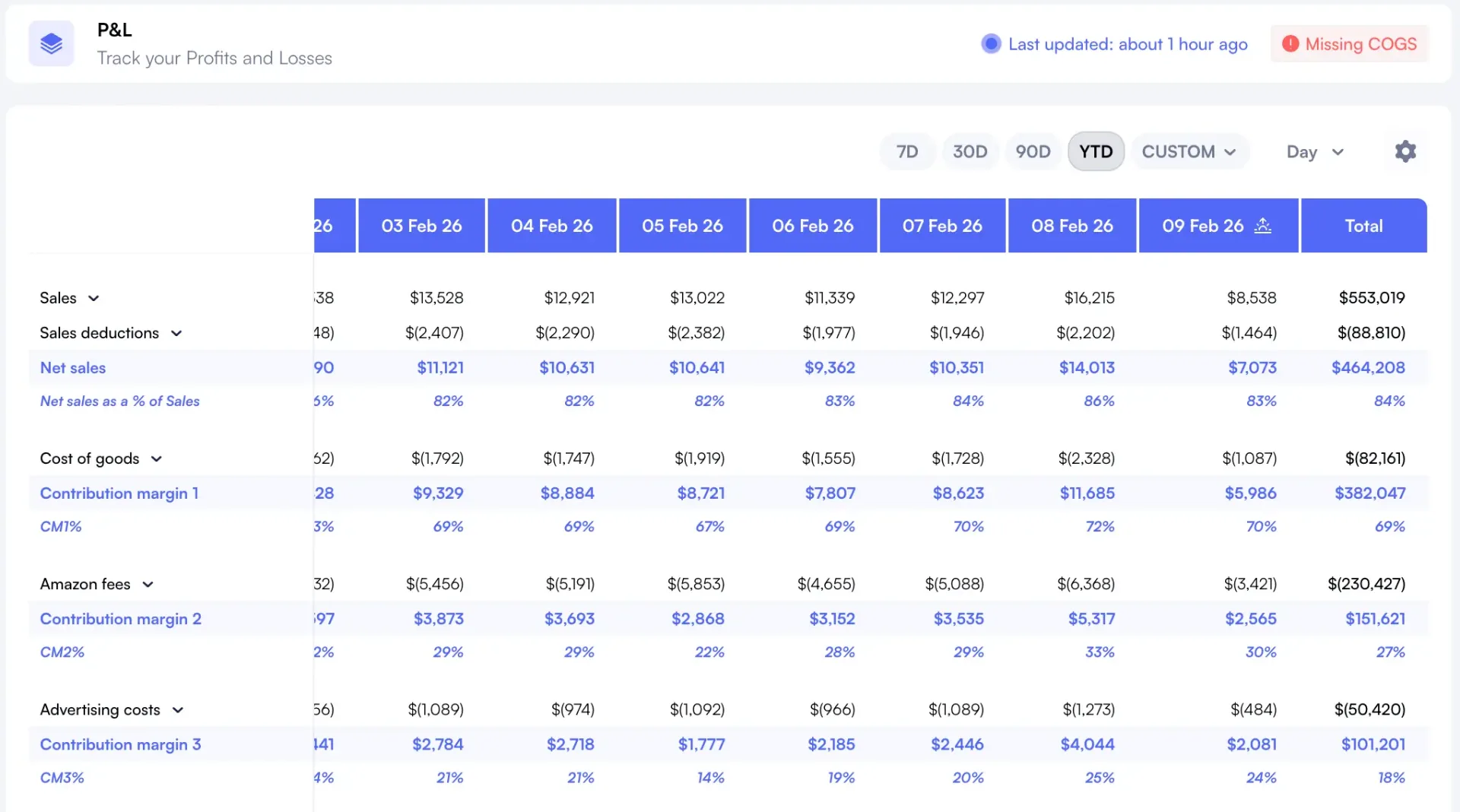
Nova vs Openbridge: feature comparison
Here's a direct comparison of Nova's ready-made Amazon data service versus Openbridge's SP-API pipeline integrations:
| Feature | Nova | Openbridge |
|---|---|---|
| Time to First Data | 24-48 hours | Days to weeks |
| Data Refresh | Hourly | Varies (hours to daily) |
| Pre-Built KPIs | 200+ calculated | Raw data only |
| Data Modeling | Included (dbt-ready) | Build your own |
| Warehouse Support | BigQuery, Snowflake | BigQuery, Snowflake, Redshift, Databricks |
| Seller Central (3P) | Full support | Full support |
| Vendor Central (1P) | Limited | Full support |
| Historical Backfill | 2+ years included | Available (extra cost) |
| Multi-Marketplace | Auto-normalized | Separate configs |
| Custom Breakdowns | Point-and-click dimensions | Build in SQL/dbt |
| Pricing | Transparent tiers | Custom quotes |
| Support | Dedicated Slack channel | Ticket-based |
Custom breakdowns: point-and-click vs SQL
With Openbridge, building portfolio segmentation means SQL queries or dbt models that your data engineers write and maintain. With Nova's Custom Breakdowns, anyone on the team can create unlimited dimensions (supplier, brand manager, lifecycle, price tier) and apply them across every dashboard. Point-and-click, no code required.
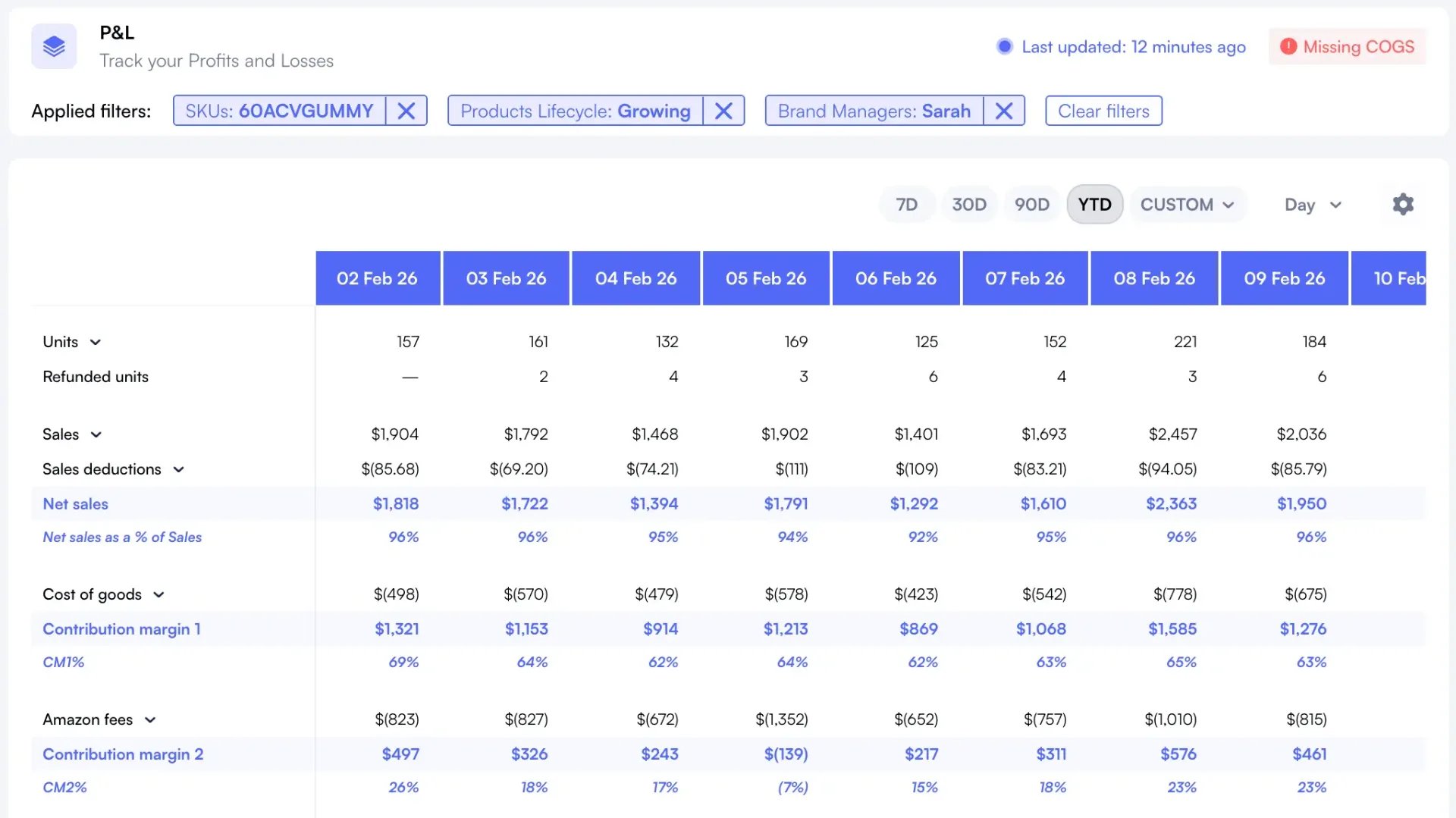
Organize your portfolio by:
Price Tiers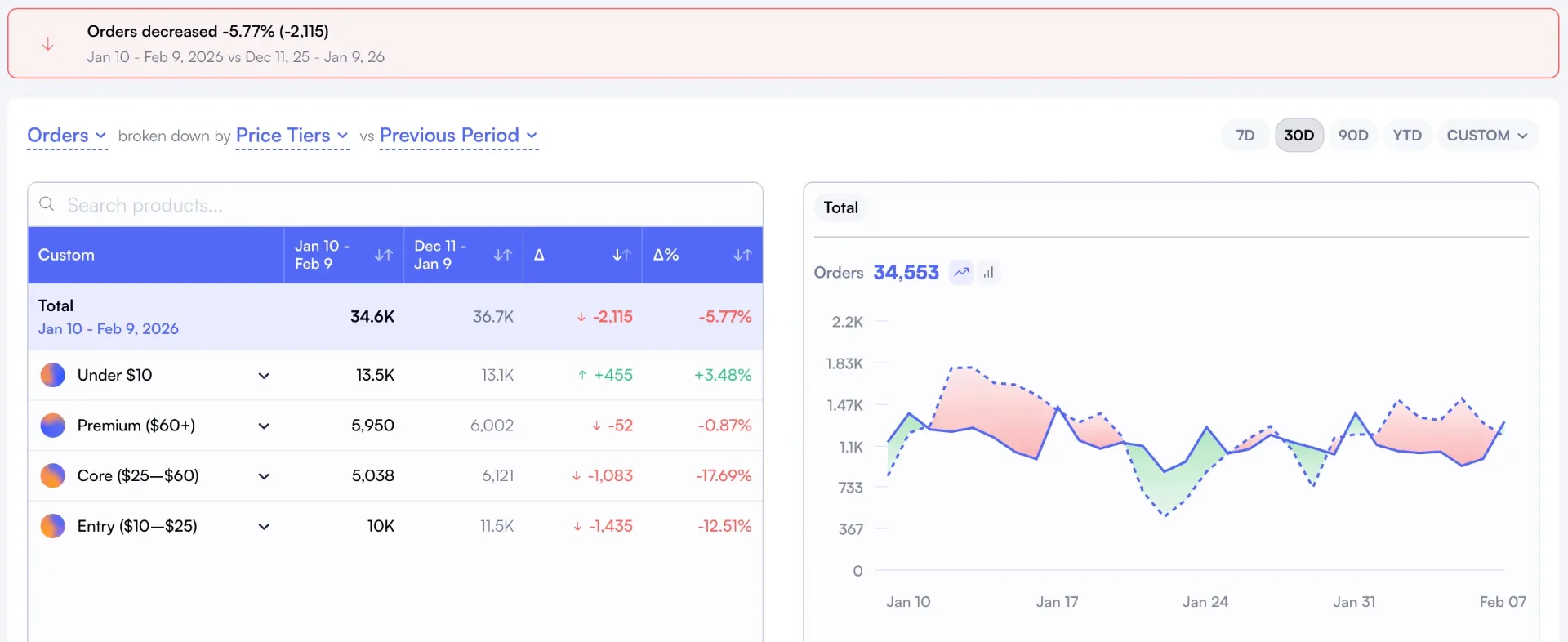
Organize your portfolio by:
Product Lifecycle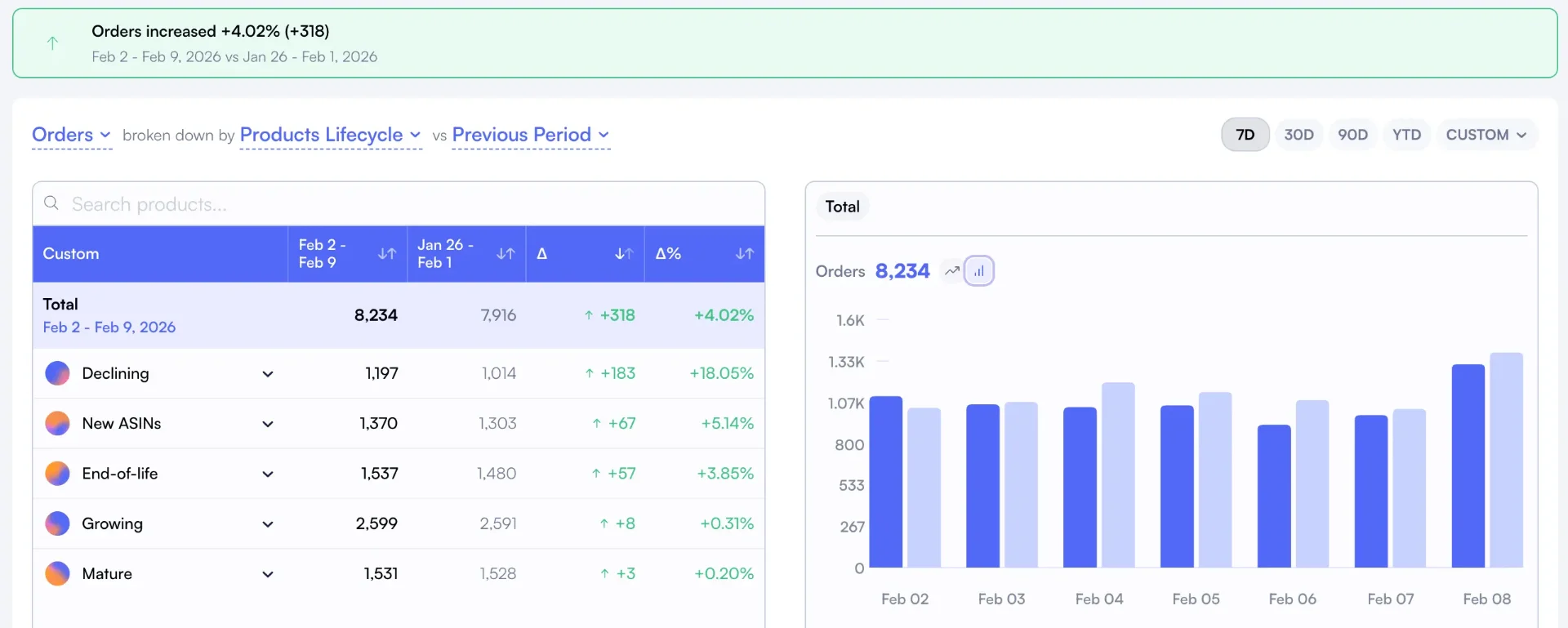
Organize your portfolio by:
Brand Managers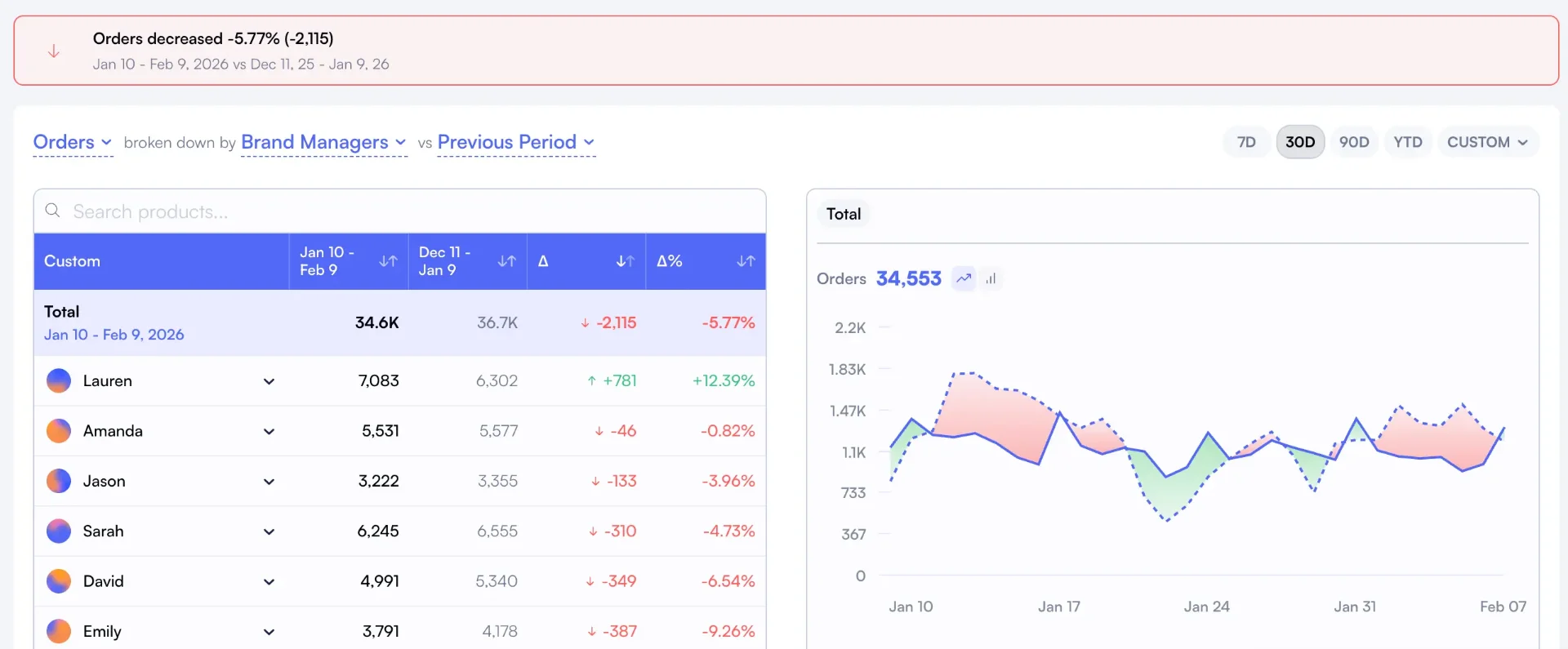
Pricing comparison
Pricing is where many teams get surprised. Here's what to expect:
Openbridge pricing
Model: Custom quotes, no public price list
Factors: data volume, account count, report types
Setup fees: may apply depending on plan
Historical data: typically additional cost
Contact Openbridge directly for current pricing.
Nova pricing
Model: transparent tiers, from $29/month
Trial: 14-day free trial, no credit card required
Extra Seller Central account: $29/month each
Included: all 21 Amazon marketplaces, all per-SKU profit KPIs
Setup fees: none
Enterprise / agency: custom via demo
Total Cost of Ownership
Don't just compare subscription costs. With Openbridge, factor in the engineering time to build data models, maintain transformations, and handle schema changes. A "cheaper" raw data service can cost more when you account for the 100+ hours of data engineering required to make it usable.
Engineering Hours (Openbridge)
100-200 hrs
To build data models & KPIs
Engineering Hours (Nova)
0 hrs
KPIs pre-calculated
Time Savings
$15K-$30K
At $150/hr engineer cost
When to Choose Nova vs Openbridge
Choose Nova When:
You need speed: Data in your warehouse in 24-48 hours, not weeks
You want ready-to-use KPIs: 200+ metrics pre-calculated
You're a 3P seller: our Seller Central coverage is comprehensive
You value support: Direct Slack access vs ticket queues
You want transparency: Clear pricing, no surprises
Your team is lean: No dedicated data engineers available
Consider Openbridge When:
You're primarily 1P: Vendor Central is your main channel
You need Redshift/Databricks: Nova focuses on BigQuery/Snowflake
You have data engineers: who can build custom transformations
You're already using it: Migration cost may exceed benefit
You need specific certifications: Openbridge has longer compliance history
Migrating from Openbridge to Nova
If you've decided to switch, here's the migration process:
Sign Up for Nova
Create your account at api.novadata.io. Connect your Amazon seller accounts via OAuth.
Configure Destination
Point Nova to your BigQuery or Snowflake instance. We can use the same warehouse as Openbridge or a new one.
Run Parallel
Keep Openbridge running while Nova backfills historical data. Compare outputs to verify accuracy.
Update Dashboards
Point your BI tools (Tableau, Looker, Power BI) to Nova's tables. Our schema documentation makes this straightforward.
Deprecate Openbridge
Once validated, cancel your Openbridge subscription and archive their data tables.
Your History Comes With You
Switching data providers is daunting. Our automated migration script imports your historical data from Openbridge exports or any CSV source in minutes. Schema mapping, query translation, and dashboard updates are all handled by our team.
Free migration support for all new customers. Talk to our team →
Your History Comes With You
Switching from Openbridge? Give us access to your current tool or share your data exports. Our team handles the rest. You start Nova with your full history on Day 1. No data loss, no hassle.
Works with exports from any analytics tool. Free for all new users. Talk to our team →
Frequently asked questions
Frequently asked questions
Making your decision
Both Openbridge and Nova solve the same starting problem: getting Amazon data out of SP-API and into a place where you can query it. The difference is what arrives. Openbridge hands you raw SP-API reports ready to land in BigQuery or Snowflake; Nova hands you a per-SKU profit model already reconciled across 21 Amazon marketplaces. Your dbt layer (and the engineers maintaining it) is the cost difference.
Bottom line
If you have data engineers and primarily use Vendor Central, Openbridge remains a solid choice. If you want analytics-ready Amazon data for Seller Central (3P) without owning the model layer, Nova ships per-SKU profit, fees, returns, refunds, reimbursements, and product-level PPC from $29/month with a 14-day free trial.
Related reading: SP-API Rate Limits Guide | BigQuery Guide | Snowflake Guide | Power BI Guide
Ready to Transform Your Amazon Business?
Join thousands of successful sellers who use Nova Analytics to make data-driven decisions and maximize their profits.
Continue Learning
Explore more expert insights to grow your Amazon business
Amazon SP-API Rate Limits: The Complete 2026 Guide
Amazon's Selling Partner API powers every third-party tool. But between rate limits, throttling, and burst quotas, most developers spend more time fighting the API than building features. This guide covers everything you need to know.
Amazon Seller Data to Snowflake
Your data team already uses Snowflake. Getting Amazon seller data in shouldn't require 18 months of engineering. Learn 3 paths: DIY SP-API, ETL tools, or Nova's pre-built Snowflake delivery with hourly refresh.
Amazon Seller Data to BigQuery
Building an Amazon data pipeline from scratch takes 18+ months and costs $2M+ in engineering time. Learn three paths to getting Amazon seller data into BigQuery: DIY with SP-API, ETL tools like Airbyte, or pre-built solutions. Includes SQL query examples for P&L analysis.