Back to Blog
Amazon PPC
Featured
Updated Jun 8, 2026

Best Amazon PPC Software 2026 - Profit-First Buyer's Guide

Most 'best Amazon PPC software' lists mix up bid management, reporting and profit attribution. Here is how the three layers fit, what to buy in each, and the 8-point checklist serious buyers use in 2026.

A
ยทCEO at Nova AnalyticsLinkedIn

Antoine founded Nova Analytics to empower Amazon sellers with enterprise-grade analytics. He specializes in data architecture and building scalable solutions for e-commerce businesses.

Jun 8, 2026ยท9 min

The short version

Amazon advertising crossed $68.6 billion in 2025, so picking the right software stack is no longer a sub-question. Bid management, reporting and profit attribution are three separate jobs, and almost every "best Amazon PPC software" list mixes them up. This guide separates them, names the categories honestly, and shows where Nova fits as the profit attribution layer for product-level ad spend.

Searching for the best Amazon PPC software in 2026 usually returns a ranked list of bid management tools. That answers the wrong question for most sellers. Bid optimization without profit context is what drives a 4x reported ROAS that quietly loses money once Amazon fees, returns and COGS are netted out.

Before you compare features, decide which of the three PPC software layers you actually need. Then pick one tool per layer instead of one tool to do all three poorly.

The three layers every Amazon PPC stack needs

1. Bid management

Automated bid changes, budget pacing, keyword harvest, negative discovery, dayparting. Optimizes for an ACoS, ROAS or impression share target.

2. Reporting and visibility

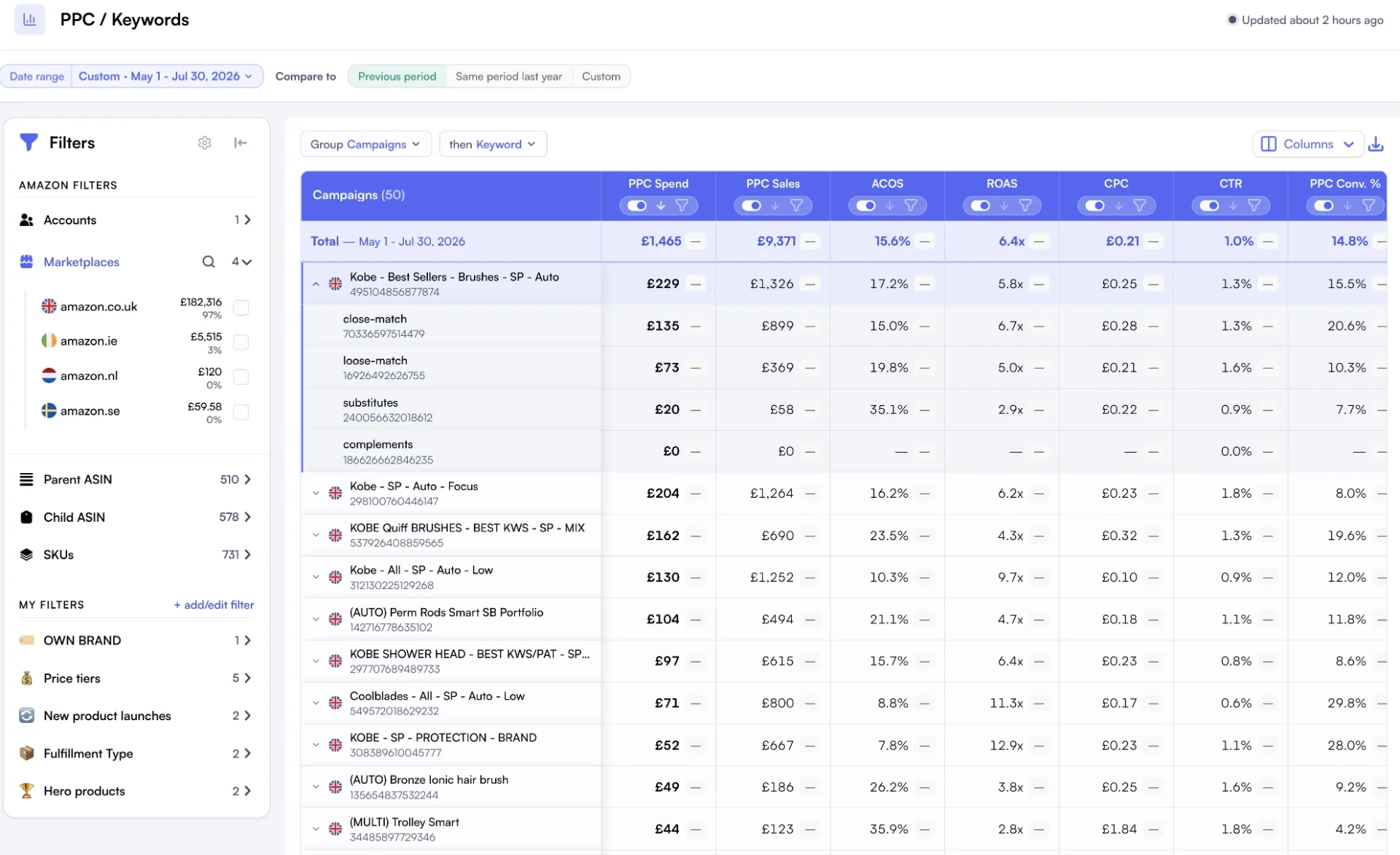
What Amazon and the Ads API expose: campaign and keyword spend, attributed sales, impressions, share of voice, search term reports, Brand Analytics.

3. Profit attribution per SKU

Spend tied to the right ASIN, then netted against referral fees, FBA fulfillment, storage, returns, refund admin and COGS to show contribution margin per product.

Confusing these is the most common buying mistake. A bid manager that drives spend efficiency is not the same as a profit analytics tool that tells you whether the spend earned a margin. You usually want one tool from layer 1 and one from layer 3, with layer 2 covered for free inside Amazon's own surfaces.

Layer 1: Amazon PPC bid management tools

Bid management is the category most lists call "Amazon PPC software". The mature platforms in 2026 cluster into three tiers.

Enterprise bid platforms

Pacvue, Skai, Perpetua, Quartile and Trellis sit at the top end. They handle Sponsored Products, Sponsored Brands, Sponsored Display and increasingly DSP from one console, support multi-marketplace campaigns, and price on a percentage of ad spend or a monthly minimum starting around four figures. The right fit if you run more than $50K monthly ad spend or operate across many brands and regions.

Mid-market automation

Adtomic, M19, Scale Insights and Intentwise target sellers in the $5K to $50K monthly ad spend range. They focus on rule-based automation and a faster onboarding cycle than enterprise platforms. Pricing is usually a flat monthly fee independent of ad spend.

Amazon-native automation

The free option is Amazon's own bidding strategies inside the Ads console: dynamic bids down only, dynamic bids up and down, and fixed bids. The Amazon Ads Agent (open beta in 2026) layers automated bid suggestions on top. The cost is zero and the trade-off is no cross-campaign optimization logic and no SKU-level profit context. See the Amazon Ads help center for current settings.

The 2026 ranking: best Amazon PPC bid management software

Scored against the 8-point buying checklist further down this article. Snapshot dated June 2026, vendor sites verified live, no affiliate relationships. Nova is intentionally absent because it does not manage bids; see the callout below the table.

#ToolBest forPricing modelScoreStrengthWeakness
1PacvueEnterprise, agenciesCustom (% of ad spend)7 / 8Deep Amazon, Walmart, Instacart and AMC coverageHeavy onboarding, opaque pricing under $25K MRR
2PerpetuaMid-to-enterprise brandsTiered + % of ad spend7 / 8Goal-based automation, strong creative testingLimited true-ROAS support without external fee feed
3QuartileMulti-retailer scale brandsCustom (% of ad spend)6 / 8AI bidding across 14+ retail media networksBlack-box optimization, slower data refresh
4SkaiEnterprise omnichannelCustom6 / 8Unified search, social and retail media consoleOverkill for Amazon-only sellers, premium price
5Helium 10 AdtomicMid-market FBA sellersBundled subscription6 / 8Tightly integrated with keyword research suiteLimited beyond Amazon, no Parent ASIN profit lens
6M19Mid-market EU-focused brands and agenciesTiered subscription6 / 8AI-driven bid + budget automation with strong EU marketplace coverageSmaller US footprint and ecosystem than Pacvue / Perpetua
7Scale Insights7-figure FBA sellersFlat monthly6 / 8Granular rules engine, flat pricing scales wellSteep learning curve, Amazon-only
8IntentwiseMid-market hybrid analyticsTiered subscription5 / 8Bid automation plus reporting in one consoleNeither best-in-class layer if you need both
9TrellisSMB merchandising-led sellersFlat monthly5 / 8Ads plus dynamic pricing in one toolLighter on enterprise reporting and AMC depth

Why Nova is not in the ranking

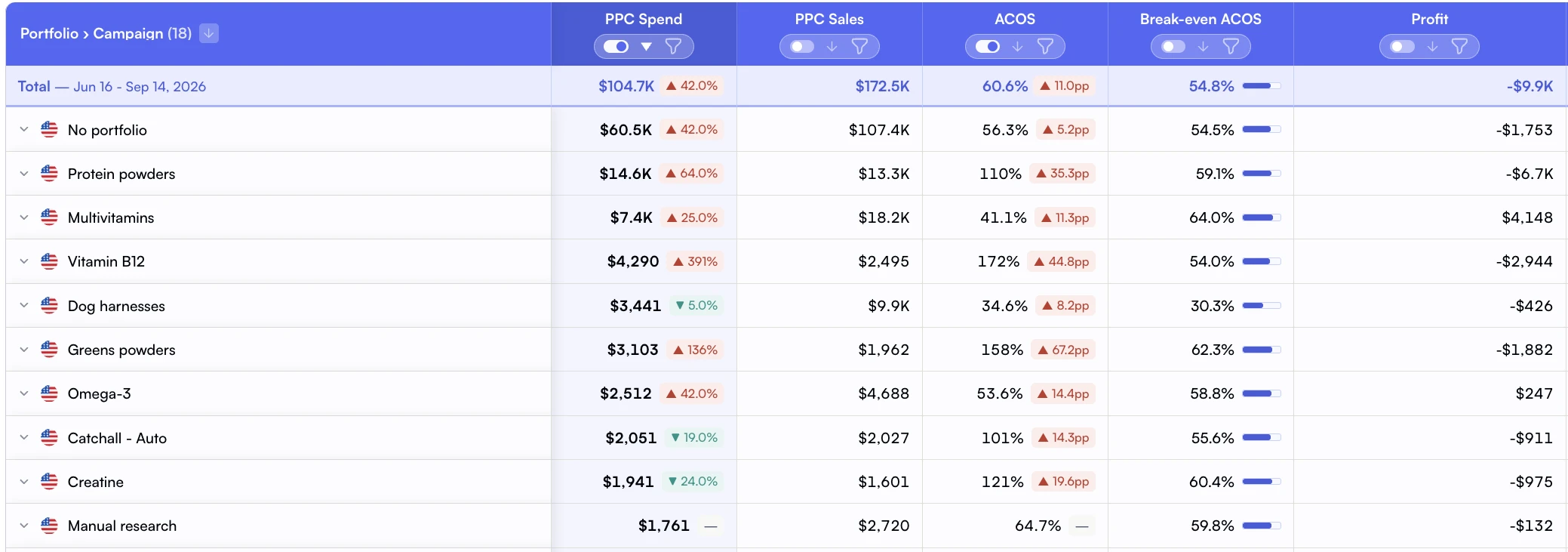
Nova does not manage bids, budgets or keywords. It runs alongside whichever bid manager you pick and answers the question they can't: did this ad spend earn a margin on this SKU or Parent ASIN, after referral fees, FBA fees, returns and COGS? Pair it with any tool in the table above for the full picture. See how Nova reports product-level PPC profit.

Methodology: each tool was scored against the 8-point checklist below (SKU-level data, true ROAS support, refresh frequency, multi-marketplace coverage, integrations, pricing transparency, free trial, data export). Vendor product pages were verified live in June 2026. No affiliate or paid placement.

Layer 2: Reporting and visibility you already have

Before paying for a reporting layer, use what Amazon ships for free.

  • Amazon Ads console: campaign, ad group, keyword and product target reports. Search term reports for keyword harvest.
  • Amazon Marketing Cloud (AMC): SQL access to clean room ad data including DSP, Sponsored Ads and conversion paths. Free to brand-registered sellers running ads.
  • Brand Analytics: Search Query Performance, Market Basket Analysis and Repeat Purchase Behavior reports. Useful for keyword strategy not visible in standard PPC reports.
  • Amazon Ads API: programmatic pull of every metric in the console plus several not exposed in the UI. The data feed every third-party tool relies on.

Most sellers do not need to buy a "reporting tool". What they need is one tool that pulls Ads API data and joins it to the rest of the seller dataset. SmartScout's ultimate Amazon PPC strategy guide covers what to do with that data once it is pulled.

See product-level PPC spend tied to true profit

Nova joins your Amazon Ads spend to fees, refunds and COGS so you see contribution margin per ASIN, refreshed hourly across 21 marketplaces.

Layer 3: Profit attribution per SKU (where Nova fits)

The job nobody else does well: take the ad spend a bid manager just optimized and answer "did that spend earn a margin on this ASIN?". Reported ROAS does not. Even true ROAS at the campaign level does not if a campaign covers multiple SKUs with different fee profiles.

Nova ingests Amazon Ads spend at the product level and joins it to:

  • Referral fees by category
  • FBA fulfillment and size-tier fees
  • Monthly storage and aged inventory surcharges
  • Inbound placement and low-inventory fees
  • Returns and refund administration
  • COGS and landed cost per unit

The output is contribution margin per ASIN after ads. The output your bid manager needs as input. See how Nova reports product-level PPC analytics, or read the deeper product-level PPC ROI guide.

The 8-point Amazon PPC software buying checklist

Use this on any tool, in any of the three layers. A score below 6 usually means the tool is selling you a shinier version of what Amazon already ships for free.

  1. SKU-level data, not just campaign-level. Without ASIN granularity you cannot tie spend to profit.
  2. True ROAS support. The tool must accept your fee and COGS data, not just attributed sales.
  3. Data refresh frequency. Hourly beats daily for in-flight Prime Day or launch decisions.
  4. Multi-marketplace coverage. All 21 Amazon marketplaces if you sell in more than one region.
  5. Integrations with the rest of your stack.Accounting, BI, warehouse, Slack, Sheets, Looker, Power BI.
  6. Transparent pricing. Flat monthly beats percentage of ad spend if you scale fast.
  7. Real free trial. 14 days, no card, full feature access. Anything less is a demo dressed as a trial.
  8. Clean data export. CSV, Sheets, and direct warehouse pipes. You should own the data after you cancel.

Stack recipes by seller size

Under $500K annual revenue

Amazon Ads console for bid management (free, dynamic bids down-only is a sensible default). Nova at $29 a month for product-level profit attribution. Skip enterprise tools until ad spend justifies them.

$500K to $5M annual revenue

Mid-market bid automation (Adtomic, M19, Scale Insights, Intentwise) or an outsourced PPC agency. Nova for SKU-level true ROAS so the agency or tool has profit context, not just ACoS targets. Brand Analytics if you are brand registered.

$5M+ and agencies

Enterprise bid platform (Pacvue, Skai, Perpetua, Quartile, Trellis) plus AMC for path analysis. Nova as the unified profit view across brands and marketplaces, often piped into Snowflake, BigQuery or Power BI. See the analytics-for-agencies buyer's guide.

Common mistakes when buying Amazon PPC software

  • Optimizing ACoS without tracking refunds. Returns and refund admin fees can flip a 25% ACoS campaign from profitable to negative on certain SKUs.
  • Ignoring organic halo. A campaign with poor ROAS can still pay for itself through organic rank lift. Look at TACoS and SKU-level organic vs PPC split, not campaign ROAS alone.
  • One tool to do all three jobs. Bid managers that "also do profit" usually default to gross-sales ROAS and miss fees. Profit tools that "also manage bids" usually do not. Pick the best in each layer.
  • Buying on price of ad spend. Percentage-of-spend pricing punishes the success the tool is supposed to deliver. Flat monthly is almost always cheaper at scale.
  • No SKU-level profit view. Without it, you optimize campaigns that subsidize loss-making ASINs. SellerApp's Amazon PPC basics guide walks through why ASIN-level visibility matters.

Where to go next

Frequently asked questions

For bid management, Pacvue ranks first overall in our 2026 review thanks to deep Amazon Ads and AMC coverage, multi-retailer support and transparent enterprise pricing. Perpetua and Quartile follow for mid-to-enterprise sellers, with Scale Insights the value pick for 7-figure sellers who want flat pricing. The ranking covers bid management only. Reporting comes free from the Amazon Ads console and AMC, and profit attribution per SKU is a separate layer Nova handles alongside whichever bid manager you pick.
Most sellers under roughly $30K monthly ad spend can run Sponsored Products in Seller Central or Amazon Ads console. Above that, manual bid management eats hours and decisions get slow. Software earns its cost when you have more than a few hundred keywords, multiple marketplaces, or need profit attribution down to the SKU.
Amazon Ads console is free and ships with Sponsored Products, Brands and Display reporting. Free third-party tools usually cap features at a small number of campaigns or short data windows. Nova's free plan tier does not exist; it starts at $29 a month with a 14-day free trial, no card required.
Bid management software changes bids, budgets and keyword targets to hit an ACoS or ROAS target. Profit attribution does not touch your campaigns. It joins ad spend to fees, refunds, returns and COGS so you know the contribution margin each SKU earned after the click. You usually need both.
No. Nova is a profit analytics platform. It reads product-level PPC spend through the Amazon Ads API and reports it inside the SKU P&L. Campaign creation, keyword harvest, dayparting and bid changes stay in the Amazon Ads console or your bid management tool of choice.
True ROAS is attributed ad sales divided by ad spend, after subtracting referral fees, FBA fulfillment, storage, returns, refund admin and COGS. Most PPC tools report platform ROAS, which uses gross sales. Two SKUs with identical 4x platform ROAS can have a positive and a negative true ROAS once fees and returns are netted.
Most enterprise bid management tools cover all major Amazon marketplaces. Nova covers all 21 marketplaces Amazon publishes data for through a single account, so the profit view stays unified even if you split campaign management across regional teams.
Use a buying checklist: SKU level data not just campaign, true ROAS support, refresh frequency, multi-marketplace coverage, integrations with the rest of your stack, transparent pricing, a real free trial and clean data export. Most agencies and 7-figure brands run a 30 day proof of concept before signing an annual contract.