Amazon reports Subscribe & Save through three metrics on purpose: S&S sales, share of total, and active subscriber count. Here is how to read them and grow recurring revenue without over-discounting.
Subscribe & Save is the closest thing Amazon offers to recurring revenue. For consumable brands, it can carry 20 to 40 percent of total sales and quietly compound LTV in a way no PPC campaign can match. The catch: most sellers track it through three numbers, do not understand what those three numbers actually predict, and end up either under-investing or over-discounting. Here is how to read the metrics that matter.
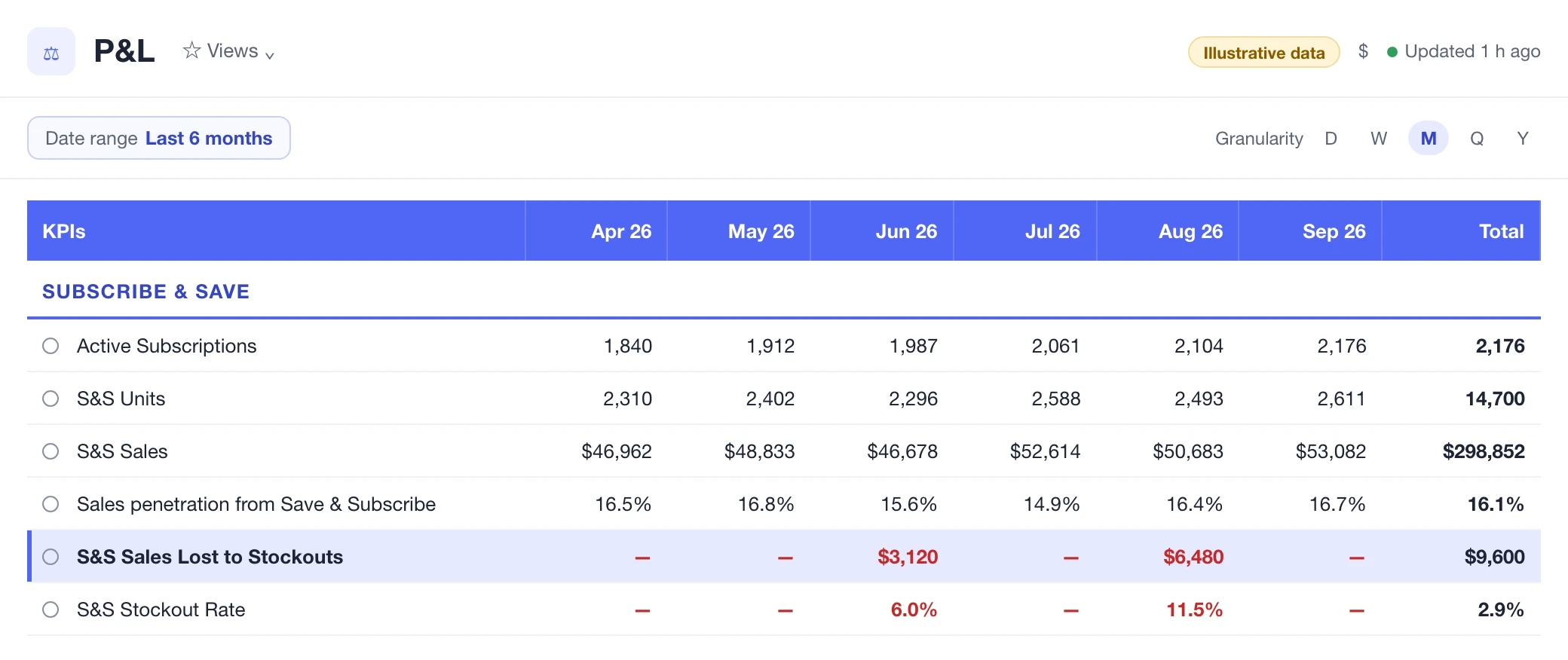
Subscribe & Save in numbers, including the subscription sales lost in the months a product ran out of stock. Illustrative data.
In short
•Three metrics tell you almost everything: S&S sales, S&S share of total sales, active subscription count.
•S&S share above 25 percent is the threshold where recurring revenue starts cushioning weak weeks.
•Active subscription count is the leading indicator. It moves before revenue does, in either direction.
•The 5-15 percent discount is real, but lower acquisition cost on repeat orders usually offsets it for consumables under 90-day reorder cycles.
•Subscribe & Save is not a fit for one-shot products. Forcing it on the wrong catalog hurts margin without lifting LTV.
Our take
If you only do one thing this month
Pull the active subscription count by SKU for the past 12 weeks and chart it. The slope of that line, not the absolute number, is your single best leading indicator of where S&S revenue is going for the next 90 days.
Best fit if
•Consumable brands with reorder cycles under 90 days (supplements, pet, household, beauty)
•Brand managers wanting a stable revenue base that does not depend on weekly ad performance
•Aggregators evaluating which acquired brands are sticky vs one-off
Skip if
•Brands selling durable goods or one-shot products
•New sellers under the review threshold needed to enroll
Subscribe & Save is reported in Seller Central as a small subset of fields, and there is a reason for that. The program is structurally simple. A customer subscribes, an order ships on a schedule, the customer either stays subscribed or churns. There are not many useful states between those.
That simplicity is also why most analytics tools either ignore S&S entirely or bury it inside a generic "subscription" report that mixes it with one-time orders. The clean way to track it is the three-metric framework that mirrors how the program actually works.
The three metrics and what each one tells you
Metric
What it measures
What it predicts
S&S sales (absolute)
Recurring revenue this period
Size of the protected base
S&S share of total sales
Recurring as % of mix
How much weekly volatility you absorb
Active subscription count
Subscribers right now
Where revenue will be in 30 to 90 days
Metric one: S&S sales (the absolute number)
The simplest of the three. Total dollars or units sold through S&S in a given period. It tells you the current size of your recurring base, but on its own it is the least useful of the three because it lags. By the time S&S sales drop, the subscriber base has already been shrinking for weeks.
Use this metric for two things: tracking absolute revenue contribution against forecast, and benchmarking against category norms. According to Marketplace Pulse data on the Subscribe & Save program, top consumable brands now generate 30 to 50 percent of unit volume through S&S.
Metric two: S&S as a share of total sales
This is the one that matters for stability. Brands with S&S share above 25 percent stop riding the weekly volatility of ads, slot promotions, and algorithm changes. The recurring base provides a floor, and the floor is what lets a finance team plan inventory POs against something other than last week's sales spike.
Below 10 percent share, S&S is a nice add-on but not a strategic asset. Between 10 and 25 percent, you have a meaningful base that can grow into one. Above 25 percent, you have what amounts to a subscription business sitting inside an Amazon storefront, and the metrics that matter shift accordingly. Amazon's Subscribe & Save program help page documents the eligibility and discount mechanics in detail.
Nova insight
To evaluate Subscribe & Save stability, compare each product's week-over-week revenue variance before and after enrollment while controlling for promotions and stockouts.
Metric three: active subscription count (the leading indicator)
This is the one most teams under-watch, and the one that actually predicts where the business is going. Active subscriber count moves before S&S revenue moves, in both directions. A flat or declining subscriber count for 4 weeks running tells you the revenue line is about to flatten or decline, even if it has not yet.
Two things move active subscriber count: gross adds (new subscribers signing up) and churn (existing subscribers cancelling or pausing). Tracking the two separately, even if Seller Central reports them as a net number, is what lets you diagnose whether the issue is acquisition (ad efficiency, listing conversion) or retention (product quality, delivery reliability).
Is the discount worth it? The actual profitability math
The Subscribe & Save discount is a real margin hit. At the base 5 percent tier, a $20 product becomes $19. At the loyalty 15 percent tier (which kicks in when a customer has 5 or more S&S items in the same shipment), the same product becomes $17. For consumable brands operating on 20 to 35 percent contribution margin, the discount eats meaningfully into per-unit profit.
It is offset by three things: lower advertising spend per repeat order (most repeat S&S orders ship without any ad attribution), lower return rates on repeat purchases of products the customer has already validated, and higher LTV from customers who stay subscribed for 6 months or more. The math typically works for products with reorder cycles under 90 days and customer churn below 10 percent per quarter. It typically does not work for one-shot products dressed up as subscriptions.
When Subscribe & Save makes financial sense
Product type
Reorder cycle
S&S typically profitable?
Vitamins, supplements
30-60 days
Yes
Pet food, treats
30-45 days
Yes
Household consumables (paper, soap)
45-90 days
Yes
Beauty, skincare
60-90 days
Often
Coffee, tea
30-60 days
Yes
Snacks, pantry staples
30-60 days
Yes
Apparel, accessories
120+ days
Rarely
Electronics, durables
Years
No
Nova insight
Do not enroll the entire catalog without checking reorder cycle and margin first. Without filtering by reorder cycle and margin, this dilutes the program-wide metrics and obscures which SKUs are actually pulling weight. Enroll selectively, then track per-SKU.
How to grow the three metrics on purpose
Once you accept that the three metrics tell you almost everything, the operational playbook gets short.
Grow active subscriber count. Optimize the listing for the S&S call-out (it shows up under the price), highlight subscription savings in A+ content, and run targeted Sponsored Brands campaigns to subscriber-prone keyword sets.
Reduce churn. Track which delivery cadences correlate with longest retention (often 60-day for supplements, 45-day for household). Adjust default frequencies accordingly. Monitor reviews on subscriber-heavy SKUs for quality drift.
Raise S&S share through bundle plays. Group complementary products so customers cross the 5-item threshold and unlock the 15 percent loyalty discount. Higher discount, more sticky basket.
What not to track (the noise that drowns the signal)
It is tempting to layer dozens of derived metrics on top of S&S: per-cohort retention curves, predictive churn scores, lifetime value forecasts, basket affinity, opt-in funnels. Most of them are downstream of the three primary metrics, and most of them are unstable on the data Amazon actually exposes.
Active subscriber count, S&S sales, S&S share of total. Three numbers. Watch them weekly. If they move, dig into the why. If they do not, the program is doing its job.
The bottom line
Subscribe & Save is one of the few levers Amazon gives sellers that compounds. The program is reported through a small set of metrics on purpose, because the underlying mechanics are simple: subscribers, sales, share. Track those three numbers per SKU, per brand, per marketplace, and you have most of what you need to grow recurring revenue intentionally.
The brands that get this right tend to retire the spreadsheet of derived metrics and focus operational meetings on the three numbers that actually move the business.
Frequently asked questions
Subscribe & Save is Amazon's recurring delivery program. Customers subscribe to consumable products at a discount (typically 5 to 15 percent off) in exchange for scheduled deliveries every 1 to 6 months. For sellers, it generates predictable revenue, lifts repeat purchase rate, and reduces the marketing cost of each subsequent order.
Most consumables qualify: pantry staples, household supplies, personal care, supplements, pet products, beauty essentials. Eligibility requires the product to be FBA-fulfilled, in stock consistently, and meet Amazon's review and rating thresholds. Brand Registry is required for branded products.
The base discount is 5 percent on a single subscription, rising to 15 percent if a customer has 5 or more subscription items shipped to the same address in the same month. Sellers can choose to fund a brand-funded discount on top, but the program runs without one.
It depends on category and customer behavior. The discount is a real margin hit, but it is offset by lower advertising spend per repeat order, lower return rates, and higher LTV. For consumable categories with reorder cycles under 90 days, the math typically works. For one-shot purchases dressed up as subscriptions, it does not.
Three core metrics matter: total S&S revenue, S&S as a percent of total sales, and active subscription count. Together they tell you the size of the recurring base, its share of the business, and whether subscriber acquisition is keeping up with churn. Anything else is downstream of these three.
Recurring shipments count toward sales velocity, which is one input into BSR. Brands that build a meaningful S&S base often see ranking stability through slow weeks because the recurring orders keep velocity steady even when ad-driven sales dip.