
Seller Central MCP
Amazon Seller Central MCP server: what is actually possible
Amazon launched its own Selling Partner plugin on 23 September 2026. Here is what it covers and what Nova adds.
- 23
- marketplaces
- 43
- tools
- 1h
- data refresh
Josh Grillo, Founder of Sell Through, on querying his Amazon accounts from Claude
24 mo
history backfilled
43
tools
23
marketplaces
99.9%
reconciliation accuracy
Amazon's plugin and Nova, side by side
Amazon does not know your supplier, freight, duty or VAT costs, so its plugin cannot return profit after them.
| Amazon Selling Partner plugin | Nova MCP | |
|---|---|---|
| Where you ask | Amazon Quick, and Claude in beta | Claude, ChatGPT, Gemini and Copilot Studio, Cursor |
| Marketplaces | Amazon's US stores, international expansion to follow | 23 Amazon marketplaces |
| Amazon data | Listings, inventory levels and sales analytics | Orders, ads, inventory, listing health and 73 charge, 45 refund and 21 reimbursement lines, reconciled per SKU |
| Your costs | Amazon does not hold your cost of goods, freight, duties, VAT treatment or FBM costs | Imported and applied to every SKU, so profit is after your costs |
| Several accounts in one view | Amazon has not said | Yes, for agencies, aggregators and brand managers |
| Vendor Central (1P) | Amazon has not said | Yes, alongside Seller Central (3P) |
| Actions | Human approval on actions, with audit trails | Nova MCP reads by default. Listing edits are available only when a workspace owner turns them on, and every edit is previewed and confirmed before it reaches Amazon. Prices and stock levels are never changed. |
| Price | Amazon has not stated a plugin fee | From $49/mo |
Full tool list: all 43 Nova MCP tools.
One endpoint, every account
Every account and marketplace in one question
One Seller Central login per account and region, or one Nova connection for all of them.
- Account 01 · US
- Account 02 · DE
- Account 03 · UK
- Account 04 · FR
- Account 05 · IT
- Account 06 · ES
- Account 07 · CA
- Account 08 · JP
- Account 09 · MX
- Account 10 · NL
- Account 11 · SE
- Account 12 · PL
"Which of my accounts lost margin last week, and on which SKUs?"
What sits behind the endpoint
Your Seller Central account, modelled before the assistant sees it
Data sources




AI assistants
 ClaudeDesktop, Code, web
 ChatGPTConnectors & custom GPTs
 GeminiMCP-capable clients
 Copilot StudioMicrosoft Copilot
700+ metrics. Real-time sales. 23 Amazon marketplaces.
Setup
Connecting Seller Central, in four steps
Authorise once, then ask.
- 01
Open Claude, go to Settings then Connectors
In Claude, open your profile, then Settings, then the Connectors tab. Works on the desktop app and on claude.ai.
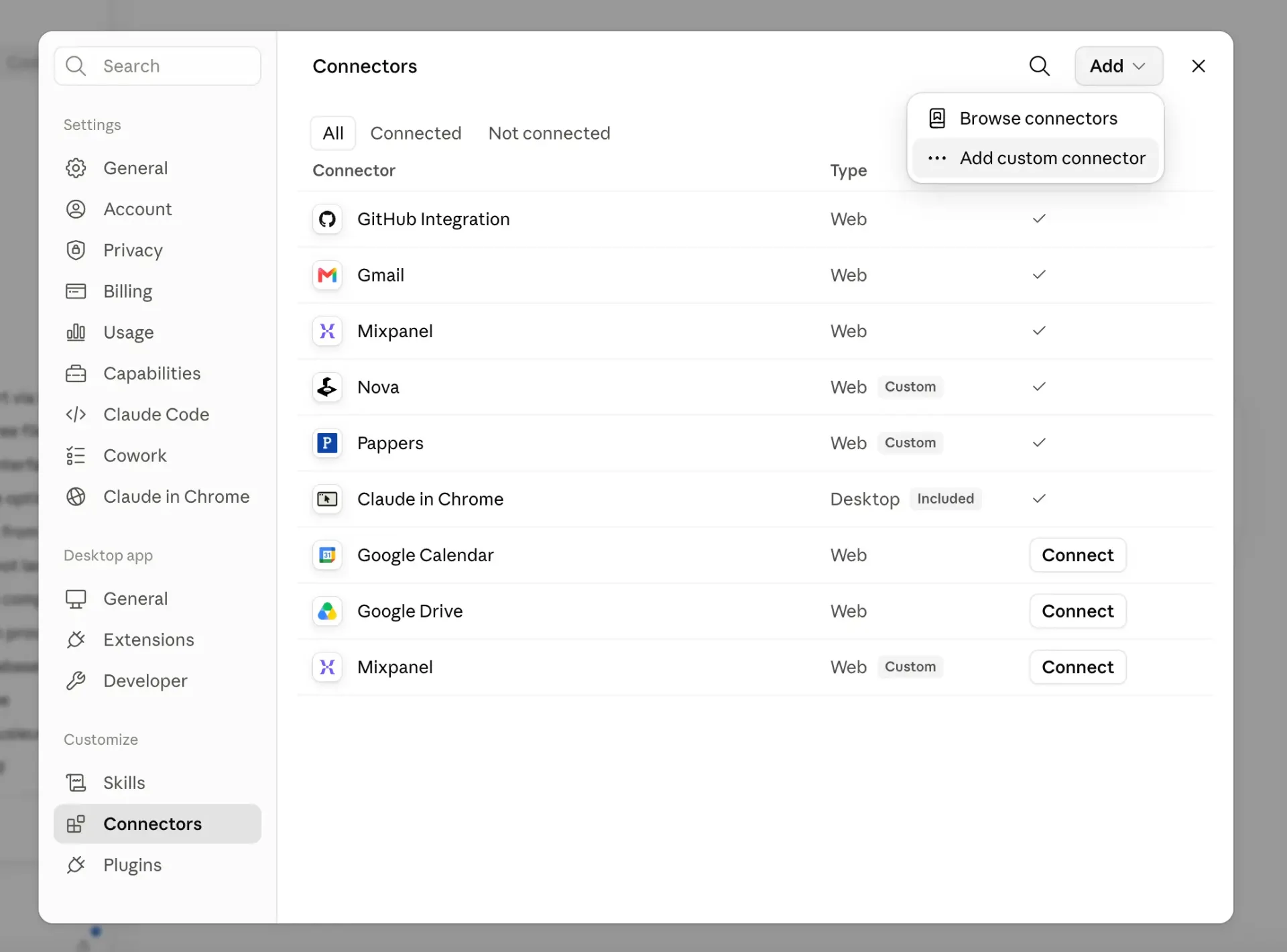
- 02
Click Add custom connector
In the Connectors panel, click Add, then Add custom connector. If you do not see the option, check that you are on a Claude paid plan.
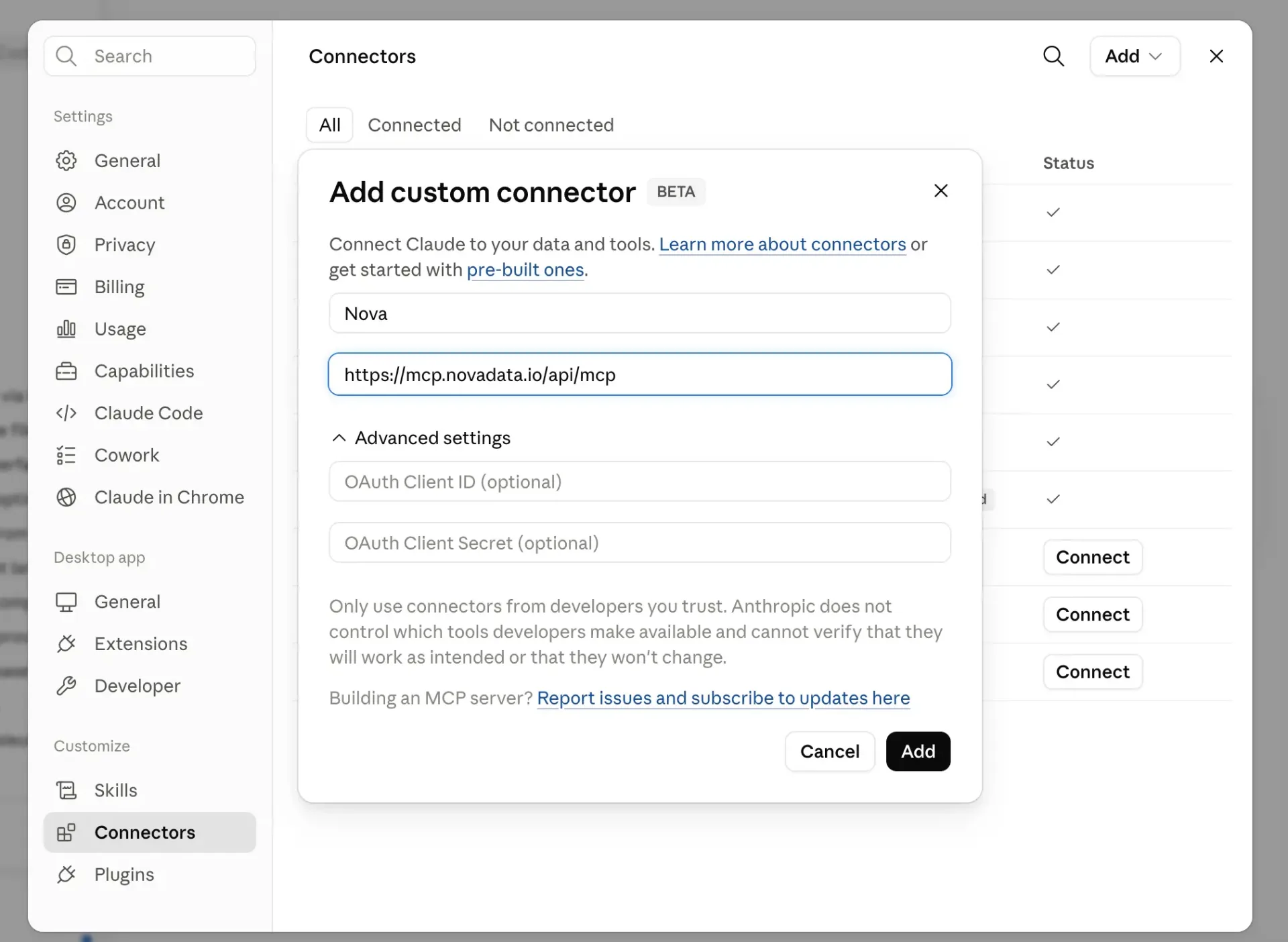
- 03
Fill in the connector details
Name
NovaRemote MCP server URL
https://mcp.novadata.io/api/mcpNo authentication is required in the current beta. Click Add, then Save.
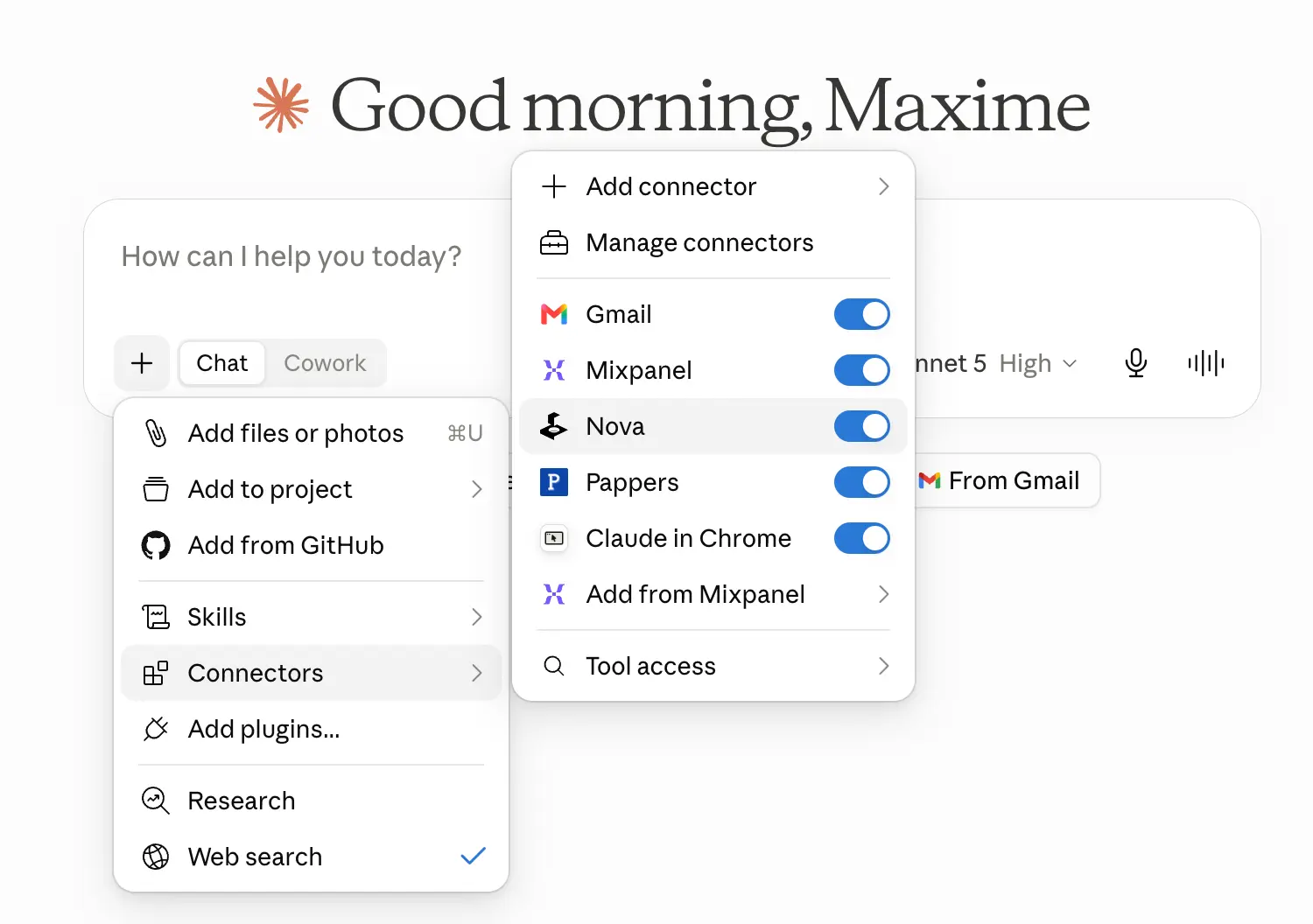
- 04
Toggle Nova on and start asking questions
Toggle Nova on, open a new conversation, and ask about your live Amazon business.
Screenshots, troubleshooting and example prompts.
Your first hour after authorisation
Answered as rows, not exports.
What was net profit per SKU last month?
query_metrics1 call| SKU | Units | Net profit |
|---|---|---|
| NV-4021 | 1,284 | $9,410 |
| NV-1180 | 902 | $3,120 |
| NV-7734 | 418 | -$640 |
Which ASINs run out of stock inside 21 days?
query_inventoryranked server side| ASIN | Units left | Days cover |
|---|---|---|
| B0C1X4M2Q9 | 310 | 9 |
| B0B7T2N5KL | 742 | 14 |
| B09Z8H1WPD | 1,120 | 20 |
Example answers. Figures shown are illustrative, the shape of the response is not.
What you can ask today
- Ask for net profit by SKU, brand, marketplace or tag over any date range
- Rank the biggest movers of the week and get the signals behind one of them
- Pull Sponsored Products, Brands and Display at campaign, ad group and keyword grain
- Read the customer search terms and Search Query Performance behind a listing
- Check FBA stock cover, and which SKUs run out inside 21 days at the current rate
- See suppressed listings, buy box state and Best Seller Rank on your own ASINs
What it will not do
- Nova MCP reads by default. Listing edits are available only when a workspace owner turns them on, and every edit is previewed and confirmed before it reaches Amazon. Prices and stock levels are never changed.
- Access another seller's account. Credentials are per account and revocable.
- Read data Amazon does not expose to the Selling Partner and Advertising APIs.
- Replace Seller Central itself. Case management and account settings stay there.
A modelled server answers in one call
Asked "which SKUs lost margin last week", a raw SP-API wrapper and Nova do very different work.
8 to 20 calls
Fee lines reconciled inside the prompt.
1 call
The joins already happened.
- 01
81
Amazon report feeds
- 02
120
transformation models
- 03
337
columns per SKU per day, 42 of them Vendor Central
"One of the issues that we really found with other MCPs was that it was just pulling in raw Amazon data. So the data was frequently inaccurate. We had to spend more time double-checking data than we actually spent using the MCP."

"One of the issues that we really found with other MCPs was that it was just pulling in raw Amazon data. So the data was frequently inaccurate. We had to spend more time double-checking data than we actually spent using the MCP."
Josh Grillo, Founder, Sell Through
Why this MCP and not another one
Coverage
SP-API, Ads, Search Query Performance, search terms, inventory, listing health and BSR, across 23 marketplaces. Vendor Central (1P) is live.
Freshness
Orders and units reach Nova within seconds of the sale, with sales estimated until Amazon confirms the exact amounts. Ad spend refreshes every two hours, search term data three times a day, Amazon finance transactions hourly, and the remaining reports daily.
Speed and tokens
Structured, pre-aggregated tables instead of raw dumps, so one question is usually one low-token call rather than several round trips.
Your costs, not just Amazon's
COGS per SKU, FBM cost, your own tags and 24 months of backfilled history, reconciled at 99.9% accuracy across 370 transaction lines.
The full row-by-row comparison lives on the Nova MCP page.
Connecting Seller Central to an assistant raises three fair questions.
Answers in seconds
Pre-aggregated responses, ranked server side, light on tokens.
Revocable
Per-account credentials you can pull back at any time.
Minutes, not a project
Authorise, paste one endpoint, 24 months of history backfills.
Point your assistant at your Seller Central data
Per-account credentials, revocable at any time, live in minutes.
14-day free trial, no card required. MCP reads by default.
query_reviews: query_reviews returns reviews and ratings per ASIN and marketplace on Seller Central accounts: review counts are available only in North America (US, CA, MX, BR), while ratings are available on every marketplace.
query_subscribe_and_save: query_subscribe_and_save returns Subscribe & Save programme health, offers and each product's state from Amazon's replenishment data.
The rest of the Amazon MCP guide
Every page in this cluster answers a different question. Start at the pillar if you want the full picture.
- Nova MCP server for AmazonThe pillar page: every data point the Nova MCP serves, the comparison against other Amazon MCP servers, and how to connect.
- Amazon AI agentsThe agent layer: what you can build once an assistant can read your seller data.
- Connect Claude in 4 stepsThe setup walkthrough, from Seller Central auth to your first prompt.
- Amazon data for ClaudeThe data catalog Claude reads: sources, grains, and the SKU profit model behind them.
- Amazon data for ChatGPTThe same model, read from ChatGPT: custom GPTs, the API, or your own agent.
- Amazon data for GeminiGemini, AI Studio and Vertex reading the same reconciled Amazon dataset.
- Amazon MCP prompt library32 copy-and-paste prompts for profit, PPC, keyword share, inventory and listings.
- Nova MCP tool referenceAll 43 tools, the question each answers, and what comes back.
- Amazon MCP for agenciesMulti-account operators: one connection across every client, and per-client profit after fees.