
Amazon cancels SP-API fees - what sellers and developers need to know
 Claude
 Gemini
 ChatGPT
Quick Summary
- •May 12, 2026: Amazon emails developers confirming SP-API usage and annual fees are cancelled, not just delayed
- •The $1,400 per developer annual subscription and the $0.40 per 1,000 GET-call overage are both withdrawn
- •Amazon cites developer feedback. The wording "at this time" leaves room for a future proposal in a different shape
- •Tool vendors that already raised prices citing SP-API fees are exposed to renegotiation requests from sellers and agencies
- •Sellers should audit invoices since November 2025 and push vendors for richer data refresh, not only price cuts
Nova surfaces every Amazon fee, refund, and margin shift in your live P&L, across 23 marketplaces. Open the live P&L
Breaking - May 12, 2026
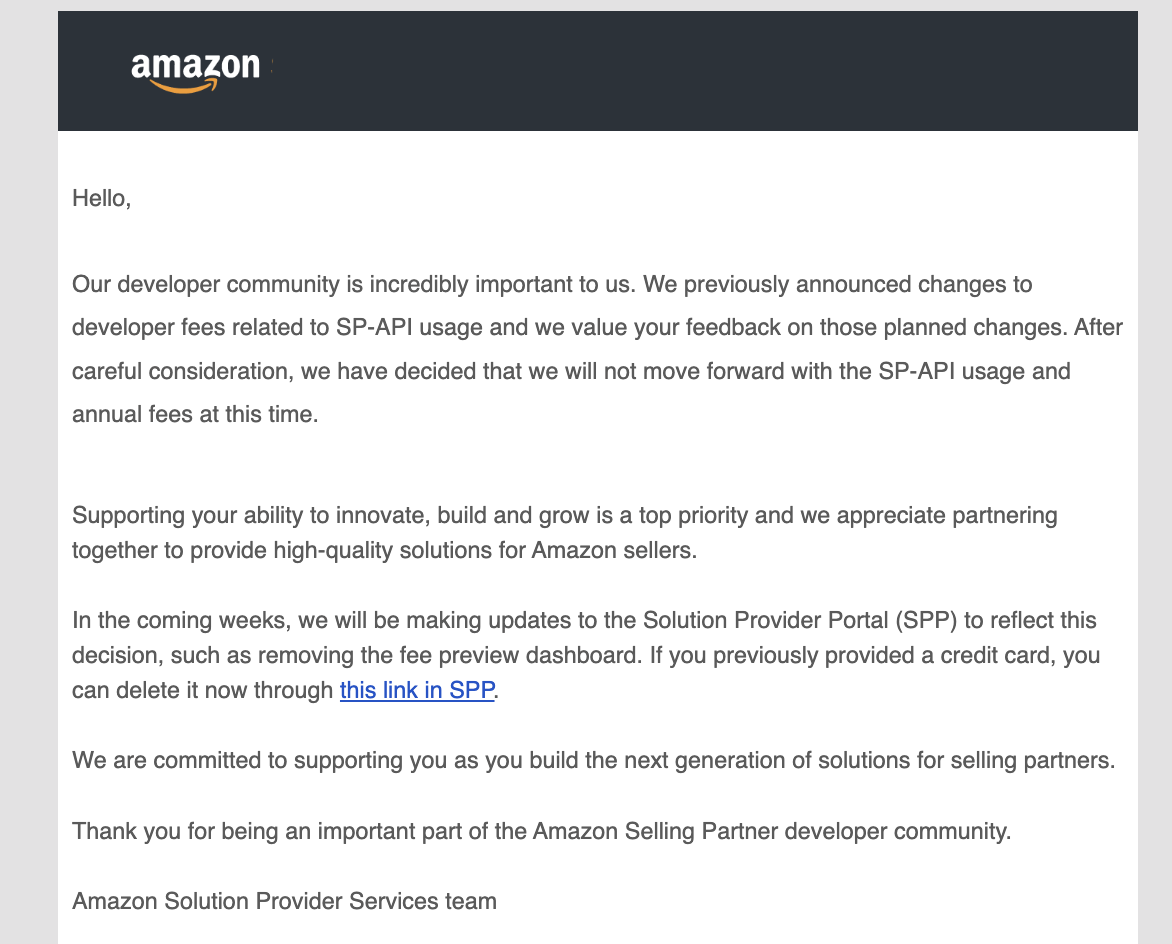
Amazon emailed third-party developers today confirming the planned Selling Partner API (SP-API) usage fees and annual subscription are cancelled, not just delayed. After careful consideration, Amazon will not move forward with SP-API usage and annual fees at this time. The original $1,400 annual subscription and $0.40 per 1,000 GET-call overage are off the table. Check the effect during the next billing cycle rather than waiting for a quarterly review.
What Amazon announced
The May 12, 2026 email from the Amazon Solutions Partner team opens with the line "Our developer community is incredibly important to us" and confirms the company has decided not to proceed with the SP-API usage and annual fees. The note frames the decision as a response to developer feedback received since the original November 2025 announcement and the March 2026 indefinite delay.
The cancellation covers two components that had been on the table:
- →The $1,400 per developer annual subscription for SP-API access
- →Usage-based overage fees of $0.40 per 1,000 GET calls beyond the included tier allowance
For sellers, the practical impact is that none of the 5-15% subscription price increases that tool vendors had warned about for late 2026 are coming because of SP-API costs. Vendors that had already raised prices to "absorb" announced fees now have a hard question to answer.
Full chronology of SP-API fees
Key Dates & Deadlines
Amazon proposes SP-API monetisation
Amazon Solutions Partner team begins informal consultations with large tool vendors about charging for SP-API access.
Public announcement and billing setup
Amazon publishes the fee schedule: $1,400 annual subscription, four usage tiers, $0.40 per 1,000 GET calls in overage. Billing portal opens for developers.
First implementation push
Original date for the annual subscription to take effect. Amazon delays after pushback from the developer community and large agencies.
Indefinite delay announced
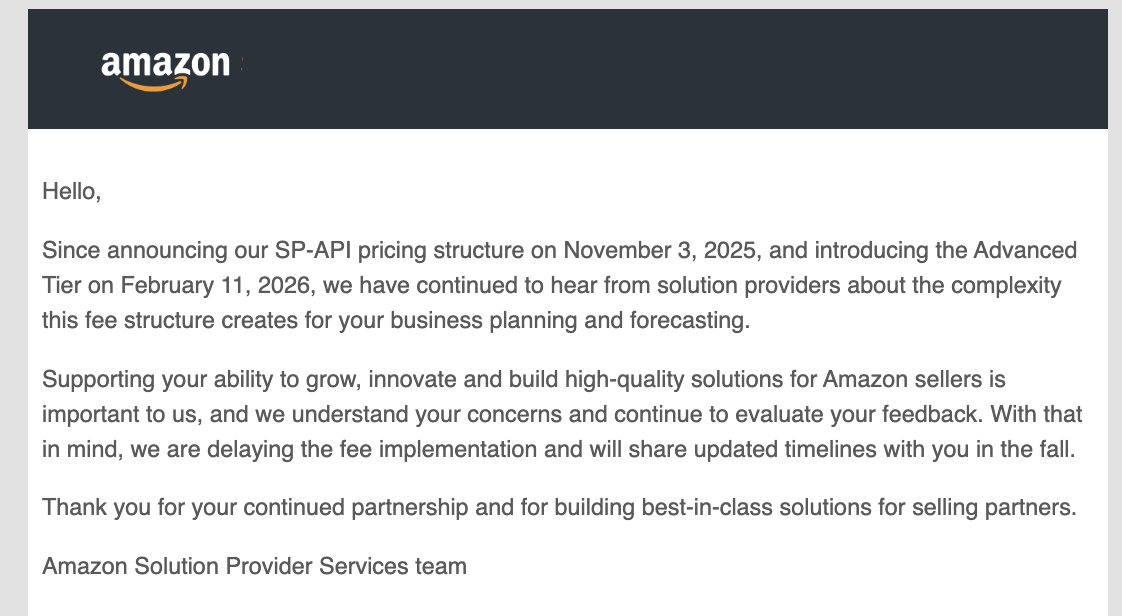
Amazon emails all solution providers postponing all SP-API fee deadlines indefinitely. Updated timelines promised for fall 2026.
Fees cancelled
Amazon confirms in writing that SP-API usage and annual fees will not move forward at this time. The fee structure is withdrawn, not just paused.
What it means for tool vendors
Vendors that already raised prices
Several large repricers, inventory tools and analytics platforms passed 5-15% increases to customers between November 2025 and March 2026 citing SP-API costs. Those increases now look hard to defend. Expect renegotiation requests from agencies and 7+ figure sellers within weeks.
Smaller and bootstrapped tools
The $1,400 floor was an existential threat for solo developers and niche tool builders. The cancellation removes it. Expect the long tail of single-purpose tools (review monitoring, refund recovery, niche reporting) to keep operating without forced consolidation.
Consolidation pressure
The merger and acquisition narrative of the past six months was largely framed around shared API cost absorption. With fees off, the consolidation thesis weakens. Deals already in motion still close on their existing logic, but the "API tax" tailwind is gone.
Roadmap reshuffle
Engineering teams that spent Q1 2026 optimising call volume to fit Basic-tier limits get that work back as headroom. Expect more frequent data refreshes, deeper historical backfills and faster onboarding flows from vendors that had been rationing calls.
What it means for sellers
The headline is simple: no API-driven price increases are coming on your seller tools in 2026. Three concrete actions for sellers and agencies:
- 1.
Audit recent price changes
Pull every tool invoice from November 2025 forward. Any vendor that raised its rate while citing SP-API fees is now overcharging on a withdrawn justification. Ask for a renegotiation or a downgrade path.
- 2.
Push for richer data refresh, not lower price alone
The cancellation gives vendors API headroom. Ask for hourly refreshes, longer history and full marketplace coverage rather than only price cuts. The latter is fungible; the former changes how you operate.
- 3.
Re-evaluate the consolidation case for tool stacks
If you consolidated to an all-in-one platform expecting per-tool API cost pass-throughs, the pure cost case is weaker now. The product case (single source of truth, unified P&L, fewer reconciliation seams) still holds. Decide deliberately, not by default.
What it means for the SP-API ecosystem long term
Amazon still spends real money operating an API that handles roughly 58 billion calls a year across more than 1.6 million developers. Cancelling the fee structure does not make that infrastructure free for Amazon. It signals that the company has decided the strategic value of an open developer ecosystem (and the third-party seller flywheel it powers) outweighs the recoverable cost.
That said, "at this time" is doing real work in the announcement. The SP-API fee proposal can return in a different shape: tier-only, write-call-weighted, or limited to the largest commercial users. Sellers and vendors should treat May 12, 2026 as a reset, not a guarantee.
How Nova is positioned
Hourly data refresh, no pass-through risk
Nova ingests Amazon SP-API data on an hourly refresh cycle and ships it into seller and enterprise workflows without per-call surcharges. Whether SP-API fees are zero (today) or return in a future shape, Nova absorbs the cost as part of operating expenses rather than billing it through to sellers.
For teams that want raw and analysis-ready Amazon data alongside the dashboards, the Amazon data library and data pipeline deliver the same SP-API feeds straight to BigQuery, Snowflake, Databricks or Sheets. The Profit and Loss module reconciles 40+ Amazon fee types against settlement data, and Custom Breakdowns lets you slice by tag, brand, marketplace or account.
Related coverage
- Amazon SP-API fees: full chronology (2025-2026) - The canonical timeline from the November 2025 announcement to today.
- Amazon SP-API rate limits: the complete 2026 guide - Throttling, retry logic and why most DIY pipelines still struggle even without fees.
Frequently Asked Questions
Common questions about this topic
Verified Sources
- Amazon Solutions Partner team email (May 12, 2026)
- Marketplace Pulse: Amazon monetises the software layer sellers depend on
- PPC Land: Amazon introduces fees for third-party developer API access
- Shopifreaks: Amazon Selling Partner API is no longer free
- eSellerHub: SP-API fees update 2026
- Amazon Seller Central forums: developer announcements
All information verified from official Amazon sources and trusted industry analysts as of publication date.
Deep Dive: Related Guides
For more comprehensive analysis on these topics:
Amazon's Selling Partner API powers every third-party tool. But between rate limits, throttling, and burst quotas, most developers spend more time fighting the API than building features. This guide covers everything you need to know.
→ Amazon FBA profit margins 2026: benchmarks by categoryWhat's a healthy FBA seller margin in 2026? Benchmarks across 10 categories, the real net-margin formula (not the simplified one), and 8 fixes that added 5-12 points of margin for real sellers.