Vendor vs Seller Central 2026: Choose 1P or 3P Wisely
Vendor Central vs Seller Central comparison: costs, margins, control, and profitability. Complete decision framework to choose 1P or 3P for Amazon success.
You just got invited to Vendor Central. Should you accept? As of September 2026, this Vendor Central vs Seller Central decision matters more than ever: Amazon's last annual vendor negotiation tightened chargeback enforcement and expanded the CRaP ("Can't Realize a Profit") list, while 3P operators have absorbed another round of inbound placement fees. The choice will reshape your business model, profit margins, and operational control. Yet most brands still don't understand the real tradeoffs between Vendor Central (1P) and Seller Central (3P).
This guide provides a data-driven decision framework with real profit comparisons, control tradeoffs, and specific scenarios for when each model makes sense. With Amazon pushing more brands toward Vendor Central, understanding these differences is critical for long-term profitability.
Run your own numbers first
If you already have a wholesale price on the table, the fastest way through this decision is to price one unit both ways. The calculator gives you the break-even wholesale discount and the extra volume 1P needs to match what you make on 3P.
Three changes since the last annual negotiation cycle reshape the 1P vs 3P math for most brands:
Tighter chargeback enforcement. Vendors report a noticeable uptick in ASN, prep, and PO-on-time chargebacks across 2026, with fewer disputes resolved in the vendor's favor. Sellers who modeled 1P margin on 2024 chargeback rates are now 2 to 4 points light on contribution margin.
Expanded CRaP list. Amazon flagged a larger share of low-ASP and bulky items as CRaP in the most recent review, either delisting them on the 1P side or forcing vendors to renegotiate cost. Brands with mixed catalogs increasingly run a hybrid: keep hero ASINs on 1P, move long-tail and bulky SKUs to 3P.
3P fee creep, but better data. Seller Central added another wave of inbound placement and AWD storage fee tweaks, but the upside is far richer reporting. Operators who pipe their 3P data into a unified P&L can now defend or attack a Vendor invite with line-by-line contribution margin, instead of guessing.
The framework below still holds. The new context simply means the decision is rarely "all 1P" or "all 3P" anymore. It's "which ASINs belong where," reviewed quarterly against your real margin data. If you run both sides, Nova's Vendor Central analytics lets you connect 1P and 3P accounts in the same workspace and switch between them.
What's the Difference? Vendor Central vs Seller Central Explained
The choice between Vendor Central and Seller Central isn't just about logistics. It's fundamentally different business models with completely different profit structures, payment terms, and operational control.
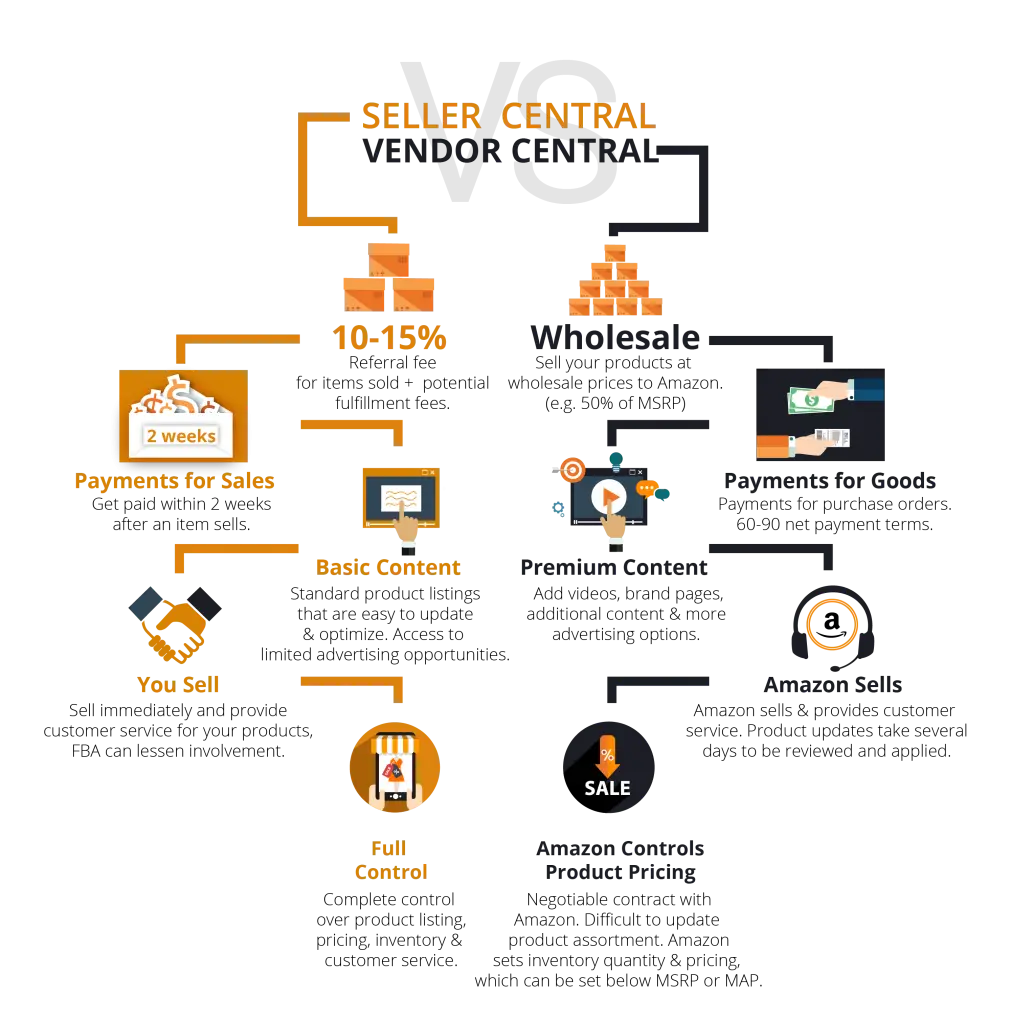
Vendor Central (1P): you're a wholesale supplier to Amazon. Amazon purchases inventory from you at wholesale prices, owns the inventory once purchased, sets retail prices, handles all fulfillment, and controls the entire customer experience. You have no say in pricing, promotions, or inventory decisions after your product ships.
Seller Central (3P): you're a retailer selling on Amazon's marketplace. You own inventory until it sells, control retail pricing and promotions, choose your fulfillment method (FBA or FBM), and manage your operations with full flexibility. You're building a direct-to-consumer brand using Amazon as your sales channel.
Feature
Vendor Central (1P)
Seller Central (3P)
Relationship
Wholesale supplier to Amazon
Retailer on Amazon
Inventory ownership
Amazon owns after purchase
You own until sold
Pricing control
Amazon sets retail prices
You control pricing
Payment terms
Net 60-90 days
Biweekly payouts
Fulfillment
Amazon handles everything
FBA or FBM (your choice)
Marketing access
A+ Premium, Vendor DSP
Sponsored Ads, DSP (at scale)
Entry requirements
Invitation only, high volume
Open to all (pro account)
Margin structure
45-65% wholesale discount
Retail minus 15-30% fees
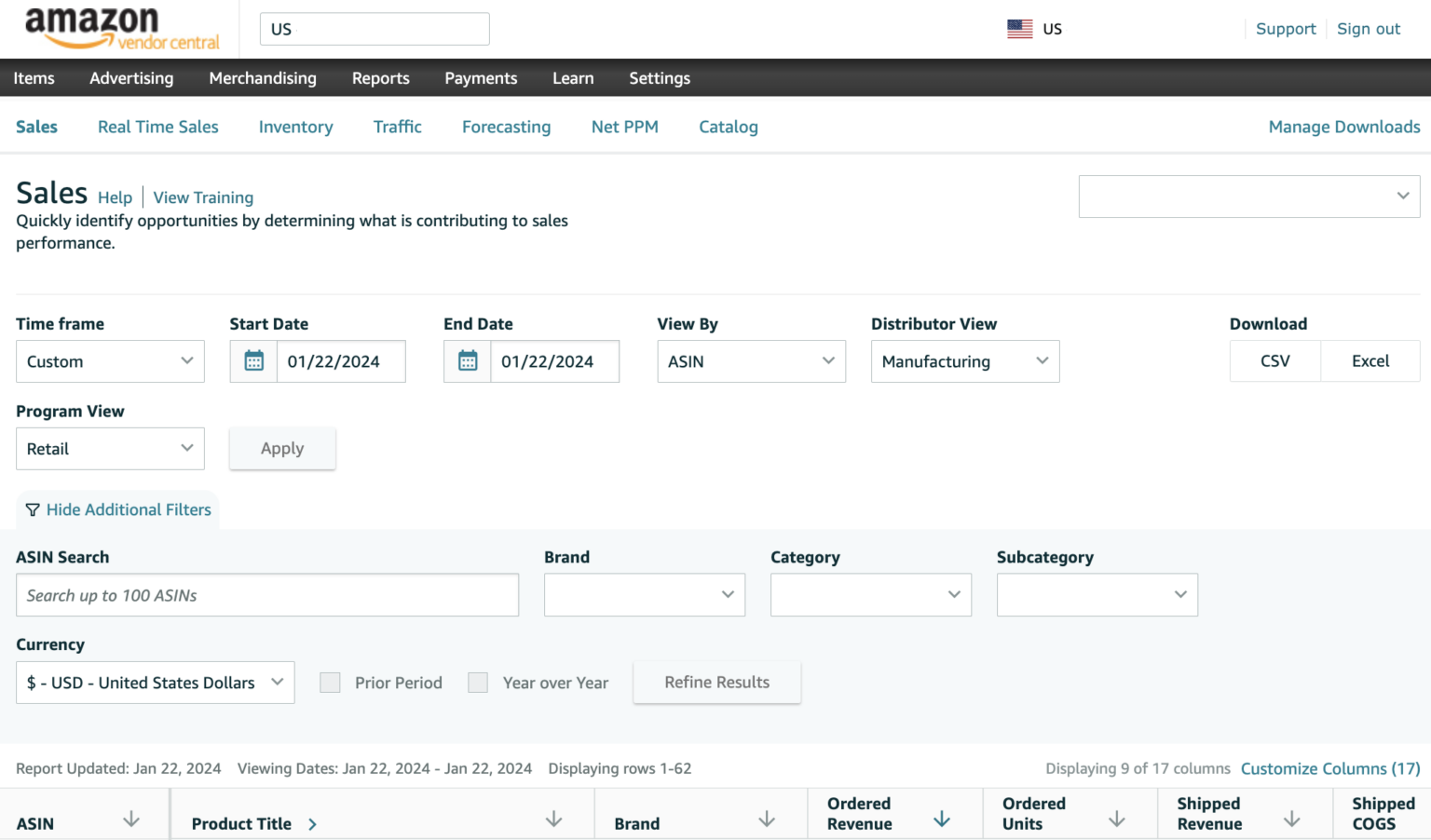
Vendor Central: Amazon's analytics for wholesale suppliers
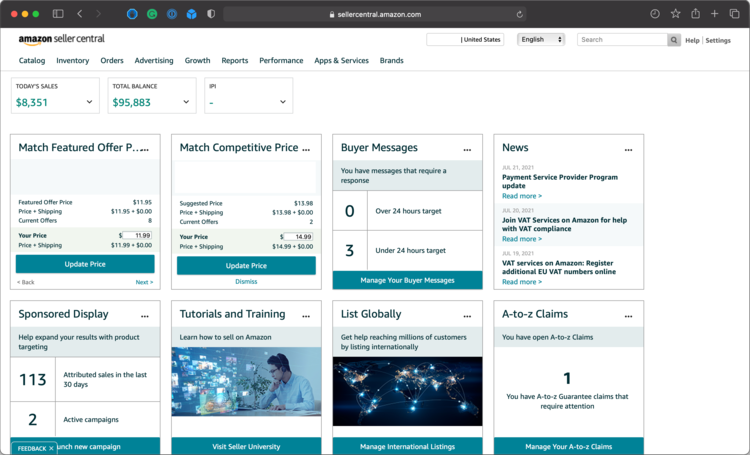
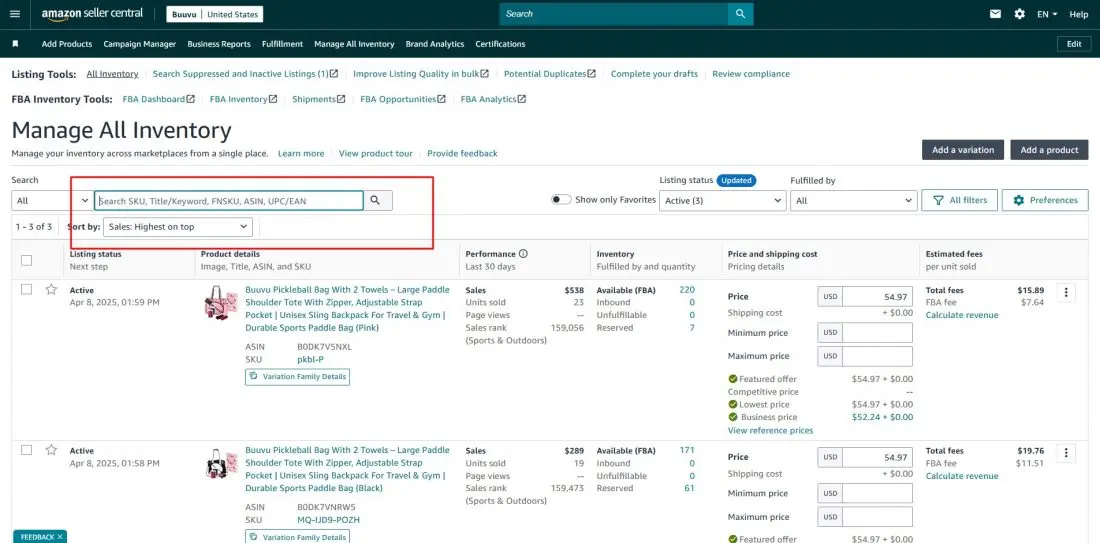
Seller Central: Your command center as a 3P retailer
Let's cut through the marketing speak and look at actual numbers. The profit margin difference between Vendor and Seller Central is dramatic, and it's the single most important factor in this decision. Maintaining healthy net margins is essential for sustainable growth in competitive online marketplaces, making the choice between business models critical for long-term viability.
Vendor Central Margin Breakdown
As a 1P vendor, you sell to Amazon at a wholesale discount (typically 45-65% off retail). Amazon then marks up to retail price and controls everything from there. Your costs include COGS, shipping to Amazon's distribution centers, and co-op marketing fees (2-5% of invoice value that Amazon automatically deducts).
What is left is usually a high single digit to low teens percentage of retail price, because you never touch the retail margin at all. The exact figure depends entirely on your negotiated cost and your chargeback rate, so model it from your own invoices rather than a rule of thumb.
Seller Central Margin Breakdown
As a 3P seller, you sell at retail price minus Amazon's fees. Typical costs include the referral fee, FBA fulfillment per unit, storage fees, COGS, PPC advertising, and freight to FBA warehouses.
Here 3P has the structural advantage: you keep the retail margin and pay Amazon a fee for access, rather than handing Amazon the retail margin outright. But the fee stack is heavy, and it is heavier every year, so work out where a 3P pound or dollar actually goes on your own products.
Side-by-Side Example: $50 Retail Price Product
Vendor Central (1P)
Amazon buys at (50% discount):$25.00
Your COGS:-$8.00
Shipping to Amazon:-$1.00
Co-op marketing (3%):-$0.75
Net Profit:$15.25
30.5% of wholesale price 15.25% of retail price
Seller Central (3P)
Retail price:$50.00
Amazon referral fee (15%):-$7.50
FBA fulfillment fee:-$4.50
Your COGS:-$8.00
Shipping to FBA:-$1.00
PPC (20% ACoS):-$10.00
Net Profit:$19.00
38% margin on retail price
The Margin Reality
3P sellers earn $19 per unit vs 1P vendors at $15.25 on the same $50 product. That's 25% more profit per sale. Scale that to 1,000 units monthly and you're talking $3,750 more profit every month, or $45,000 annually.
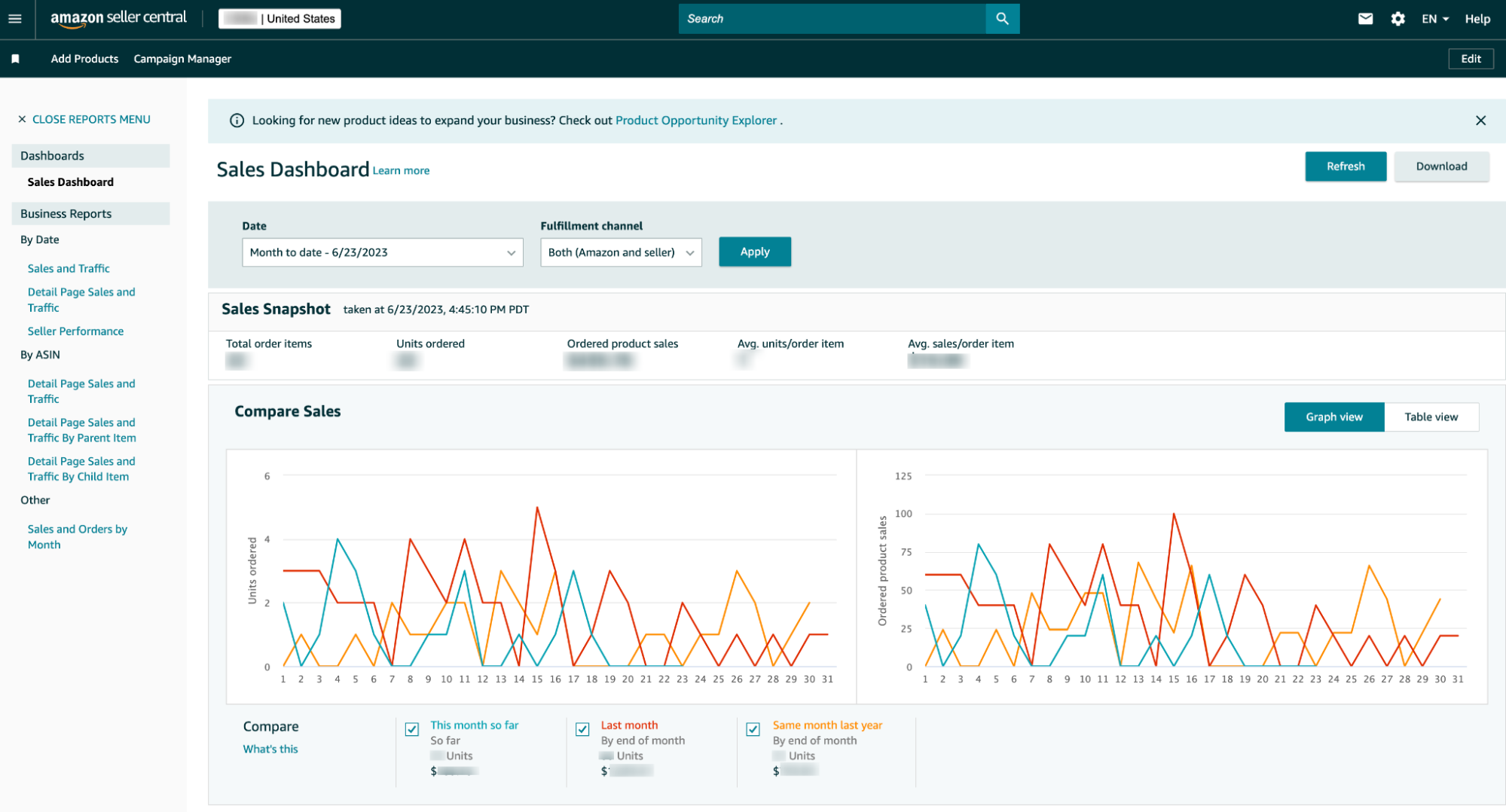
Seller Central provides detailed sales analytics, but lacks product-level profitability insights that tools like Nova provide
Research on platform strategy shows that businesses maintaining pricing control and operational flexibility achieve significantly higher margins than those operating on wholesale terms in digital marketplaces.
Control & Flexibility: Where 3P Wins Decisively
Beyond margins, operational control determines your ability to build a sustainable brand on Amazon. Let's examine where Seller Central's flexibility creates massive advantages.
Pricing Control
With Vendor Central, Amazon controls pricing completely. They'll undercut you to win price wars, match competitors without asking permission, and run aggressive promotions during key selling periods. You have zero say in these decisions.
With Seller Central, you control every pricing decision. You can optimize for margin versus volume, test pricing strategies, protect brand positioning during launches, and respond to competitive pressure within minutes.
Real Example: Why Pricing Control Matters
A supplement brand generated $1.2M annual revenue as a 1P vendor with 11.7% net margin ($140K profit). Amazon aggressively discounted their hero product by 18% during Q4, destroying margins. After switching to 3P Seller Central, same brand achieved $980K revenue with 30% margin ($294K profit). Lower revenue, but 110% higher profit.
Inventory Control
As a 1P vendor, Amazon decides order quantities based on their algorithms. They frequently over-order, then hit you with shortage chargebacks when inventory moves slower than their forecast. These chargebacks can represent 3-8% of revenue in disputes and forced markdowns.
As a 3P seller, you control exactly what you send to FBA warehouses. You can test products in small quantities, scale winners quickly, and kill losers before they drain cash. Your inventory decisions, your risk management.
Seller Central gives you complete inventory visibility and control over what you send to FBA, when you send it, and how much
Brand Presentation
Vendor Central offers A+ Premium Content and Vendor DSP advertising access. Seller Central provides standard A+ Content and Sponsored Ads (with DSP available for larger sellers). In reality, A+ Premium's enhanced features rarely justify the 50-65% margin sacrifice you're making by operating as 1P.
Product Launch Flexibility
This is where 3P's advantage becomes overwhelming. As a Vendor Central supplier, you must convince Amazon's buyer team to add new SKUs. This process takes weeks or months, involves bureaucratic negotiations, and often gets rejected entirely. As a Seller Central operator, you launch new products instantly. Create listing, send inventory, start selling within days.
Research on direct-to-customer strategies shows that operational flexibility is a key driver enabling brands to increase shareholder value through direct customer relationships rather than wholesale distribution.
Research from the U.S. Small Business Administration shows that operational efficiency and inventory control directly correlate with profitability for small businesses. Companies that maintain control over fulfillment and operations achieve better margins than those relying solely on third-party wholesale channels.
Relevant Nova tools for 3P operational control:
Custom Analytics for tracking pricing performance across your catalog
Custom Breakdowns for organizing and analyzing complex 3P product portfolios
Beyond the obvious margin difference, Vendor Central carries hidden costs that many brands don't discover until months into their 1P relationship. These costs can easily add another 3-7% hit to your already thin margins.
Co-op Marketing Fees (2-5% of invoice value)
Amazon automatically deducts co-op marketing fees from your invoices for promotional placement, enhanced visibility, and featured positioning. These aren't optional. You can't negotiate them. They're simply taken from every payment. For a brand doing $1M annually with Amazon, that's $20,000-50,000 in non-negotiable marketing fees whether you see ROI or not.
Shortage Chargebacks
Amazon's receiving systems regularly claim you short-shipped units. You'll receive chargebacks for "missing inventory" that you know you shipped. Disputing these chargebacks is time-consuming, often unsuccessful, and can take 6+ months to resolve. Industry data suggests vendors lose 1-3% of revenue to shortage disputes and chargebacks annually.
Payment Terms (Net 60-90 days)
You ship product today and receive payment in 60-90 days. This creates massive cash flow challenges for growing brands. You're financing Amazon's inventory. Meanwhile, 3P sellers receive payments every 14 days. According to U.S. Census Bureau e-commerce statistics, the retail e-commerce sector continues to grow rapidly, with businesses maintaining faster payment cycles showing better financial health. The opportunity cost difference on a $500K inventory investment at 90-day terms versus 14-day terms is approximately $15,000 annually in lost working capital flexibility.
Cash Flow Reality Check
A $2M annual vendor relationship means you're carrying approximately $350,000-500,000 in outstanding receivables at any given time (assuming 60-75 day average payment). That working capital could fund inventory expansion, new product launches, or marketing in a 3P model with biweekly payouts.
Minimum Order Quantities
Amazon often requires large purchase orders that tie up significant capital. If products move slower than forecasted, you're stuck with dead inventory and storage fees accumulate (though Amazon pays storage as the owner, they reduce future wholesale pricing to compensate for their costs).
According to National Retail Federation's retail payments study, payment terms and cash flow management are critical factors for retail profitability. Extended payment cycles create working capital challenges, while faster payment methods enable better business agility and growth.
When Vendor Central Actually Makes Sense
To be fair and credible, there are legitimate scenarios where Vendor Central is the right choice. Here's when 1P actually makes strategic sense for your business.
1. You Manufacture at Scale and Need Guaranteed Volume
If you're a factory with minimum order quantities of 10,000+ units per production run, Vendor Central's predictable large purchase orders provide the volume certainty you need to efficiently run production. Amazon buying 20,000 units upfront gives you production scale economies that smaller 3P orders can't match. This works especially well for commodity products where margin isn't the priority but volume throughput is.
2. Your Brand Prioritizes Maximum Reach Over Profit
Amazon's buy box algorithm gives preferential treatment to 1P inventory in certain categories. If you're in aggressive market-share building mode and willing to sacrifice margin for maximum traffic exposure, 1P can deliver higher visibility. This makes sense for new category entrants trying to establish presence quickly, where customer acquisition matters more than immediate profitability.
3. You Lack Logistics and Fulfillment Capabilities
Vendor Central completely removes operational burden. Amazon handles all customer service, returns processing, logistics coordination, and marketplace management. If you don't have internal resources for FBA management or marketplace operations, and you're not ready to build those capabilities, 1P's simplicity has real value. You trade margin for operational ease.
4. You're Already a Wholesale-Focused Business
If you're selling to Target, Walmart, Costco, and other major retailers at similar wholesale margins (45-55% off retail), adding Amazon as another wholesale account makes perfect sense. You're not trying to build an Amazon-first direct-to-consumer brand; you're distributing through traditional retail channels and Amazon is just one more retailer buying from you.
Hybrid Model Strategy
About 20% of established brands operate hybrid models: Vendor Central for 3-5 hero products generating predictable volume, and Seller Central for new product launches, seasonal items, and long-tail SKUs requiring margin optimization. This requires sophisticated analytics to track profitability across both models and avoid channel conflict.
Research from Shopify's channel management guide shows that brands successfully operating across multiple sales channels share one common trait: robust analytics infrastructure to track per-channel profitability and prevent margin erosion.
When Seller Central (3P) is the Clear Winner
For most modern brands building a sustainable Amazon business, Seller Central delivers decisive advantages across profitability, control, and growth potential.
1. Profit Margin is Your Priority
2. You're Building a Direct-to-Consumer Brand
If your goal is building long-term brand equity, owning customer relationships (through Brand Registry), and controlling brand messaging and positioning, 3P is non-negotiable. You're not a supplier to Amazon; you're building a direct relationship with customers using Amazon as your sales channel. This mindset shift is critical for long-term brand value. For brand managers focused on protecting brand positioning and maximizing lifetime customer value, Seller Central is the only viable path.
3. You Need Operational Flexibility
Modern e-commerce requires speed. Launch products instantly. Test pricing strategies daily. Adjust inventory levels dynamically. React to competitor moves within hours. Seller Central gives you the operational agility to compete in fast-moving categories where 1P's bureaucratic processes would kill you.
4. You Have (or Can Build) Analytics Capabilities
Here's the critical requirement for 3P success: you need better data than 1P vendors. Seller Central demands accurate tracking of ACoS, TACoS, contribution margin by SKU, inventory health metrics, and fee analysis. Research from Deloitte's retail profitability insights shows that the future of retail success lies in consumer-centric data and analytics capabilities. Without proper analytics infrastructure, you're flying blind. But with the right tools (like Nova's profit & loss analytics), 3P sellers gain an unfair advantage through near real-time profit visibility that 1P vendors simply don't have access to.
According to business strategy research, online sellers with sophisticated analytics infrastructure significantly outperform competitors on ROI, with the performance gap widening as successful brands adopt near real-time profitability tracking and data-driven decision-making tools.
The Switching Decision: Can You Move from 1P to 3P?
Yes, you can switch from Vendor Central to Seller Central, but it requires careful planning and realistic expectations. Here's the practical reality of transitioning between models.
Gradual Transition is Recommended
Don't shut down your 1P relationship overnight. The smart approach: start launching new SKUs exclusively as 3P while maintaining your Vendor Central account for existing high-volume products. This lets you test profitability, build operational capabilities, and establish organic rankings before making the full switch.
Expect an Initial Revenue Dip
When you switch ASINs from 1P to 3P, Amazon's buy box algorithm initially favors established 1P history. You'll likely experience a 15-25% revenue decline for the first 60-90 days while your 3P listings rebuild organic ranking and buy box winning percentage. However, profit typically stays flat or improves immediately due to higher margins, even with lower revenue.
Required Capabilities for Successful Switch
You'll need these operational capabilities before transitioning:
Inventory management system: Continuous tracking across multiple warehouses and FBA
PPC expertise: in-house team or trusted agency for Sponsored Ads management
Analytics platform: Critical for tracking product-level profitability (Seller Central's native reports are insufficient)
Working capital: 60-90 days of FBA inventory funding since you're moving from Amazon's purchase orders to self-funded inventory
Real Transition Case Study
Home goods brand generating $3.2M annually as a 1P vendor with 14% net margin ($448,000 profit). Frustrated with Amazon's aggressive discounting destroying brand positioning, they planned an 8-month transition to 3P. First quarter after switch: revenue dropped 22% to $620,000 but margin jumped to 31% ($192,000 quarterly profit). By month 12 of operating fully as 3P, revenue recovered to $2.8M annually with sustained 29% margin = $812,000 annual profit. That's an 81% profit increase despite 12.5% lower revenue.
Transition Timeline Planning
Month 1-2: Build 3P infrastructure (analytics, PPC team, inventory systems). Month 3-4: Launch 5-10 new SKUs as 3P test. Month 5-6: Transition 20% of existing catalog. Month 7-12: Complete transition while monitoring profitability weekly. Don't rush. Getting the foundation right matters more than speed.
The Data Advantage: Why 3P Sellers Need Superior Analytics
Here's the uncomfortable truth: succeeding as a 3P seller requires significantly better analytics infrastructure than 1P vendors need. But this "requirement" is actually your competitive advantage.
The 3P Analytics Gap
Vendor Central provides basic reporting through Amazon's portal. It's limited, but it exists. Seller Central provides even more limited native reports that don't track what actually matters: product-level contribution margin, true ACoS and TACoS by SKU, PPC profitability versus organic profitability, inventory health and days of inventory tracking, or comprehensive fee analysis.
What 3P Sellers Must Track That 1P Vendors Don't
Product-level contribution margin: Not just revenue, but actual profit after all fees, PPC, and COGS
True ACoS and TACoS by SKU: Understanding total advertising efficiency including organic halo effects
PPC profitability vs organic profitability: which products are profitable with ads versus without
Inventory health and stock coverage: Days of inventory, restock timing, and which SKUs deserve FBA space
Fee analysis: Breakdown of storage, fulfillment, referral fees to identify optimization opportunities
Why This Matters: Speed Equals Competitive Advantage
As a 3P seller, you're making 2-5 operational decisions daily versus 1P vendors who plan quarterly. Should you raise this price? Which product should get more PPC budget? Is this SKU still profitable after the latest fee increase? Can you afford to reorder this inventory? Fast, accurate data means you optimize while competitors guess. You can't improve what you can't measure accurately.
What a 1P to 3P switch actually surfaces
The first thing brands lose when they move off 1P is a clean read on which products actually make money. Wholesale invoices hide the fee stack; 3P exposes every line of it. Rebuilding a product-level P&L is usually the first job after the switch, and it typically surfaces three groups: SKUs losing money to advertising, SKUs priced below what the market will bear, and SKUs worth pushing harder. You cannot see any of that in a revenue report.
Decision Framework: Choosing Your Amazon Business Model
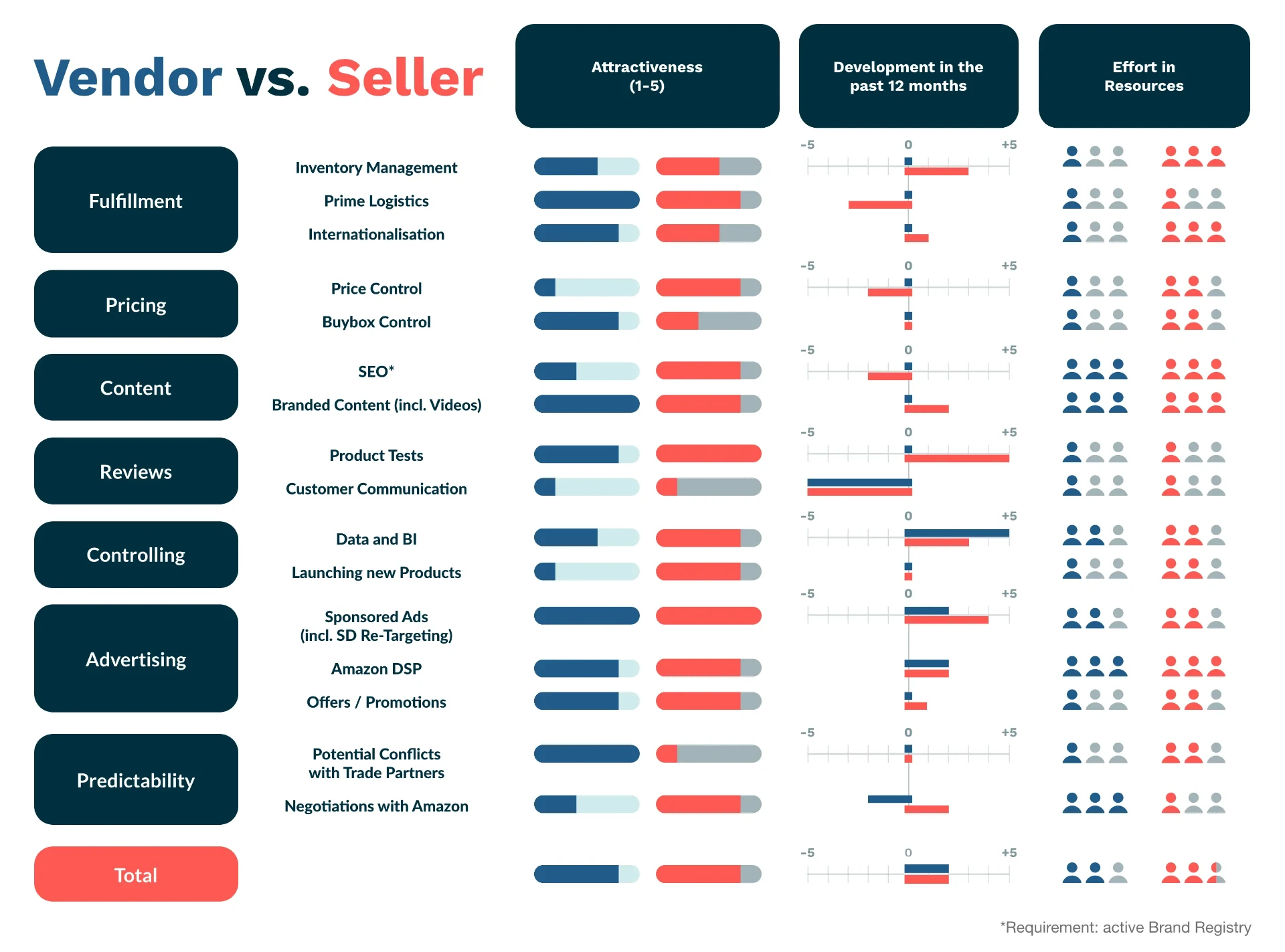
Detailed comparison showing how Vendor Central (blue) and Seller Central (red) stack up across key operational areas including fulfillment, pricing control, content options, and advertising capabilities
Let's make this actionable. Answer these five questions to determine which model fits your business strategy, capabilities, and goals.
1. What's Your Priority: Volume or Margin?
Volume priority → Consider 1P: If you manufacture at scale, need guaranteed purchase orders for production planning, and can accept a wholesale margin in exchange for predictable volume, Vendor Central works. Margin priority → Choose 3P: If profitability matters more than vanity revenue metrics, keeping the retail margin and paying Amazon a fee for access leaves more per unit, provided you keep advertising under control.
2. What's Your Manufacturing/Sourcing Structure?
Factory with 10,000+ unit MOQs → 1P makes sense: Large minimum order quantities benefit from Amazon's bulk purchase orders providing production certainty. Flexible sourcing, small batches → 3P is better: If you can source in smaller quantities or manufacture on-demand, 3P's inventory flexibility lets you test and iterate faster.
3. How Important is Pricing Control?
Don't care if Amazon changes prices → 1P works: If you view Amazon as just another wholesale customer and pricing control isn't critical to brand positioning, 1P's simplicity has value. Need to protect brand positioning → Must be 3P: If brand perception, premium positioning, or MAP pricing matters to your strategy, you can't let Amazon discount at will.
4. What's Your Cash Flow Situation?
Strong working capital, can wait 90 days for payment → 1P feasible: If you have sufficient capital to finance 90-day receivables, 1P's payment terms won't kill you. Need regular cash flow → 3P essential: Biweekly payouts (14-day cycles) provide the cash flow velocity growing brands need for inventory reinvestment and scaling.
5. Do You Have Analytics Capabilities?
No analytics team, prefer simplicity → 1P easier: If you don't have resources for data infrastructure and prefer Amazon handling complexity, 1P's operational simplicity has real value. Have or can build analytics → 3P unlocks higher profit: with proper analytics tools (like Nova's seller dashboard), 3P's flexibility becomes a massive competitive advantage.
Common questions about Vendor Central vs Seller Central
Generally, you cannot use both for the same ASINs. Amazon doesn't allow duplicate listings. However, you can operate both models simultaneously for different products. Many brands use a hybrid approach: Vendor Central for high-volume hero products and Seller Central for new launches and long-tail SKUs.
Amazon typically invites high-volume sellers or brands with strong sales performance. Factors include: consistent monthly revenue over $1M, strong brand presence, high customer ratings, and large product catalogs. Most brands receive invitations directly from Amazon buyer teams.
There is no single number, because it depends on your negotiated wholesale cost, your category and your advertising. Structurally, 3P keeps the retail margin and pays Amazon a fee, while 1P earns only the wholesale margin.
Yes, but it requires careful planning and typically takes 3-6 months. The recommended approach is gradual: start launching new SKUs as 3P while maintaining 1P relationships for existing high-volume products.
While not required, analytics software dramatically improves 3P profitability. Seller Central's native reports lack product-level contribution margin tracking, PPC profitability analysis, and near real-time inventory health insights.
Seller Central (3P) offers significantly more brand control. You control pricing, inventory levels, product launches, promotional timing, and brand messaging. Vendor Central gives Amazon pricing control.
Vendor Central (1P) operates on Net 60-90 day payment terms. Seller Central (3P) provides biweekly payouts (every 14 days). For growing brands, 3P's faster payment cycle is a significant cash flow advantage.
For most modern brands, Seller Central (3P) offers faster scaling due to inventory flexibility and instant product launches. You can test new SKUs within days and adjust pricing based on performance.
Final Recommendation: The 3P Advantage for Modern Brands
After examining margins, control, flexibility, cash flow, and growth potential across both models, the conclusion for most brands building sustainable Amazon businesses is clear: Seller Central (3P) delivers superior long-term value.
Why 3P Wins for Most Brands
You keep the retail margin: 3P pays Amazon a fee for access rather than surrendering the retail markup outright
Complete pricing and brand control: Protect positioning, test strategies, and maintain MAP pricing
Operational flexibility: Launch products instantly, adjust inventory in real-time, and react to market changes within hours
Faster payment cycles: Biweekly payouts (14 days) versus 60-90 day vendor payment terms dramatically improve cash flow
Immediate product launches: No waiting for Amazon buyer approval or bureaucratic negotiations
When 1P Vendor Central Makes Sense
Large manufacturers prioritizing volume certainty over margin optimization
Brands with established wholesale relationships across multiple major retailers (Target, Walmart, Costco)
Products requiring massive scale that Amazon's bulk ordering provides
Businesses without resources to build 3P operational and analytics capabilities
The Analytics Imperative for 3P Success
Here's the final critical point: 3P sellers need better data infrastructure than 1P vendors to succeed. Seller Central's native reporting is insufficient for profitability optimization. You must accurately track product-level contribution margin, true advertising efficiency, inventory health, and cash flow projections. This requirement is actually your competitive advantage, sellers with superior analytics outperform competitors by 40-60% on profitability metrics. For C-suite executives making strategic business model decisions, this data advantage is the difference between sustainable profitability and margin erosion.
Ready to Maximize Your 3P Profitability?
Nova Analytics gives you the product-level insights, real-time data, and profitability tracking you need to make confident decisions as a Seller Central operator. See your true margins, identify winners and losers, and optimize faster than competitors.