Amazon seller fees 2026: how much Amazon actually charges
Referral fees, FBA fulfillment, storage, inbound placement, returns, advertising, and 10 more. The complete reference guide to every Amazon seller fee with current rates.
On most sales Amazon takes a 15% referral fee and, if it ships the order, an FBA fee from $2.43 per unit, on top of $39.99 a month for a Professional plan. In the worked example below, Amazon's fees come to about a third of a $24.99 price; across Nova accounts they came to a median 31% of sales between April and September 2026. This guide sets out every 2026 rate, read from Amazon's own pages and dated, fee family by fee family.
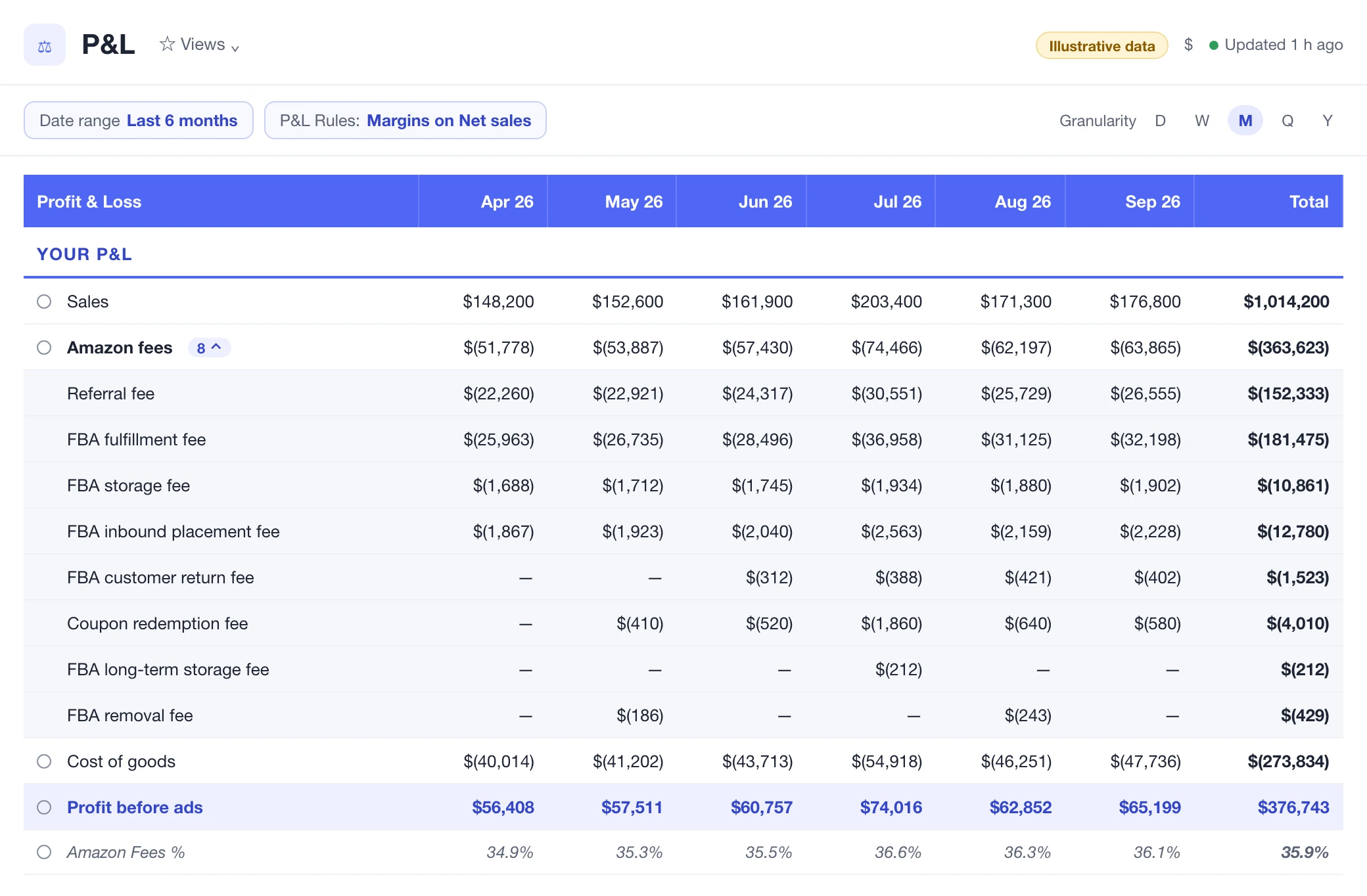
Every Amazon fee as its own P&L line, month by month. Here fees take about 36% of sales, close to the worked example below. Illustrative data.
How much does it cost to sell on Amazon?
A Professional plan costs $39.99 a month. Every sale then pays a referral fee, most often 15% of the price with a $0.30 minimum, and FBA fees if Amazon ships the order: a fulfilment fee set by size tier and shipping weight, monthly storage on the inventory you hold, and charges such as inbound placement and returns processing where they apply. Across Nova accounts, Amazon's fees came to a median 31% of sales between April and September 2026.
What changed in 2026
Four changes moved the per-unit cost of an FBA order this year. A 3.5% fuel and logistics surcharge joined every US fulfilment fee on 17 April 2026. Non-peak fulfilment fees rose again on 15 January for standard-size products priced between $10 and $50. The aged inventory surcharge gained a new band above 456 days on 16 January. Inbound placement fees for standard-size products went up by about $0.05 per unit, and the old Large Bulky tier split into Small Bulky and Large Bulky.
From October, two seasonal rates apply on top. Monthly storage rises from $0.78 to $2.40 per cubic foot for standard-size units from October to December, and peak fulfilment rates run from 15 October 2026 to 14 January 2027.
The single most useful thing to know about Amazon fees is that they are charged per unit, not per dollar. The referral fee scales with price. The fulfilment fee does not: a $12 product and a $60 product of the same size and weight pay the same fulfilment fee. That one fact decides which products survive a fee increase.
Beyond those two fees, the rest of the bill is the part a rate card never shows, because it depends on how you operate rather than what you sell: how you send stock in, how long it sits, how often you discount, how much comes back. Reconciling it by hand is the job an Amazon P&L dashboard does automatically, allocating each fee to the SKU that incurred it rather than averaging it across the catalogue.
Put together, the bill usually lands between a quarter and two fifths of sales, and it moves month to month with storage, promotions and returns rather than with the rate card. The screen at the top shows that pattern: the referral and fulfilment fees track sales, while coupon, return, long-term storage and removal fees arrive in lumps.
Referral and fulfillment fees make up almost the whole bill for the median account. Everything else is small in the typical bill but lumpy: a storage, placement or return charge can make one month look very different from the next.
Run it in Claude
Break down my Amazon fees by fee type for the last 3 months, show each as a % of sales, and list the 10 SKUs where Amazon fees take the largest share of the price.
Why cheap products pay the most
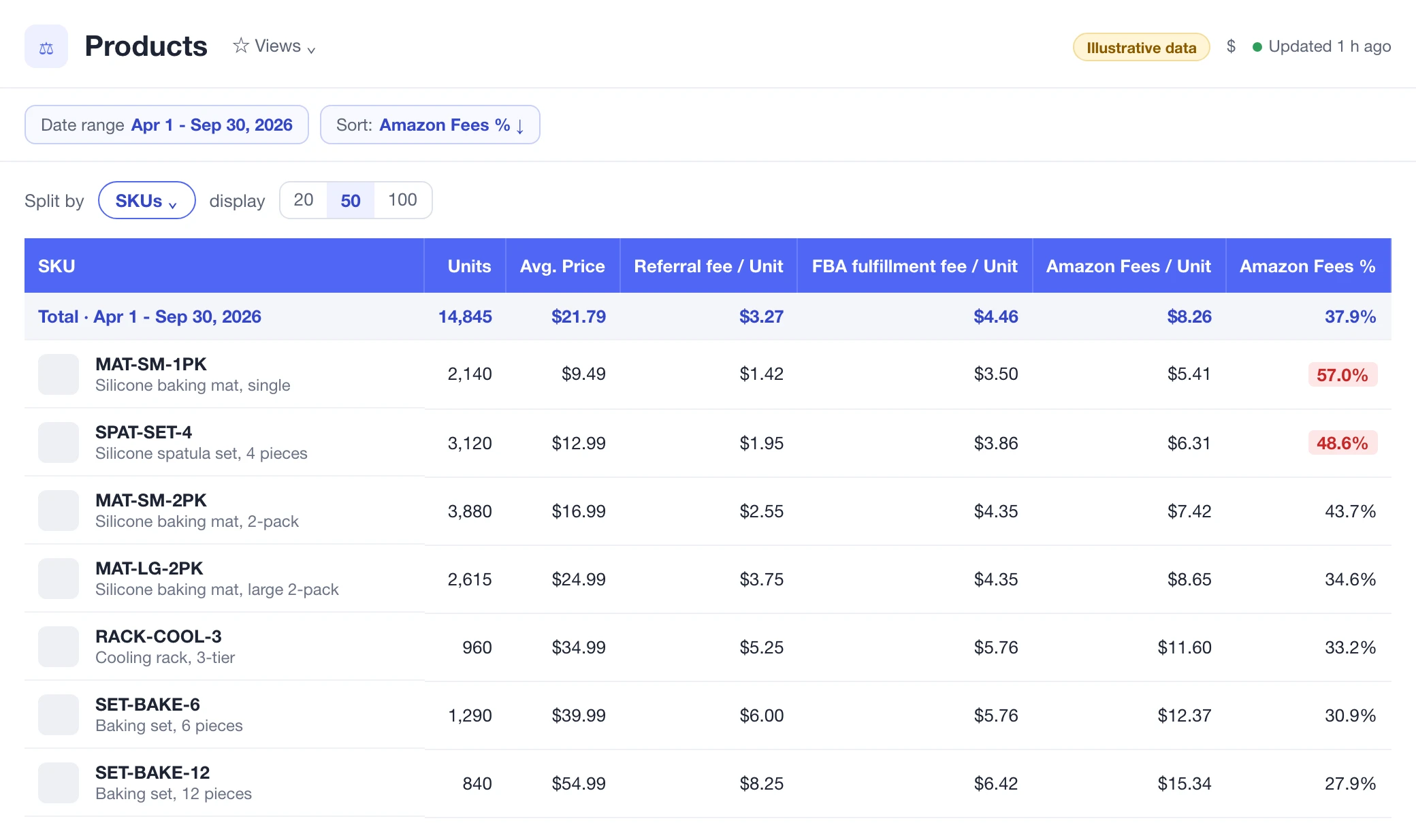
Fulfillment fees are charged per unit, so the same product at four prices pays a very different share of its price. The referral fee scales with price; fulfillment changes only when the product crosses a size, weight or price band.
One product, four prices: large standard, 8+ to 12 oz, Home and Kitchen, 2026 non-peak rates
One product, four prices: large standard, 8+ to 12 oz, Home and Kitchen, 2026 non-peak rates
Price
Referral fee (15%)
Fulfillment fee + 3.5% surcharge
Amazon fees per unit
Share of price
$9.99
$1.50
$3.38 + $0.12 = $3.50
$5.00
50.0%
$24.99
$3.75
$4.20 + $0.15 = $4.35
$8.10
32.4%
$49.99
$7.50
$4.20 + $0.15 = $4.35
$11.85
23.7%
$100.00
$15.00
$4.46 + $0.16 = $4.62
$19.62
19.6%
$9.99
Referral fee (15%)
$1.50
Fulfillment fee + 3.5% surcharge
$3.38 + $0.12 = $3.50
Amazon fees per unit
$5.00
Share of price
50.0%
$24.99
Referral fee (15%)
$3.75
Fulfillment fee + 3.5% surcharge
$4.20 + $0.15 = $4.35
Amazon fees per unit
$8.10
Share of price
32.4%
$49.99
Referral fee (15%)
$7.50
Fulfillment fee + 3.5% surcharge
$4.20 + $0.15 = $4.35
Amazon fees per unit
$11.85
Share of price
23.7%
$100.00
Referral fee (15%)
$15.00
Fulfillment fee + 3.5% surcharge
$4.46 + $0.16 = $4.62
Amazon fees per unit
$19.62
Share of price
19.6%
Illustrative prices and arithmetic, using the published referral and fulfillment rates above. Before storage, inbound placement, returns and promotions. Peak rates from 15 October 2026 to 14 January 2027 are higher.
Same catalog, very different fee burden. Fees are charged per unit, so the cheapest SKUs give Amazon the largest share of their price. Illustrative data.
Bundling, multipacks and price points just above $10 or $50 can change a product's fulfillment band: compare the three price-band columns in the fulfillment table before changing the offer.
Every Amazon seller fee in one table
The reference table. Every rate below is read from the Amazon page linked under it, on the date shown. Where a fee depends on size, weight or category, the section further down has the tiers.
Amazon seller fees, United States, September 2026
Amazon seller fees, United States, September 2026
Fee
Rate
When charged
Applies to
Professional selling plan
$39.99 per month
Monthly
Professional accounts
Individual per-item fee
$0.99 per item sold
Every sale
Individual accounts
Referral fee
5% to 45% of total sales price by category, most often 15%, usually a $0.30 minimum
Every sale
All sellers
Closing fee
$1.80 per unit
Every sale
Books, DVD, music, software, video games and consoles
FBA fulfilment fee
$2.43 per unit and up by size tier, weight and price band, plus a 3.5% fuel and logistics surcharge
When the order ships
FBA sellers
Monthly storage fee
$0.78 per cubic foot standard and $0.56 oversize January to September, $2.40 and $1.40 October to December, plus a utilisation surcharge where it applies
Monthly, 7th to 15th
FBA sellers
Aged inventory surcharge
$0.50 per cubic foot from 181 days, rising to $7.90 or $0.35 per unit above 456 days
Monthly, snapshot on the 15th
FBA sellers
Inbound placement service fee
$0.14 to $6.50 per unit by size tier and split option, no fee on Amazon-optimised splits
When a shipment is created
FBA sellers
Low-inventory-level fee
$0.32 to $2.09 per unit
When the order ships
Standard and bulky FBA units below 28 days of supply
Returns processing fee
$1.65 per returned unit and up by size tier and weight
Third month after the shipment month
Apparel and shoes on every return, other categories above a return-rate threshold
Removal and disposal fees
$0.84 to $14.32 per unit, plus $1.06 per pound above the top band
When the unit is removed or disposed
FBA sellers
Digital services fee
2% in the UK, 3% in France, Italy and Spain, applied on top of selling and FBA fees
With the underlying fee
Sellers established in or selling into those stores
Professional selling plan
Rate
$39.99 per month
When charged
Monthly
Applies to
Professional accounts
Individual per-item fee
Rate
$0.99 per item sold
When charged
Every sale
Applies to
Individual accounts
Referral fee
Rate
5% to 45% of total sales price by category, most often 15%, usually a $0.30 minimum
When charged
Every sale
Applies to
All sellers
Closing fee
Rate
$1.80 per unit
When charged
Every sale
Applies to
Books, DVD, music, software, video games and consoles
FBA fulfilment fee
Rate
$2.43 per unit and up by size tier, weight and price band, plus a 3.5% fuel and logistics surcharge
When charged
When the order ships
Applies to
FBA sellers
Monthly storage fee
Rate
$0.78 per cubic foot standard and $0.56 oversize January to September, $2.40 and $1.40 October to December, plus a utilisation surcharge where it applies
When charged
Monthly, 7th to 15th
Applies to
FBA sellers
Aged inventory surcharge
Rate
$0.50 per cubic foot from 181 days, rising to $7.90 or $0.35 per unit above 456 days
When charged
Monthly, snapshot on the 15th
Applies to
FBA sellers
Inbound placement service fee
Rate
$0.14 to $6.50 per unit by size tier and split option, no fee on Amazon-optimised splits
When charged
When a shipment is created
Applies to
FBA sellers
Low-inventory-level fee
Rate
$0.32 to $2.09 per unit
When charged
When the order ships
Applies to
Standard and bulky FBA units below 28 days of supply
Returns processing fee
Rate
$1.65 per returned unit and up by size tier and weight
When charged
Third month after the shipment month
Applies to
Apparel and shoes on every return, other categories above a return-rate threshold
Removal and disposal fees
Rate
$0.84 to $14.32 per unit, plus $1.06 per pound above the top band
When charged
When the unit is removed or disposed
Applies to
FBA sellers
Digital services fee
Rate
2% in the UK, 3% in France, Italy and Spain, applied on top of selling and FBA fees
When charged
With the underlying fee
Applies to
Sellers established in or selling into those stores
Fulfilment, storage, placement, returns and removal rates are per size tier: the tables further down show the bands. Advertising is billed separately and is not an Amazon selling fee.
The referral fee is Amazon's commission, charged on the total sales price including any delivery and gift-wrap charges you bill, not on the item price alone. Most categories charge 15% with a $0.30 per-unit minimum. Several charge a rate that changes with price, which is where rate cards on other sites tend to be wrong: Beauty is not "8% to 15%", it is 8% up to $10 and 15% above.
Referral fee rates, United States, September 2026
Referral fee rates, United States, September 2026
Category
Referral fee
Minimum
Most categories (Everything Else, Home and Kitchen, Toys, Sports, Office, Tools, Lawn and Garden, Eyewear, Footwear, Mattresses)
15%
$0.30
Beauty, Health and Personal Care
8% up to $10.00, 15% above
$0.30
Baby Products
8% up to $10.00, 15% above
$0.30
Clothing and Accessories
5% up to $15.00, 10% above $15.00 to $20.00, 17% above $20.00
$0.30
Grocery and Gourmet
8% up to $15.00, 15% above
None
Consumer Electronics
8%
$0.30
Electronics Accessories
15% on the portion up to $100.00, 8% above
$0.30
Computers
8%
$0.30
Furniture
15% on the portion up to $200.00, 10% above
$0.30
Jewelry
20% on the portion up to $250.00, 5% above
$0.30
Watches
16% on the portion up to $1,500.00, 3% above
$0.30
Automotive and Powersports
12%
$0.30
Pet Products
15%, except 22% for veterinary diets
$0.30
Amazon Device Accessories
45%
$0.30
Media (books, DVD, music, software, video)
15%, plus a $1.80 closing fee per unit
None
Most categories (Everything Else, Home and Kitchen, Toys, Sports, Office, Tools, Lawn and Garden, Eyewear, Footwear, Mattresses)
Referral fee
15%
Minimum
$0.30
Beauty, Health and Personal Care
Referral fee
8% up to $10.00, 15% above
Minimum
$0.30
Baby Products
Referral fee
8% up to $10.00, 15% above
Minimum
$0.30
Clothing and Accessories
Referral fee
5% up to $15.00, 10% above $15.00 to $20.00, 17% above $20.00
Minimum
$0.30
Grocery and Gourmet
Referral fee
8% up to $15.00, 15% above
Minimum
None
Consumer Electronics
Referral fee
8%
Minimum
$0.30
Electronics Accessories
Referral fee
15% on the portion up to $100.00, 8% above
Minimum
$0.30
Computers
Referral fee
8%
Minimum
$0.30
Furniture
Referral fee
15% on the portion up to $200.00, 10% above
Minimum
$0.30
Jewelry
Referral fee
20% on the portion up to $250.00, 5% above
Minimum
$0.30
Watches
Referral fee
16% on the portion up to $1,500.00, 3% above
Minimum
$0.30
Automotive and Powersports
Referral fee
12%
Minimum
$0.30
Pet Products
Referral fee
15%, except 22% for veterinary diets
Minimum
$0.30
Amazon Device Accessories
Referral fee
45%
Minimum
$0.30
Media (books, DVD, music, software, video)
Referral fee
15%, plus a $1.80 closing fee per unit
Minimum
None
Tiered categories charge each rate on the portion of the price inside its band, except Beauty, Baby, Clothing and Grocery, where the whole price takes the rate for the band it falls in. Gift Cards, Media, Grocery and video game categories have no minimum referral fee.
The fulfilment fee is charged per unit when the order ships, and depends on the size tier, the shipping weight of the packaged unit and, since 2025, the price band the item sells in. Amazon's current tiers are small standard, large standard, small bulky, large bulky and four extra-large bands. The oversize names used before 2024 are gone.
FBA fulfilment fees, non-peak, 15 January to 14 October 2026, excluding apparel
FBA fulfilment fees, non-peak, 15 January to 14 October 2026, excluding apparel
Size tier and shipping weight
Item under $10
Item $10 to $50
Item above $50
Small standard, 2 oz or less
$2.43
$3.32
$3.58
Small standard, 8+ to 10 oz
$2.77
$3.68
$3.94
Small standard, 14+ to 16 oz
$2.95
$3.96
$4.22
Large standard, 4 oz or less
$2.91
$3.73
$3.99
Large standard, 8+ to 12 oz
$3.38
$4.20
$4.46
Large standard, 1.5+ to 1.75 lb
$4.75
$5.57
$5.83
Large standard, 3+ lb to 20 lb
$6.15 plus $0.08 per 4 oz above 3 lb
$6.97 plus $0.08 per 4 oz above 3 lb
$7.23 plus $0.08 per 4 oz above 3 lb
Small bulky, 0 to 50 lb
$6.78 plus $0.38 per lb above the first lb
$7.55 plus $0.38 per lb
$7.55 plus $0.38 per lb
Large bulky, 0 to 50 lb
$8.58 plus $0.38 per lb above the first lb
$9.35 plus $0.38 per lb
$9.35 plus $0.38 per lb
Extra-large, 0 to 50 lb
$25.56 plus $0.38 per lb above the first lb
$26.33 plus $0.38 per lb
$26.33 plus $0.38 per lb
Small standard, 2 oz or less
Item under $10
$2.43
Item $10 to $50
$3.32
Item above $50
$3.58
Small standard, 8+ to 10 oz
Item under $10
$2.77
Item $10 to $50
$3.68
Item above $50
$3.94
Small standard, 14+ to 16 oz
Item under $10
$2.95
Item $10 to $50
$3.96
Item above $50
$4.22
Large standard, 4 oz or less
Item under $10
$2.91
Item $10 to $50
$3.73
Item above $50
$3.99
Large standard, 8+ to 12 oz
Item under $10
$3.38
Item $10 to $50
$4.20
Item above $50
$4.46
Large standard, 1.5+ to 1.75 lb
Item under $10
$4.75
Item $10 to $50
$5.57
Item above $50
$5.83
Large standard, 3+ lb to 20 lb
Item under $10
$6.15 plus $0.08 per 4 oz above 3 lb
Item $10 to $50
$6.97 plus $0.08 per 4 oz above 3 lb
Item above $50
$7.23 plus $0.08 per 4 oz above 3 lb
Small bulky, 0 to 50 lb
Item under $10
$6.78 plus $0.38 per lb above the first lb
Item $10 to $50
$7.55 plus $0.38 per lb
Item above $50
$7.55 plus $0.38 per lb
Large bulky, 0 to 50 lb
Item under $10
$8.58 plus $0.38 per lb above the first lb
Item $10 to $50
$9.35 plus $0.38 per lb
Item above $50
$9.35 plus $0.38 per lb
Extra-large, 0 to 50 lb
Item under $10
$25.56 plus $0.38 per lb above the first lb
Item $10 to $50
$26.33 plus $0.38 per lb
Item above $50
$26.33 plus $0.38 per lb
Rates exclude the 3.5% fuel and logistics surcharge that has applied since 17 April 2026. Peak rates apply from 15 October 2026 to 14 January 2027 and run higher: small standard 2 oz or less is $2.62, $3.51 and $3.77 in the same three price bands. Apparel has its own rate card. Products priced under $10 automatically receive Low-Price FBA rates.
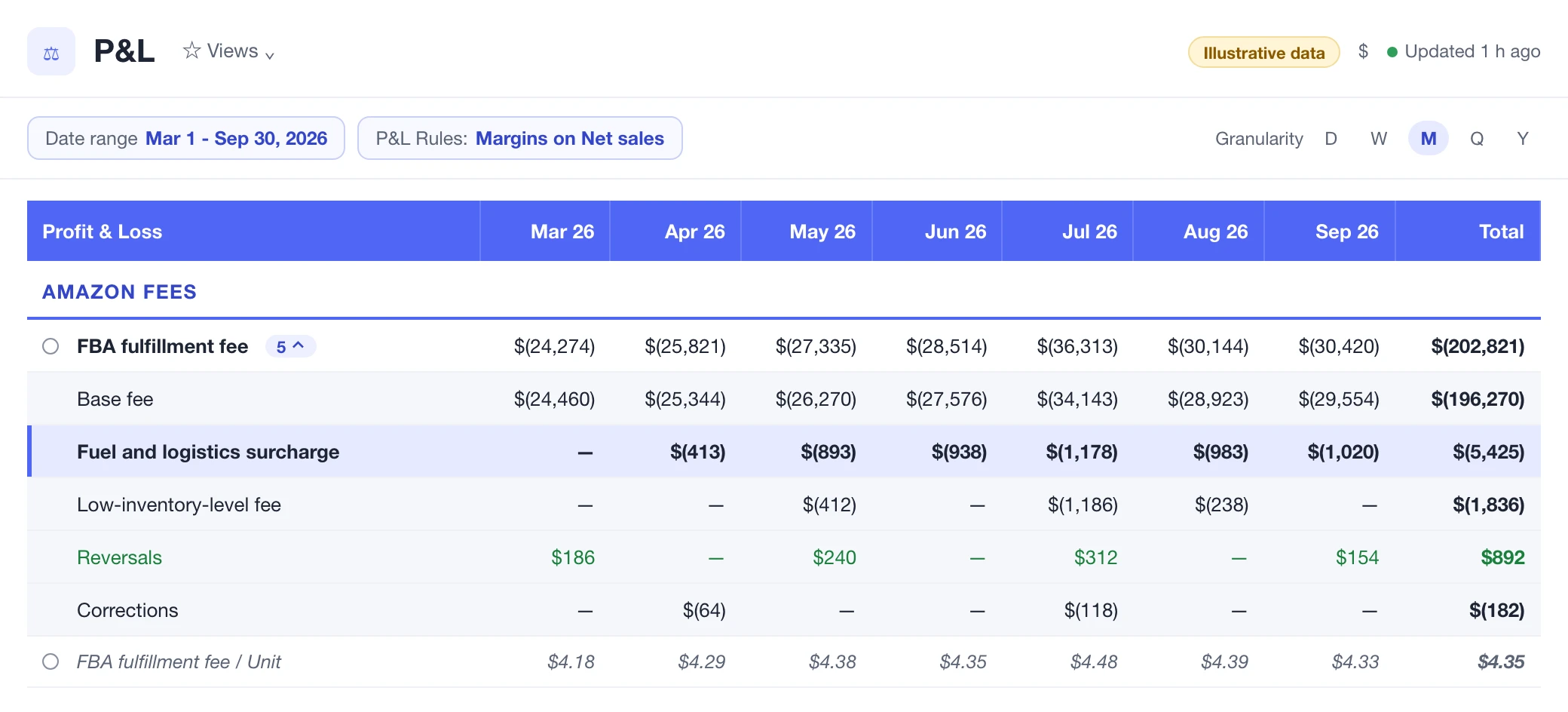
The fulfillment fee is several charges in one line. The fuel surcharge appears from 17 April, the low-inventory-level fee only in the months it was billed, and reversals are money Amazon gave back after re-assessing a fee. Illustrative data.
What is inside the fulfillment fee line. The base fee, the 3.5% fuel and logistics surcharge since 17 April 2026, and the low-inventory-level fee when a product ships with low stock. Reversals are part of a fee Amazon gives back after re-assessing it; corrections are a corrected fee charged again after a reversal. Nova shows each as its own line where Amazon reports the detail.
The fee is set on the packaged unit, so packaging is a lever: shaving an inch or an ounce that crosses a tier boundary changes the fee for every unit you ship after it. If you are weighing FBA against shipping yourself, our FBA vs FBM comparison runs the arithmetic both ways.
Storage fees and the aged inventory surcharge
Storage is billed monthly on the average daily cubic feet your inventory occupies, at one rate from January to September and a much higher rate from October to December. Some sellers also pay a utilisation surcharge on top, based on the ratio of stock held to stock shipped over the past 13 weeks.
Monthly inventory storage fees, per cubic foot, September 2026
Monthly inventory storage fees, per cubic foot, September 2026
Period and tier
Base fee
Utilisation surcharge
Total at the top band
January to September, standard size
$0.78
$0.44 to $1.88 depending on the ratio
$2.66
January to September, oversize
$0.56
$0.23 to $1.26
$1.82
October to December, standard size
$2.40
$0.44 to $1.88
$4.28
October to December, oversize
$1.40
$0.23 to $1.26
$2.66
January to September, standard size
Base fee
$0.78
Utilisation surcharge
$0.44 to $1.88 depending on the ratio
Total at the top band
$2.66
January to September, oversize
Base fee
$0.56
Utilisation surcharge
$0.23 to $1.26
Total at the top band
$1.82
October to December, standard size
Base fee
$2.40
Utilisation surcharge
$0.44 to $1.88
Total at the top band
$4.28
October to December, oversize
Base fee
$1.40
Utilisation surcharge
$0.23 to $1.26
Total at the top band
$2.66
The utilisation surcharge only applies to Professional sellers whose first US shipment was more than 365 days ago, who hold at least 25 cubic feet a day in that size tier, and whose storage utilisation ratio is above 22 weeks. New sellers, Individual sellers and anyone under 25 cubic feet pay the base fee only. Dangerous goods use a separate rate card.
Units that stop selling pay twice: storage every month, then the aged inventory surcharge once they pass 181 days. That threshold is the one most fee guides still get wrong, and it has not been 271 or 365 days for some time.
Aged inventory surcharge, from 16 January 2026
Aged inventory surcharge, from 16 January 2026
Inventory age
Surcharge per cubic foot
181 to 210 days
$0.50
211 to 240 days
$1.00
241 to 270 days
$1.50
271 to 300 days
$5.45
301 to 330 days
$5.70
331 to 365 days
$5.90
366 to 455 days
$6.90, or $0.30 per unit, whichever is greater
456 days or more
$7.90, or $0.35 per unit, whichever is greater
181 to 210 days
Surcharge per cubic foot
$0.50
211 to 240 days
Surcharge per cubic foot
$1.00
241 to 270 days
Surcharge per cubic foot
$1.50
271 to 300 days
Surcharge per cubic foot
$5.45
301 to 330 days
Surcharge per cubic foot
$5.70
331 to 365 days
Surcharge per cubic foot
$5.90
366 to 455 days
Surcharge per cubic foot
$6.90, or $0.30 per unit, whichever is greater
456 days or more
Surcharge per cubic foot
$7.90, or $0.35 per unit, whichever is greater
Charged on top of the monthly storage fee, on a snapshot taken on the 15th of each month, with inventory aged first in, first out. The first three bands exclude clothing, shoes, bags, jewelry and watches.
When you create a shipping plan, Amazon prices the convenience of sending everything to one place. Send to a single location and you pay the minimal-split fee. Send bulky stock to two or three locations and you pay a reduced partial-split fee. Send five or more identical cartons or pallets to the locations Amazon assigns and there is no fee at all.
FBA inbound placement service fee per unit, shipping plans from 15 January 2026
FBA inbound placement service fee per unit, shipping plans from 15 January 2026
Size tier and weight
Minimal splits, one location
Partial splits
Amazon-optimised splits
Small standard, 8 oz or less
$0.14 to $0.32
Not available
No fee
Small standard, 8+ to 16 oz
$0.16 to $0.32
Not available
No fee
Large standard, 12 oz or less
$0.20 to $0.40
Not available
No fee
Large standard, 1.5+ to 3 lb
$0.34 to $0.60
Not available
No fee
Large standard, 15+ to 20 lb
$0.55 to $1.90
Not available
No fee
Small bulky, 5 lb or less
$1.10 to $1.60
$0.55 to $1.10
No fee
Small bulky, 42+ to 50 lb
$4.80 to $5.95
$1.23 to $3.32
No fee
Large bulky, 5 lb or less
$1.30 to $1.80
$0.55 to $1.25
No fee
Large bulky, 42+ to 50 lb
$5.50 to $6.50
$1.23 to $3.50
No fee
Small standard, 8 oz or less
Minimal splits, one location
$0.14 to $0.32
Partial splits
Not available
Amazon-optimised splits
No fee
Small standard, 8+ to 16 oz
Minimal splits, one location
$0.16 to $0.32
Partial splits
Not available
Amazon-optimised splits
No fee
Large standard, 12 oz or less
Minimal splits, one location
$0.20 to $0.40
Partial splits
Not available
Amazon-optimised splits
No fee
Large standard, 1.5+ to 3 lb
Minimal splits, one location
$0.34 to $0.60
Partial splits
Not available
Amazon-optimised splits
No fee
Large standard, 15+ to 20 lb
Minimal splits, one location
$0.55 to $1.90
Partial splits
Not available
Amazon-optimised splits
No fee
Small bulky, 5 lb or less
Minimal splits, one location
$1.10 to $1.60
Partial splits
$0.55 to $1.10
Amazon-optimised splits
No fee
Small bulky, 42+ to 50 lb
Minimal splits, one location
$4.80 to $5.95
Partial splits
$1.23 to $3.32
Amazon-optimised splits
No fee
Large bulky, 5 lb or less
Minimal splits, one location
$1.30 to $1.80
Partial splits
$0.55 to $1.25
Amazon-optimised splits
No fee
Large bulky, 42+ to 50 lb
Minimal splits, one location
$5.50 to $6.50
Partial splits
$1.23 to $3.50
Amazon-optimised splits
No fee
Ranges reflect the inbound region: shipments sent to western locations cost more than eastern ones. Partial splits are only offered for bulky sizes. The Amazon-optimised option requires at least five identical cartons or pallets per item, with the same quantity and item mix in each.
Promotions carry two costs: the discount you fund, and a fee for running the promotion. Since 2 June 2025 the US structure is public: each promotion combines an up-front fee with a performance fee tied to the sales it generates. Vine charges an enrolment fee per parent ASIN.
US promotion and deal fees since 2 June 2025
US promotion and deal fees since 2 June 2025
Promotion
Up-front fee
Performance fee
Notes
Coupon
$5 per coupon
2.5% of coupon sales
Same on Prime Day
Best Deal, non-peak
$70 per day
1% of deal sales, capped at $2,000 per deal
Runs 1 to 14 days
Lightning Deal, non-peak
$70 per day
1% of deal sales, capped at $2,000 per deal
Prime Exclusive Discount, Prime Day
$100 per discount
None stated
Best Deal / Lightning Deal, Prime Day
$1,000 / $500 fixed
None stated
Coupon
Up-front fee
$5 per coupon
Performance fee
2.5% of coupon sales
Notes
Same on Prime Day
Best Deal, non-peak
Up-front fee
$70 per day
Performance fee
1% of deal sales, capped at $2,000 per deal
Notes
Runs 1 to 14 days
Lightning Deal, non-peak
Up-front fee
$70 per day
Performance fee
1% of deal sales, capped at $2,000 per deal
Notes
Prime Exclusive Discount, Prime Day
Up-front fee
$100 per discount
Performance fee
None stated
Notes
Best Deal / Lightning Deal, Prime Day
Up-front fee
$1,000 / $500 fixed
Performance fee
None stated
Notes
Before 2 June 2025, coupons charged $0.60 per unit sold and Best Deals and Lightning Deals charged $300 and $150 per deal. Peak event dates and durations stay fixed; on non-peak days a Best Deal can run any 1 to 14 days you choose.
Two different rules apply. Apparel and shoes pay a returns processing fee on every returned unit. Every other category pays it only on returns above a return-rate threshold set per product, and only if the product shipped at least 25 units that month. When a customer is refunded, Amazon also keeps a refund administration fee out of the referral fee it returns to you.
FBA returns processing fee per returned unit, September 2026
FBA returns processing fee per returned unit, September 2026
Size tier and weight
Apparel and shoes, every return
All other categories, returns above the threshold
Small standard, 4 oz or less
$1.65
$1.78 at 2 oz or less, $1.90 at 4+ to 6 oz
Small standard, 12+ to 16 oz
$1.95
$2.21
Large standard, 4 oz or less
$2.04
$2.36
Large standard, 12+ to 16 oz
$2.27
$3.39
Large standard, 1.75+ to 2 lb
$2.98
$4.63
Large standard, 3+ lb to 20 lb
$3.89 plus $0.10 per half lb above 3 lb
$5.00 plus $0.05 per 4 oz above 3 lb
Small standard, 4 oz or less
Apparel and shoes, every return
$1.65
All other categories, returns above the threshold
$1.78 at 2 oz or less, $1.90 at 4+ to 6 oz
Small standard, 12+ to 16 oz
Apparel and shoes, every return
$1.95
All other categories, returns above the threshold
$2.21
Large standard, 4 oz or less
Apparel and shoes, every return
$2.04
All other categories, returns above the threshold
$2.36
Large standard, 12+ to 16 oz
Apparel and shoes, every return
$2.27
All other categories, returns above the threshold
$3.39
Large standard, 1.75+ to 2 lb
Apparel and shoes, every return
$2.98
All other categories, returns above the threshold
$4.63
Large standard, 3+ lb to 20 lb
Apparel and shoes, every return
$3.89 plus $0.10 per half lb above 3 lb
All other categories, returns above the threshold
$5.00 plus $0.05 per 4 oz above 3 lb
A product's return rate is the share of a month's shipped units returned in that month and the two following months, measured against a threshold published per fee category. The charge posts between the 7th and 15th of the third month after the shipment month. Products shipping fewer than 25 units in a month are exempt, as are the first 20 units of an eligible parent ASIN under FBA New Selection.
Advertising is not an Amazon selling fee. It is billed separately, it is optional in principle, and for most catalogues it is unavoidable in practice. Judge it against the contribution margin each product can carry once Amazon's fees are paid.
The metric that matters against fees is TACoS, because it puts ad spend against all sales rather than ad-attributed sales only. Our TACoS guide explains the calculation, and Nova's PPC analytics puts spend next to the profit of the products it moved.
Other fees
The remaining charges are small individually and specific in when they apply. Removal and disposal are priced identically per unit, and from 1 March 2026 both are charged as each unit is processed rather than at the end of the order.
Removal and disposal fees per unit, September 2026
Removal and disposal fees per unit, September 2026
Size tier
Shipping weight
Fee per unit
Standard size
0 to 0.5 lb
$0.84
Standard size
0.5+ to 1.0 lb
$1.53
Standard size
1.0+ to 2.0 lb
$2.27
Standard size
More than 2 lb
$2.89 plus $1.06 per lb above 2 lb
Large bulky, extra-large and special handling
0 to 1.0 lb
$3.12
Large bulky, extra-large and special handling
2.0+ to 4.0 lb
$6.36
Large bulky, extra-large and special handling
More than 10.0 lb
$14.32 plus $1.06 per lb above 10 lb
Standard size
Shipping weight
0 to 0.5 lb
Fee per unit
$0.84
Standard size
Shipping weight
0.5+ to 1.0 lb
Fee per unit
$1.53
Standard size
Shipping weight
1.0+ to 2.0 lb
Fee per unit
$2.27
Standard size
Shipping weight
More than 2 lb
Fee per unit
$2.89 plus $1.06 per lb above 2 lb
Large bulky, extra-large and special handling
Shipping weight
0 to 1.0 lb
Fee per unit
$3.12
Large bulky, extra-large and special handling
Shipping weight
2.0+ to 4.0 lb
Fee per unit
$6.36
Large bulky, extra-large and special handling
Shipping weight
More than 10.0 lb
Fee per unit
$14.32 plus $1.06 per lb above 10 lb
Disposal fees use the same rate card. Special handling covers apparel, shoes, watches, jewelry and dangerous goods.
Low-inventory-level fee. Charged per unit shipped when a product's historical days of supply sit below 28 days on both the 90-day and the 30-day measure, from $0.32 for a small standard unit close to the threshold to $2.09 for a large bulky unit under 14 days of cover. Since 15 January 2026 the metric is calculated per FNSKU rather than per parent ASIN, and Grocery products are exempt, as are slower-moving items. Amazon's rate card, checked on 15 September 2026. One account in four paid it at least once between April and September 2026 (Nova analysis).
Closing fee. $1.80 per unit sold in books, DVD, music, software, video games, consoles and gaming accessories, on top of the referral fee. Amazon's page, checked on 15 September 2026.
Digital services fee. 2% for sellers established in the UK and 3% for France, Italy and Spain, applied as a percentage increase on referral, closing and, in the UK and France, FBA fulfilment fees. It reflects national digital services taxes, so a seller established in the US selling only on amazon.com does not pay it. Amazon's page, checked on 15 September 2026.
Liquidation and Subscribe & Save. FBA Liquidation recovers part of the value of excess stock instead of paying to dispose of it, and Subscribe & Save discounts are funded by the seller. Amazon does not publish a single public rate for either, so we do not print one: both are quoted in Seller Central when you enrol, and both show on your settlement once they apply.
Worked example: what a $24.99 product keeps
An illustration, not a benchmark. A Home and Kitchen product selling at $24.99, large standard size tier, 12 oz shipping weight, sent in on minimal shipment splits, held about two months in stock. The Amazon rates are the 2026 non-peak rates from the tables above. The cost of goods, inbound freight and ad spend per unit are assumptions, marked as such.
Illustrative unit economics at $24.99, 2026 non-peak rates
Illustrative unit economics at $24.99, 2026 non-peak rates
Line
Amount
Where it comes from
Selling price
$24.99
Assumption
Referral fee, 15%
-$3.75
Home and Kitchen rate
FBA fulfilment, large standard 8+ to 12 oz, $10 to $50 band
-$4.20
2026 non-peak rate card
Fuel and logistics surcharge, 3.5% of the fulfilment fee
-$0.15
In effect since 17 April 2026
Inbound placement, minimal splits
-$0.30
Middle of the $0.20 to $0.40 band
Monthly storage, about 0.15 cubic feet for two months off-peak
-$0.23
$0.78 per cubic foot base rate
Amazon fees, total
-$8.63
34.5% of the selling price
Cost of goods
-$5.00
Assumption
Inbound freight to the fulfilment centre
-$0.75
Assumption
Advertising per unit sold
-$2.50
Assumption
Left per unit
$8.11
32.5% of the selling price
Selling price
Amount
$24.99
Where it comes from
Assumption
Referral fee, 15%
Amount
-$3.75
Where it comes from
Home and Kitchen rate
FBA fulfilment, large standard 8+ to 12 oz, $10 to $50 band
Amount
-$4.20
Where it comes from
2026 non-peak rate card
Fuel and logistics surcharge, 3.5% of the fulfilment fee
Amount
-$0.15
Where it comes from
In effect since 17 April 2026
Inbound placement, minimal splits
Amount
-$0.30
Where it comes from
Middle of the $0.20 to $0.40 band
Monthly storage, about 0.15 cubic feet for two months off-peak
Amount
-$0.23
Where it comes from
$0.78 per cubic foot base rate
Amazon fees, total
Amount
-$8.63
Where it comes from
34.5% of the selling price
Cost of goods
Amount
-$5.00
Where it comes from
Assumption
Inbound freight to the fulfilment centre
Amount
-$0.75
Where it comes from
Assumption
Advertising per unit sold
Amount
-$2.50
Where it comes from
Assumption
Left per unit
Amount
$8.11
Where it comes from
32.5% of the selling price
Returns, coupons, removals and the long tail of smaller charges are not in this table, and they are charged separately when they apply.
In September 2026 the median account was billed 11 different fee types, and the middle half between 9 and 13 (Nova analysis). That is why a statement is hard to read. Below are the Nova P&L line names and the charges behind them.
Amazon fee-line decoder, with posting schedules already stated in this guide
Fee line
What it is
When it posts
Referral fee
Amazon's commission on the total sales price.
Every sale
FBA fulfillment fee
The base fee, fuel and logistics surcharge, and low-inventory-level fee for shipping an FBA unit.
When the order ships
FBA storage fee
Monthly charge for the space your inventory occupies.
Monthly, 7th to 15th
FBA long-term storage fee
The aged inventory surcharge on stock held beyond the age bands.
Monthly, snapshot on the 15th
FBA inbound placement fee
Charge for the shipment split option you choose when sending stock to Amazon.
When a shipment is created
FBA inbound transportation fee
The cost of transporting inventory into Amazon's fulfillment network.
FBA customer return fee
Returns processing charge where the category and return-rate rules apply.
Third month after the shipment month, 7th to 15th
Coupon fees
The fee for running a coupon, separate from the discount you fund.
When the coupon runs, plus a share of coupon sales
Deal fees
Participation charge for a deal, separate from its discount.
Per day the deal runs, plus a share of deal sales
FBA removal and disposal fees
Charge for returning or disposing of inventory held by Amazon.
As each unit is processed
Refunded referral fee
Referral fee credited back on a refund, minus the refund administration fee Amazon keeps.
When the customer is refunded
Subscription fee
The Professional selling plan charge.
Monthly
Digital services fee
An additional charge on selling and FBA fees in the stores where it applies.
With the underlying fee
FBA reimbursements
A credit Amazon pays back, not another charge.
Run it in Claude
List every Amazon fee type I was charged last month with the amount, its share of sales and the change versus the month before, and explain any fee line that is new this month.
Where each fee shows up in Seller Central
No single Seller Central report lists every fee. Each family posts in a different place, on a different schedule, which is why a fee audit starts with knowing where to look.
Fee
Where to find it
Referral fees
Payments, Transaction View, per-order breakdown
FBA fulfillment fees
Payments, Transaction View; per-SKU forecast in Inventory, Manage FBA Inventory
Storage fees
Reports, Fulfillment, Monthly Storage Fees (posts after the 15th)
Aged inventory surcharge
Reports, Fulfillment, Aged Inventory Surcharge
Inbound placement fees
Inventory, Send to Amazon, shipment-level cost preview
Not every fee on your settlement is final. Amazon issues reimbursements for lost, damaged and overcharged events: warehouse-damaged inventory, lost shipments, customer-return mismatches, weight or dimension misclassifications. Read the reimbursement lines already sitting in your own settlement data and compare them month to month rather than working from a rule of thumb. Between April and September 2026, 98% of accounts received at least one FBA reimbursement, and for the median account they offset about 1% of the fee bill (Nova analysis).
They post under Payments, Transaction View, filtered by type "Reimbursement". Manual claims must be filed within 60 days of the event, and the claims most often missed are inbound shipment shortages, customer-returned units never put back into inventory, and fee overcharges where Amazon's dimensions disagree with the actual unit. Nova shows every Amazon reimbursement as its own line in your Amazon P&L, next to the fees it offsets. Filing the cases themselves stays in Seller Central, and the reimbursement guide walks through the process.
Track every fee in one P&L
Nova reads the settlement data behind all of this and allocates every Amazon fee line to the SKU and the day it belongs to, rather than averaging it across the catalogue. That covers 73 Amazon charge lines, 45 refund lines and 21 reimbursement types, in one Amazon P&L. For strategies on bringing the bill down, read how to reduce Amazon FBA fees, and for the year-on-year movement, the 2026 fee changes guide.
Frequently asked questions
How much does Amazon take from a $100 sale?›
For the illustrative Home and Kitchen product in this guide, large standard, 8+ to 12 oz, Amazon takes about $19.62 in referral and fulfillment fees, including the fuel surcharge, at 2026 non-peak rates. That is before storage, inbound placement, returns and ads.
What percentage does Amazon take from sellers?›
Amazon fees, net of reimbursements and credits, came to a median 31.3% of sales across Seller Central accounts with at least $20,000 in sales from 17 April to 30 September 2026. The middle half sat between 24.2% and 38.6%. The referral fee alone is usually 15%. Source: Nova analysis, measured 8 October 2026.
How much does an Amazon coupon cost?›
Since 2 June 2025, a US coupon costs an up-front fee of $5 per coupon plus 2.5% of the sales the coupon generates, replacing the old $0.60 per unit sold. The same structure applies on Prime Day.
How much does it cost to sell on Amazon?›
A Professional plan costs $39.99 a month, or $0.99 per item sold on the Individual plan. Each sale pays a referral fee set by category, and with FBA a fulfilment fee set by size tier and shipping weight, plus monthly storage on the inventory you hold.
What are Amazon's commission rates for sellers?›
Amazon's commission is the referral fee: a percentage of the total sale price set by category, with a $0.30 minimum in most categories. Many categories charge 15%, and some tier by price, such as Beauty at 8% up to $10 and 15% above.
Does Amazon charge a listing fee?›
No. Listing a product costs nothing. You pay the plan, $39.99 a month on Professional or $0.99 per item sold on Individual, and fees start when an item sells: the referral fee, plus FBA fees if Amazon fulfils the order.
What is Amazon's biggest fee for sellers?›
For FBA sellers it is usually the fulfilment fee rather than the commission, because it is charged per unit and does not scale with price. Sellers who ship their own orders pay mainly the referral fee.
How are FBA fees calculated?›
Amazon charges a fixed fee per unit by size tier and shipping weight, measured on the packaged unit, so price does not change it. That is why it weighs more on cheap items.
What is the Amazon low-inventory-level fee?›
Amazon still charges it. It applies to standard-size and bulky FBA units when both the 90-day and the 30-day historical days of supply sit below 28 days, at $0.32 to $2.09 per unit by size tier. Grocery products, slower-moving items and units outside those size tiers are exempt.
Are Amazon fees going up in 2026?›
Yes, in pieces. A 3.5% fuel and logistics surcharge joined every US fulfilment fee on 17 April 2026, and holiday peak rates run from 15 October. The 2026 fee changes guide has each line.
Do FBM sellers pay fewer fees than FBA sellers?›
FBM sellers skip FBA fulfilment and storage fees but pay the referral fee, their own shipping, packaging and labour. Whether that is cheaper depends on size and weight. FBA also makes offers Prime-eligible, which usually lifts conversion.
Sources
Every rate on this page was read from an Amazon page on 15 September 2026. Where a rate sits behind a Seller Central sign-in, no number is quoted.
Nova reconciles referral, FBA, storage, inbound placement and the rest against your settlements, so the fee bill on this page is the one you can see per SKU.