Amazon cash flow management: the FBA seller playbook
Why profitable Amazon sellers run out of cash, how disbursements actually work, and the weekly routine to stop being surprised by your bank balance. With a worked $500K/month example.
Most Amazon sellers do not have a profit problem. They have a cash flow problem dressed up as a profit problem. Your P&L says you made $80K last month. Your bank account says you have $9K and a supplier invoice due Friday. Both are true at the same time, and that gap is what kills otherwise healthy FBA businesses.
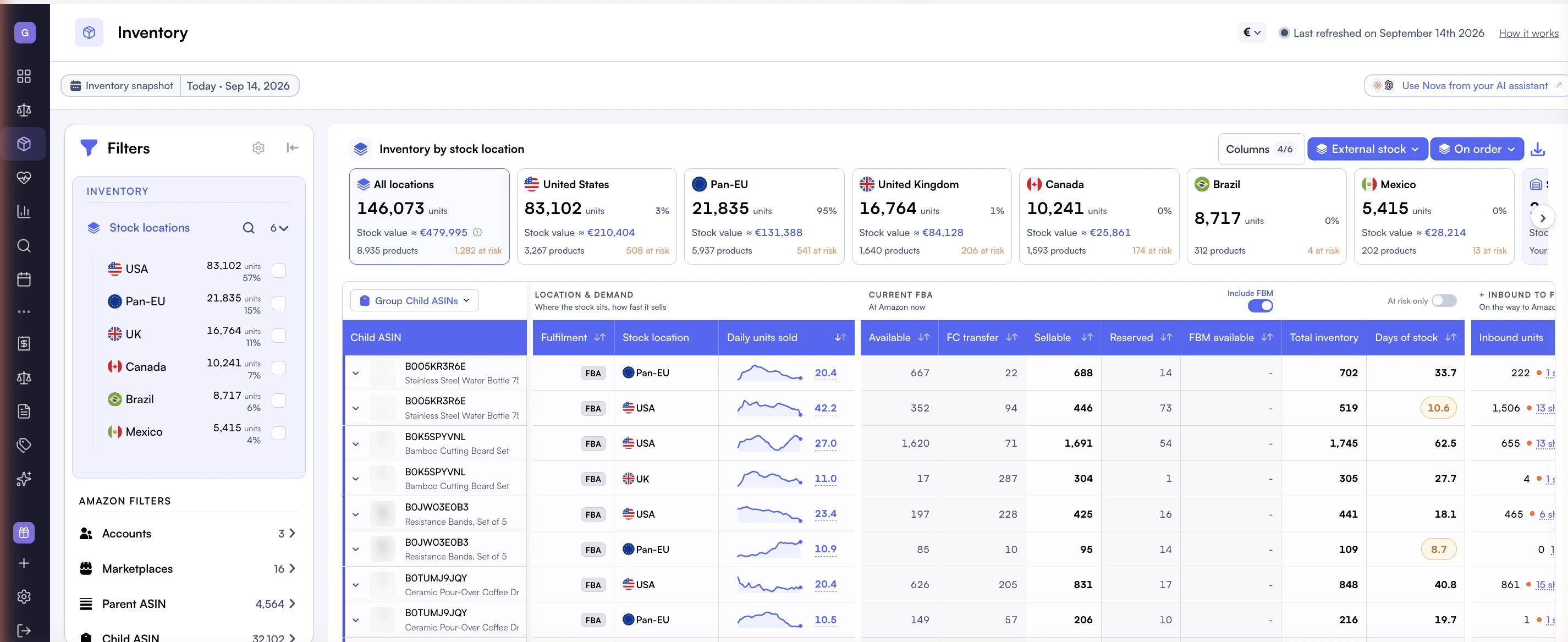
Inventory by location shows where product stock is tying up working capital.
This guide breaks down how Amazon actually pays you, where the cash leaks hide, how to model your cash conversion cycle, and the weekly routine operators use to stop being surprised by the bank balance. It applies to FBA, FBM, and multi-channel sellers, with notes where the mechanics differ.
Typical disbursement gap
7-21 days
From sale to bank deposit
Reserve as % of revenue
3-12%
Held back by Amazon at any time
FBA seller CCC
60-120 days
Cash tied up per turn
The Amazon cash flow paradox
A profitable Amazon business can run out of cash for one structural reason: Amazon collects from buyers immediately, then holds your money for two weeks while you have already paid your supplier, your freight forwarder, and your ad bill. Growth makes it worse, not better. Every extra dollar of revenue creates an extra dollar of working capital tied up in inventory, fees, and reserves before the matching disbursement arrives.
Sellers who win at cash flow do not have better margins. They have a clearer view of three things: when money actually moves, what it costs to move it, and how much of it Amazon is sitting on at any moment. Everything in this guide is built around making those three views readable on a Monday morning, in under 15 minutes, with numbers you trust.
Most sellers describe Amazon's payment cycle as "every two weeks." That is half true. The full picture has four moving parts.
1. The DD+7 disbursement clock
Since March 12, 2026, every seller account runs on DD+7 (Delivery Date + 7 days). The clock no longer starts at order placement. It starts when the carrier confirms delivery, then Amazon holds funds for 7 calendar days before queueing the transfer. Per Amazon's Finances API documentation, that settlement still aggregates orders, refunds, fees, advertising charges, and adjustments into a single net figure. Net effect: 2-day Prime FBA often pays faster than the old 14-day cycle, while 10+ day FBM or economy shipping can stretch the gap to 17 to 21 days. Our DD+7 breakdown has the full timing tables by shipping method.
2. The reserve hold
Amazon holds a portion of your settled balance as a reserve against future returns, A-to-z claims, and chargebacks. New sellers see 50 to 100% reserves for the first 90 days. Established sellers typically see 3 to 12% of recent revenue held back at any time. The reserve grows automatically with sales velocity, which means a great month can shrink your disbursement before it grows it.
3. The transfer lag
Once Amazon initiates a disbursement, your bank typically receives funds in 3 to 5 business days. Cross-border accounts add another 1 to 3 days for FX and intermediary banks. Stack that on top of the 14-day cycle and you are looking at 17 to 22 days from a sale to spendable cash.
4. Account-level holds
Policy issues, IP complaints, and inventory rectification can freeze part or all of a disbursement without warning. These are rarely visible in your default Seller Central view until the transfer date passes. Sellers who run multiple accounts feel this most because a hold on one account can knock out a planned supplier payment on another. Operators with portfolios across regions usually consolidate visibility through multi-account analytics so a hold on one account does not blindside the whole business.
The 5 cash leaks killing FBA sellers
These are the leaks that quietly turn a 22% net margin into a 3% bank balance. Each one is fixable, but only if you can see it.
01. Reserve growth on a hot month
A 30% revenue jump can pull an extra 6 to 10% of that revenue into reserves. A great Prime Week looks like a thin disbursement two weeks later. Forecasting this requires modeling reserve as a percentage of trailing 14-day sales, not as a fixed number.
02. Returns posted to the wrong period
Amazon refunds the buyer immediately but posts the cost to your account on the next settlement. A refund processed on day 13 of one cycle hits the disbursement of the next, distorting both periods. Without SKU-level visibility into return reasons and timing, you cannot separate one-off problems from product-quality issues. Our reimbursement guide covers what you can claim back.
03. FBA storage fee spikes
Monthly storage fees jump in October and stay elevated through January. Long-term storage fees and aged-inventory surcharges hit on the 15th of every month. Sellers who ignore inventory age compound the cost: slow SKUs eat working capital twice, once in stuck inventory and again in storage charges. The 2026 fee structure is laid out in our FBA fee changes guide.
04. PPC overshoot
Ad spend deducts from your disbursement before it deducts from your P&L feeling. A 4% TACoS month feels manageable until you realize the absolute spend was $24K against a $9K reserve hold, and the disbursement is half what you planned for. PPC has to be modeled as a cash outflow, not just a margin line.
05. The COGS-to-cash lag
You wire the supplier on day 0, the goods land FBA on day 45, the first sale ships on day 50, and the cash from that sale lands on day 70. Use the dates in this example to calculate how long working capital remains committed before settlement. Tracking this properly starts with the basics in our COGS tracking guide.
Building your cash conversion cycle
The cash conversion cycle (CCC) is the single best operator metric for Amazon cash flow. It tells you, in days, how long a dollar is locked up before it comes back as spendable cash.
Formula
CCC = DIO + DSO - DPO
DIO (days inventory outstanding): Average days a unit sits in inventory before sale.
DSO (days sales outstanding): Average days from sale to bank deposit. For Amazon FBA, 14 to 22 is typical.
DPO (days payable outstanding): Average days you take to pay suppliers. Negotiated, not given.
Worked example: $500K/month FBA seller
Metric
Value
Notes
DIO
62 days
Mix of fast and slow movers
DSO
18 days
DD+7 with fast Prime delivery plus 4-day bank transfer
DPO
45 days
Net 30 with key suppliers, net 60 with one
CCC
35 days
62 + 18 - 45
At $500K monthly revenue and 35% COGS, that 35-day cycle ties up roughly $200K of working capital at any time. Cutting DIO by 15 days through better forecasting frees ~$87K in cash without changing margin or sales. That is the use point most sellers miss.
A weekly cash routine: 4 numbers every Monday
Choose a short weekly metric list and investigate changes against thresholds you set for your business.
1. Net disbursement vs forecast
If actual is more than 10% below forecast, the gap is almost always reserve growth, returns, or an account-level hold. Investigate before Wednesday.
2. Total reserve balance, week over week
Rising reserve with flat sales signals a returns or claims issue. Falling reserve on a strong week is normal. Use the trend, not the absolute number.
3. Days of inventory on hand by category
Anything north of 90 days is eating storage fees and trapping working capital. Anything under 21 days is a stockout risk. Both deserve the same urgency.
4. Contribution margin per SKU, rolling 28 days
A SKU that flips negative on contribution margin is burning cash with every order. Catch it within a week, not a month. Our contribution margin guide walks through the calculation.
Lots of teams run this as part of a structured Monday review. If you want a fuller agenda, the weekly business review checklist slots cash flow alongside ad efficiency and inventory health.
When to use working capital options
Even with tight CCC management, scaling on Amazon usually requires outside capital at some point. The right vehicle depends on what you are solving for.
Cash flow forecasting lives in your spreadsheet, your accountant's tool, or your head. It can only be as accurate as the underlying numbers. The breakdown for most sellers is not the model. It is the inputs: stale Seller Central reports, rough fee estimates, and missing return data that drift weeks before anyone notices.
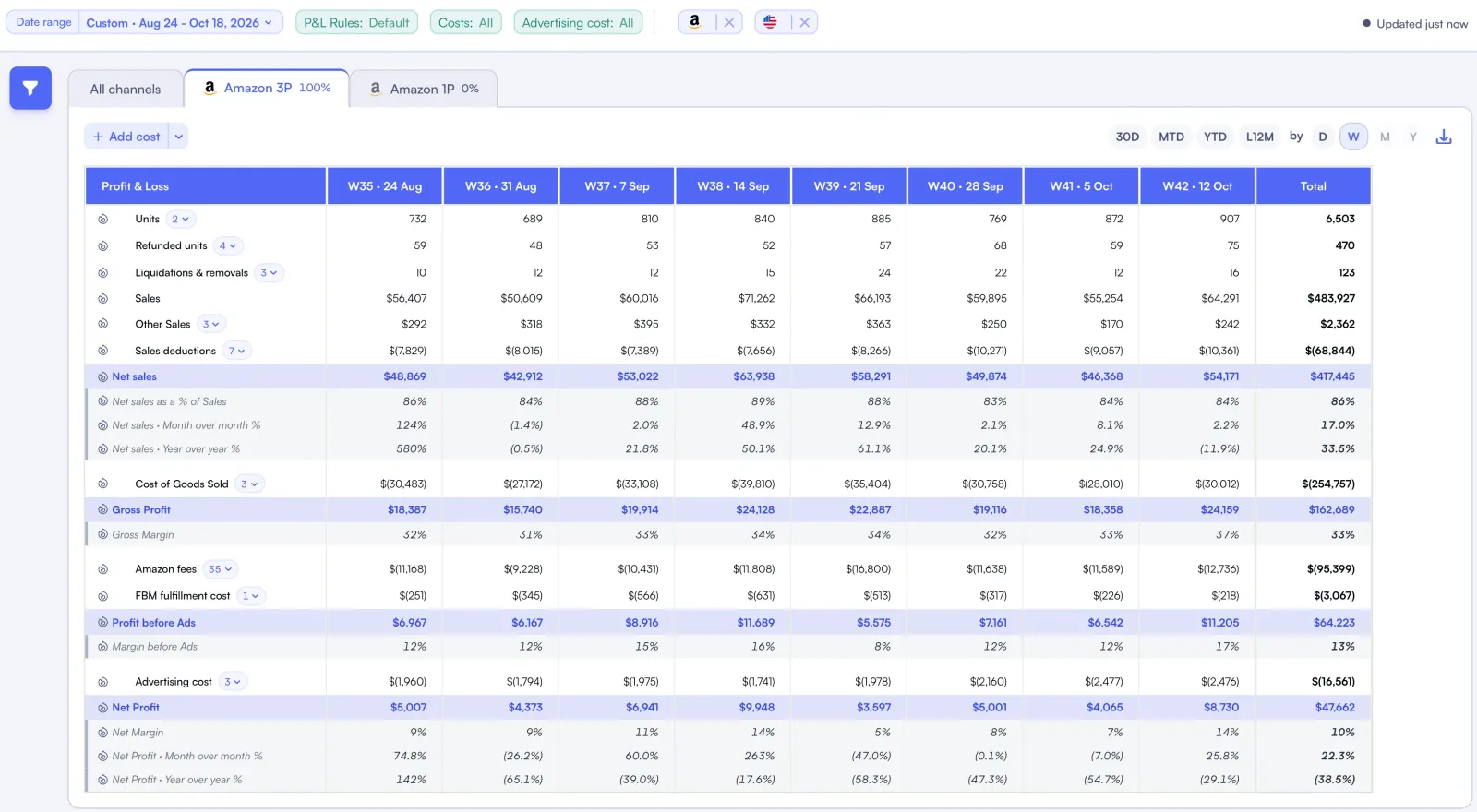
Read sales alongside every cost layer to see how much profit remains.
Nova does not run your cash flow model for you. What it does do is feed that model with clean inputs: 40+ Amazon fee types tracked at SKU level, 371 metrics across 23 marketplaces, with orders and units arriving in real time. Plug those numbers into your forecast and the gap between projected and actual disbursements typically tightens to 5 to 8%. You can see the P&L analytics in detail, or browse the COGS tracker and Seller Cockpit for the rest of the data layer.
Find answers to common questions about our platform
Since the DD+7 migration completed on March 12, 2026, Amazon holds your funds for 7 calendar days after delivery confirmation before initiating a disbursement. For 2-day Prime FBA orders that often clears faster than the legacy 14-day cycle. For slower FBM or economy shipping, total time from sale to bank can stretch to 17 to 21 days once the 3 to 5 day bank transfer is added. New accounts and high-risk categories sit on longer reserves on top of that.
The Seller Central balance shows accrued sales minus tracked deductions at that moment. The bank transfer is the disbursement amount minus reserves Amazon holds for returns, A-to-z claims, chargebacks, and policy holds. The gap between the two numbers is normal but often misread as a payment problem when it is really a reserve growth problem.
Cash conversion cycle (CCC) for an FBA seller is days inventory outstanding plus days sales outstanding minus days payable outstanding. For a typical FBA brand it runs 60 to 120 days: 30 to 60 days for inventory to sell, 14 to 30 days for Amazon to pay, minus 30 to 60 days you negotiate with suppliers. A higher CCC means you finance Amazon's growth out of your own working capital.
A reasonable rule of thumb is 2 to 3x your monthly cost of goods sold tied up at any time, plus a buffer for Q4. A seller doing $500K per month in revenue with 35% COGS needs roughly $350K to $525K in inventory and inbound product capital just to keep the wheel turning, before any growth. Faster turning categories need less, slow movers need more.
Sometimes. Amazon Lending offers fast access against your seller history but locks repayment to your disbursements. Third-party AR financing and lines of credit cost more in headline rate but leave your Amazon cash flow untouched. The right choice depends on whether your bottleneck is speed (Amazon Lending wins) or cash flow flexibility (third-party wins).
Build a 13-week rolling cash forecast. For each week, project gross sales, subtract estimated fees by type (referral, FBA, storage, advertising, returns), subtract reserve growth, and add the resulting net to the bank balance. Replace last week's forecast with actuals every Monday. Forecasts that pull from clean SKU-level fee data are usually within 5 to 8% of actual disbursements.
The cycle is similar but the levers differ. FBM sellers carry their own fulfillment cost and timing, which gives more control over storage and shipping cash but adds 3PL invoices and labor as cash outflows. Disbursement timing from Amazon is identical. Most multi-channel brands run a unified cash forecast that splits FBA and FBM cost lines but rolls up to one bank balance.
Four numbers are enough for most operators: net disbursement vs forecast, total reserve balance week over week, days of inventory on hand by category, and contribution margin per SKU rolling 28 days. Anything that moves more than 10% week over week needs an explanation before Friday.
The Monday morning test
If you can answer four questions on a Monday morning in 15 minutes, your cash flow is under control. What did Amazon actually pay me last week vs forecast? How much is currently sitting in reserve? Which categories have inventory that is too old or too thin? Which SKUs are losing money on contribution margin?
If any of those answers takes more than five minutes to find, the underlying data layer is the bottleneck, not your discipline. Fix the inputs first. The model usually takes care of itself.
Ready to Transform Your Amazon Business?
Join thousands of successful sellers who use Nova Analytics to make data-driven decisions and maximize their profits.